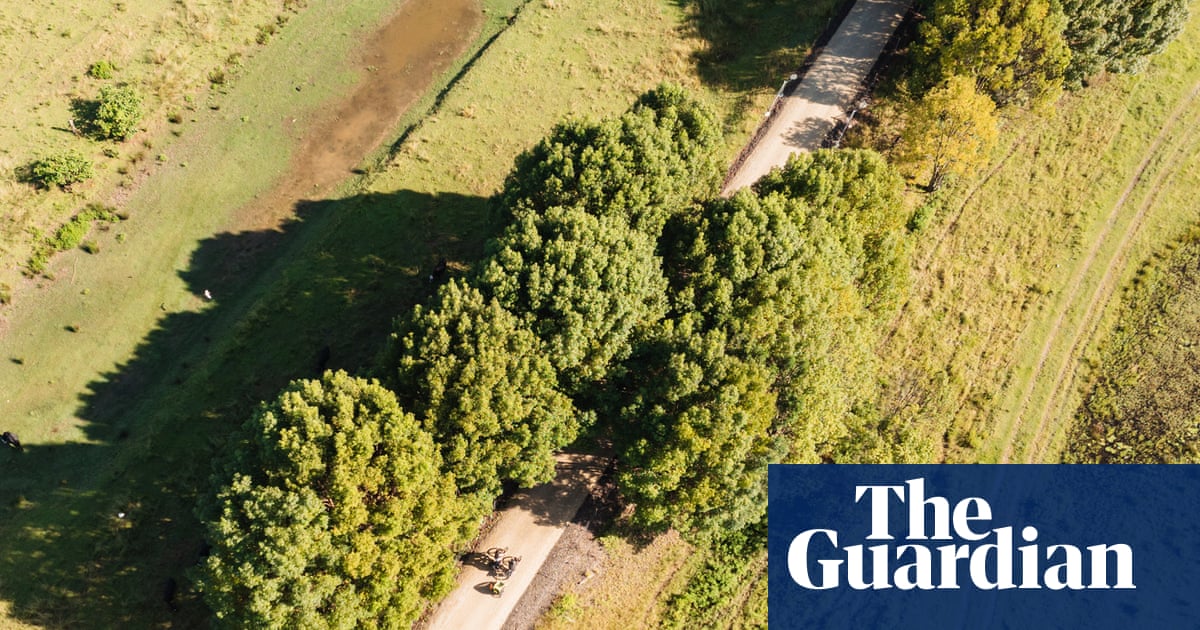
There are glow-worms in the old train tunnel if you look hard enough into the deepest, darkest black, Paul Hixon says.The visitor from Brisbane is cycling the Murwillumbah to Crabbes Creek section of the northern rivers rail trail with his two daughters, but today he only plans to make it as far as the Burringbar tunnel.Since the trains stopped running along the rail line, the tunnel – the longest of nine along the route – has been colonised by glow-worms and microbats that are sometimes possible to find, even in the middle of a bright, sunny day.Built to serve local farmers, the Lismore to Tweed branch line railway closed in 2004. Photograph: Tweed Shire CouncilHixon and his two daughters are hardly the only ones out today. A woman has stopped to read her book along a section of track that runs through thick rainforest; a young couple on a date watch the riders going by.For now, the rail trail exists in two halves, the stretch around the Tweed River area and another stretch in the western hinterland between Casino and Lismore. If the full track gets built, it will be possible to take a bike 135km from the canefields in the Tweed, all the way south along the coast through Mullumbimby and Byron Bay before heading back out to the hinterland through Bangalow, Lismore and Casino.A map showing the route of the northern rivers rail trail and the missing link That vision, however, hit a pothole in June when a joint request for $42m in grant funding from the federal government by the Byron, Lismore and Ballina shire councils to complete the 54km missing link was knocked back.The mayor of Byron shire, Sarah Ndiaye, describes the decision as “heartbreaking”. She says the refusal had been a surprise, and that it appears authorities “picked smaller projects to have more impact in more places”.The condition of existing track near Bangalow. Photograph: Royce Kurmelovs/The Guardian“I was really disappointed and I know a lot of other people were too, because we waited a really long time for them to say no,” Ndiaye says. “When you look at the social and economic benefits that would come from the destination side of it, the social and physical side of it, and any economic benefit, the government will benefit and so will the people.”“But even when the project stacks up, in the current environment it doesn’t seem like enough.”Where once Byron shire was the hold-out in the hope of a new train service, a lack of interest from state and federal governments over time has recently seen it lock in behind the construction of the rail trail as a viable project, creating a united front.A completed rail trail would draw visitors through the region like an artery, Ballina’s mayor says. Photograph: Tweed Shire Council‘Public transport is pretty much nonexistent here … The rail trails provide that essential link in a safe way.’ Photograph: Tweed Shire CouncilThe Lismore to Tweed branch line railway, built to serve local farmers, officially opened in 1894 after a decade of lobbying and development. Steam gave way to diesel as the railway continued its operation in one form or another until 2004 when the XPT service ended and the hills fell silent.When the last train left the station, a crowd of 200 people saw it off carrying candles, a mock coffin and protest signs.Lydia Kindred from Northern Rivers Rail Ltd is an advocate for a revival of rail service in the region, initially by extending an existing solar-powered train from Byron to Mullumbimby, the first in a four-stage plan to run a 72km line out to Lismore.The group is seeking investors, she says, adding that although the train and the rail trail have often been presented in opposition to each other, Kindred sees them as “complimentary”.“Having both, to us, seems like the answer,” she says. “We aren’t against having a bike path. And the whole thing could be a real model for other regions.”Completing the rail trail would bring investment to the region, which has suffered several climate-related disasters in recent years. Photograph: Tweed Shire Council Photograph: Tweed Shire CouncilThe mayor of Ballina shire, Sharon Cadwallader, says a completed rail trail “makes sense” as it would draw visitors through the region like an artery, providing the basis for a thriving eco-tourism industry in the region built around multi-day trips.“The way I see it is, it’s more than a cycling path: it’s a regional economic project, it’s a tourism project, it’s a health project and it’s a community connection project,” Cadwallader says.“Public transport is pretty much nonexistent here. And particularly safety on the road is a big thing. We see cyclists on our road systems being bowled over, and we don’t want that. The rail trails provide that essential link in a safe way.“You know, we’re stronger as a region. It’s not just about Ballina, it’s about all our neighbouring councils as well. It gives us stronger links [to] our neighbours and I think that’s really important.”‘Now people realise they have to fight for it’ … A community group is campaigning for the rail trail to be finished. Photograph: Tweed Shire CouncilCadwallader says completing the rail trail would bring much needed investment to the region at time when business is doing it tough. During the 2024-25 financial year, she says regional GDP declined 2.50% in Ballina, 1.90% in Lismore, 4.90% in Byron and 2.10% in the Richmond valley.Part of that, Ndiaye says, is linked directly to climate change.“The state has been struggling with a consistent, steady stream of disaster to clean up after and that’s really impacting our funding,” Ndiaye says. “[State and federal authorities] are having to respond to way more climate-related disasters than they ever had anticipated. For us in 2022, we saw over $300m damage in one night, and we were just one shire.”As proof of the economic potential of the rail trail, Pat Grier, a longtime advocate for the cycleway, points to the 150km Otago Central Rail Trail, which he first visited about 15 years ago while on holiday in New Zealand.“A friend said, ‘why don’t you try this rail trail thing in Otago?’” He says. “At first I thought the last thing I need is to bicycle for four days, but it turned out to be a very pleasant experience as you stopped along the way.”“I said that’s what we should be doing back home. We’ve got more to offer. We’ve got the mountains on one side, the sea on the other.”In his view, the northern rivers has everything it needs to draw people to the region: spectacular landscapes, rich history, good food, local distilleries, music and writers’ festivals – and a disused rail system.It is why now, after the knock-back, he and his group have organised a new campaign calling for the rail trail to be finished.“I think something positive will come from this setback as now people realise they have to fight for it,” Grier says. “It really is all about vision. This would transform the region. We aren’t giving up.”
Canefields to ocean to rolling hills: vision splendid of 135km northern NSW rail trail short-changed
Full Article
📰 Original Source
Read full article at Theguardian →KhanList aggregates and links to publicly available news content. We do not host full articles from third-party sources. Always verify important information with original sources.