
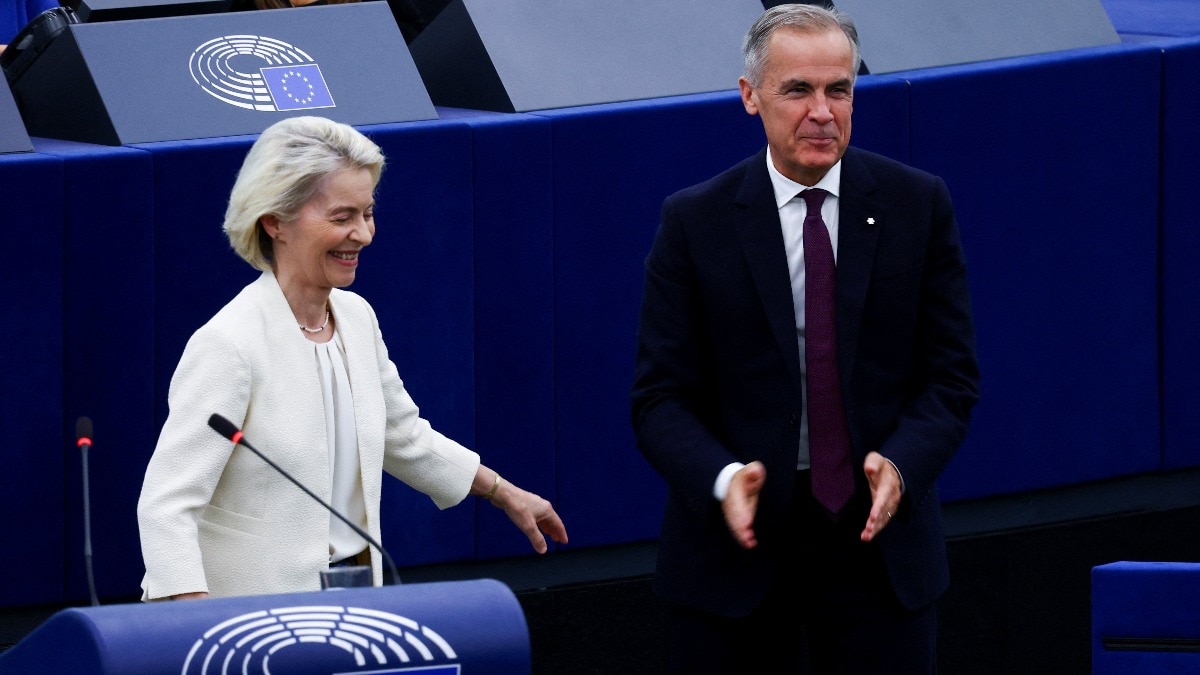
European Commission President Ursula von der Leyen has proposed a new model for Canada's ties with the European Union, preposing that Ottawa become the bloc's first "associate member" as tensions between Canada and its traditional ally, the US, continue to strain trade relations. The proposal would deepen Canada-EU economic and security cooperation at a time when Ottawa is seeking to diversify its partnerships beyond Washington.Von der Leyen made the proposal during her annual State of the Union address to the European Parliament in Strasbourg on Wednesday, with Canadian Prime Minister Mark Carney in the chamber. Members of the European Parliament gave her a standing ovation before she walked over to embrace Carney."I said we must urgently reimagine our partnerships. So, I would like to work with you on opening the door for Canada to be the first associate member of the EU," von der Leyen said.The idea is significant because the EU currently has no formal "associate member" category. So what exactly would it mean for Canada? WHAT WOULD ASSOCIATE MEMBER MEAN?There is no existing EU treaty provision that defines an associate member. The concept has been discussed in different forms before, including a German proposal for Ukraine to use associate membership as a possible step towards full EU accession.But Canada would be different. It is not seeking full EU membership. Carney said earlier this week that Ottawa wanted a "unique alliance" with the bloc rather than membership. Von der Leyen's proposal appears aimed at creating a new middle ground between being an ordinary partner and becoming a full EU member.The exact terms, however, remain unclear. One EU diplomat told Reuters that "nobody really knows what it means", flagging the lack of an established legal framework for such a status.Von der Leyen outlined a broad vision for closer cooperation between Brussels and Ottawa.The two sides could work together on defence, artificial intelligence, energy, critical minerals, manufacturing and Arctic security. Von der Leyen also proposed integrating their defence industrial bases and creating a technology alliance."We will work on intelligent manufacturing. We will create a tech alliance. We will integrate defence industrial bases. We will make the Arctic a flagship joint project," she said. The EU chief said the relationship was rooted in shared political values as well as economic interests.The EU and Canada "see the world with the same eyes: from AI to climate change, from the Arctic to geopolitics," she said."But above all ... Europe and Canada believe in democracy."She also stressed that the partnership was not designed as a bloc against another country."Partnerships are a strategic choice for Europe. But they also respond to the fracture in the international rules-based system," von der Leyen said."This is a partnership not against anyone else."WHY CANADA WANTS CLOSER TIES WITH EUCanada is seeking to diversify its economic and strategic relationships amid a sharp deterioration in ties with the US under President Donald Trump. He has pledged to double Canada's non-US trade over the next decade. His government is also looking towards Europe for stronger cooperation in areas including defence, technology and critical minerals.The next major test will come at the Canada-EU summit in Montreal on October 29-30, where Ottawa and Brussels are expected to discuss the details of their expanding partnership.Canada and the EU already have a trade agreement, CETA. But deeper economic integration could prove complicated. Some EU countries have yet to fully ratify the deal, while Canada protects sectors such as telecommunications and dairy.WHY THE IDEA COULD BE COMPLICATEDAny formal associate status would have to be worked out by the EU's 27 member states. Von der Leyen, as European Commission president, cannot create such a status on her own.Full EU membership also comes with major rights, including participation in EU institutions, voting powers and access to the bloc's Single Market. An associate arrangement would not necessarily provide those benefits.That distinction matters for Canada -- and for countries already seeking full membership.EU candidate states such as Montenegro, Albania, Ukraine and Moldova must undertake lengthy reforms and align their laws with EU rules. A special arrangement for Canada could therefore raise questions about whether a non-European country was receiving a different route into closer integration.The proposal opens a new chapter in Canada-EU ties, but the details are far from settled. With no existing framework for "associate membership", Brussels and Ottawa would have to work out what the arrangement means -- and how far it goes.- EndsWith inputs from agenciesPublished By: Satyam SinghPublished On: Sep 16, 2026 19:43 IST
Canada to become first associate member of EU. What von der Leyen's proposal means
Full Article
Original Source
Read the full article at Indiatoday →KhanList aggregates and links to publicly available news content. We do not host full articles from third-party sources. Always verify important information with original sources.