
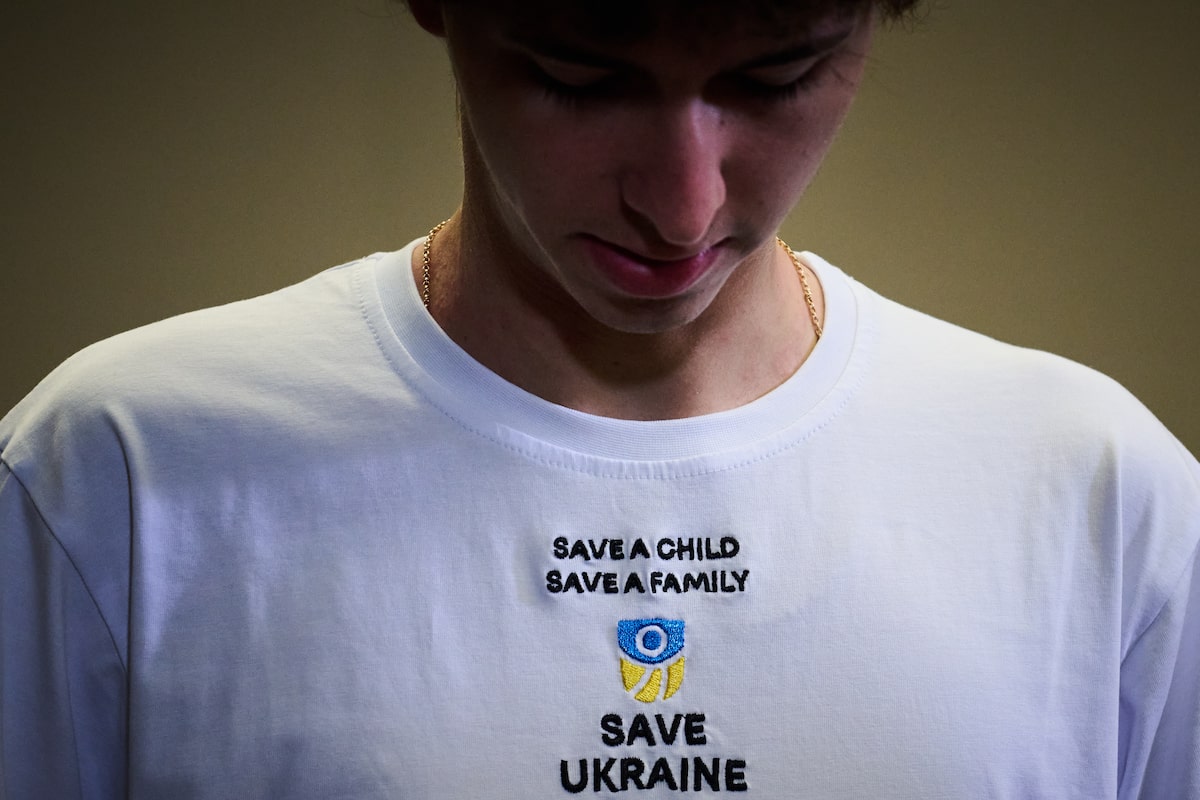
Open this photo in gallery:Matviy Chos, who escaped Russian captivity where he was held as a teenager, at the Pathways to Peace conference in Toronto on Tuesday. Eight-three countries and international organizations attended the conference focused on the return of Ukrainian children being held in occupied Ukrainian territory or in Russia, Sept. 29.Sammy Kogan/The Canadian PressThe international campaign to rescue Ukrainian children from Russian control has been complicated by identity verification issues and the search for intermediaries to negotiate the return of the children, officials say.Canada, Ukraine and Norway led a conference in Toronto this week to seek progress on the return of the estimated 20,650 Ukrainian children in Russian hands in occupied Ukrainian territory or in Russia itself. But the effort will need to rely on countries with closer ties to Moscow to serve as mediators, Foreign Affairs Minister Anita Anand acknowledged.Ms. Anand said 83 countries and international organizations attended the conference, of which 54 signed a “Toronto pledge” to help recover the children, along with detained civilians and prisoners of war. This exceeds the number who signed a similar commitment at a Montreal conference two years ago.Under the new pledge, the countries expressed grave concern at the deportation and forcible transfer of Ukrainian children by Russia. They called for global efforts to identify, trace and locate the children and verify information about each case.“We have pledged to bring them back, knowing that it can be dangerous, complex, difficult, but above all necessary,” Ms. Anand told the conference.How two Ukrainian children fought their way back homeShe cited India, Germany and the United States as countries that could be mediators on the issue, since they have better relations with Moscow. The conference participants agreed on the need for “sustained and expanded diplomatic efforts” to find “additional states that could act as intermediaries,” Latvian official Dace Melbarde told the closing session.Alexandra Chyczij, the president of the Ukrainian Canadian Congress, said “back channels” are crucial for the release of the children because Moscow won’t talk to those who openly support Ukraine. “I think we need to continue to use every possible channel we have,” she told journalists.Another potential mediator is South Africa, a longtime friend of Moscow, which is working with Qatar on a parallel initiative to seek the return of the children. South Africa has been “engaging with the Russians,” but the process “has not been easy,” said Zane Dangor, director-general of South Africa’s Department of International Relations and Cooperation (DIRCO).Open this photo in gallery:Minister of Foreign Affairs Anita Anand, right, gives closing remarks at the conference as Ukrainian Minister of Social Policy Denys Uliutin, left, looks on.Sammy Kogan/The Canadian PressDisagreements on how to verify the identities of the children – whose personal information has often been changed by Russian officials – are among the obstacles on the issue, the South African government says.“That has been a sticky point,” said Chrispin Phiri, a spokesperson for DIRCO. “There is a dispute about what verification process can be used to ascertain the identity of the kids amongst others.”South Africa sees itself practising “shuttle diplomacy” between Ukraine and Russia, including on the issue of the Ukrainian children, Mr. Phiri told The Globe and Mail. But it hoped the Toronto conference would help clarify the process for verifying their identities, he said.In Depth: The children’s gulagMs. Anand, speaking at the opening of the Toronto conference, noted that Russia has “altered children’s identities and personal information” as part of its efforts to erase their Ukrainian identity.Ukrainian President Volodymyr Zelensky, in a visit to Pretoria last year, handed South African President Cyril Ramaphosa a list of 400 Ukrainian children and asked him to help secure their return.Asked whether South Africa had made any progress on the list, Mr. Phiri said the effort was stalled by technical issues, including verification and safe passage mechanisms.Mr. Ramaphosa raised the issue directly with Russian President Vladimir Putin earlier this month in New Delhi at the annual conference of BRICS countries (Brazil, Russia, India, China, South Africa and five others).South Africa was grateful to be invited to the Toronto conference, but “we will want to hear your views on that as well, because we would like to attend, to see how best we can continue advancing our relations,” Mr. Ramaphosa told Mr. Putin in their Sept. 11 meeting. It was unclear if the two leaders discussed the issue further.South Africa has declined to join the 51-member International Coalition for the Return of Ukrainian Children, which was founded in 2024 and is co-chaired by Canada and Ukraine. It reportedly made the decision because the coalition is dominated by Western countries that are perceived as enemies of Moscow.Instead it has been working with Qatar and the Vatican – two other states that declined to join the coalition or sign the “Toronto pledge” Tuesday − in a separate initiative to seek the children’s return. Qatar told the conference that it has helped rescue and return 87 Ukrainian children since 2023.Mr. Ramaphosa first raised the issue of the children with Mr. Putin in 2023 when he led a delegation of African leaders to Moscow to seek peace in Ukraine, but Mr. Putin brushed off the issue and insisted that Russia was merely ensuring the safety of the children.South Africa describes itself as a “non-aligned” country and has abstained on most United Nations votes about Russia’s invasion of Ukraine. But last December it broke from this stand to vote in favour of a UN General Assembly resolution calling for the immediate return of the children.
Canada seeking mediators to help rescue Ukrainian children
Full Article
Original Source
Read the full article at Theglobeandmail →KhanList aggregates and links to publicly available news content. We do not host full articles from third-party sources. Always verify important information with original sources.