
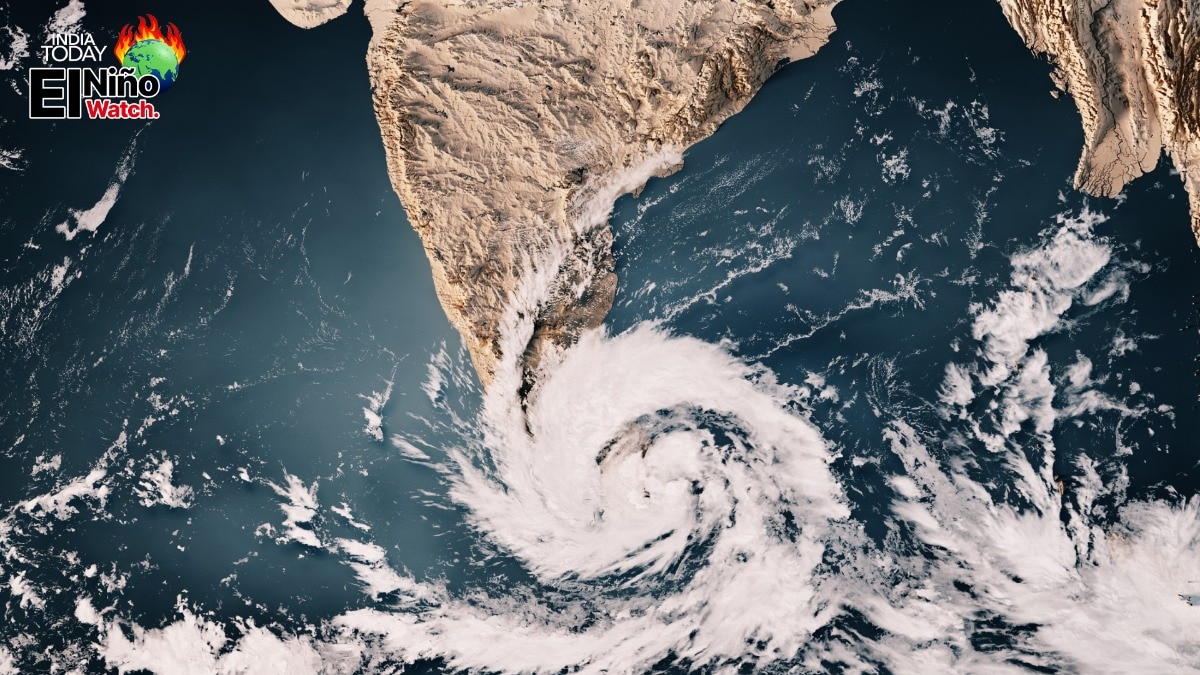
Scientists have identified how a positive Indian Ocean Dipole can strengthen El Nino. The link could improve monitoring of extreme events, though it does not apply universally.New Delhi,Nov 11, 2026 15:13 ISTThe Indian Ocean could play a crucial role in turning an ordinary El Nino into a powerful Super El Nino, according to a scientific study that has uncovered an important connection between two of the world's largest ocean systems.Researchers have found that a positive Indian Ocean Dipole (IOD), a phenomenon marked by contrasting sea-surface temperatures across the Indian Ocean, can help intensify El Nino events in the Pacific by changing atmospheric circulation and ocean currents.The study, published in the journal Nature Communications, examined some of the strongest El Nino events on record, including those of 1972, 1982 and 1997.Scientists found that all three coincided with positive Indian Ocean Dipole events, raising questions about whether warming patterns in the Indian Ocean could influence the intensity of Pacific Ocean warming. Photo: Getty The researchers investigated how this connection works and found that the Indian Ocean can generate persistent westerly wind anomalies over the western equatorial Pacific, potentially strengthening an ongoing El Nino.HOW DOES THE INDIAN OCEAN INFLUENCE EL Nino?A positive IOD develops when the western Indian Ocean becomes warmer than normal while the eastern Indian Ocean, near Indonesia, experiences cooler-than-normal sea-surface temperatures. This temperature contrast alters atmospheric circulation and rainfall patterns, producing changes that can extend beyond the Indian Ocean.According to the study, these atmospheric changes can generate stronger westerly winds over the western Pacific. These winds trigger oceanic Kelvin waves that travel eastwards, deepening the thermocline and allowing warmer subsurface water to influence surface temperatures in the eastern Pacific.This can reinforce the warming associated with El Nino. Photo: Getty The researchers also identified a self-limiting mechanism within the Pacific. During El Nino, atmospheric responses can generate easterly wind anomalies over the eastern Pacific, encouraging upwelling of cooler water and counteracting warming.The positive IOD can help overcome this natural brake by supplying additional westerly wind forcing from the western Pacific.WHAT ABOUT THE 2015 SUPER EL Nino?The researchers also examined the 2015 El Nino, which produced exceptionally large sea-surface temperature anomalies.However, unlike the 1972, 1982 and 1997 events, the 2015 episode did not display the same eastern-Pacific-intensified structure. The researchers suggested that strong decadal variability may have contributed significantly to its warming.The findings highlight how closely connected the Indian and Pacific oceans are when it comes to global climate patterns.However, the study does not establish that every positive IOD produces a Super El Nino.Instead, it suggests that Indian Ocean conditions can influence the intensity and evolution of certain extreme El Nino events, making the IOD an important factor to monitor alongside Pacific Ocean temperatures.- Ends
Can the Indian Ocean supercharge El Nino? Rare connection uncovered
Full Article
Original Source
Read the full article at Indiatoday →KhanList aggregates and links to publicly available news content. We do not host full articles from third-party sources. Always verify important information with original sources.