
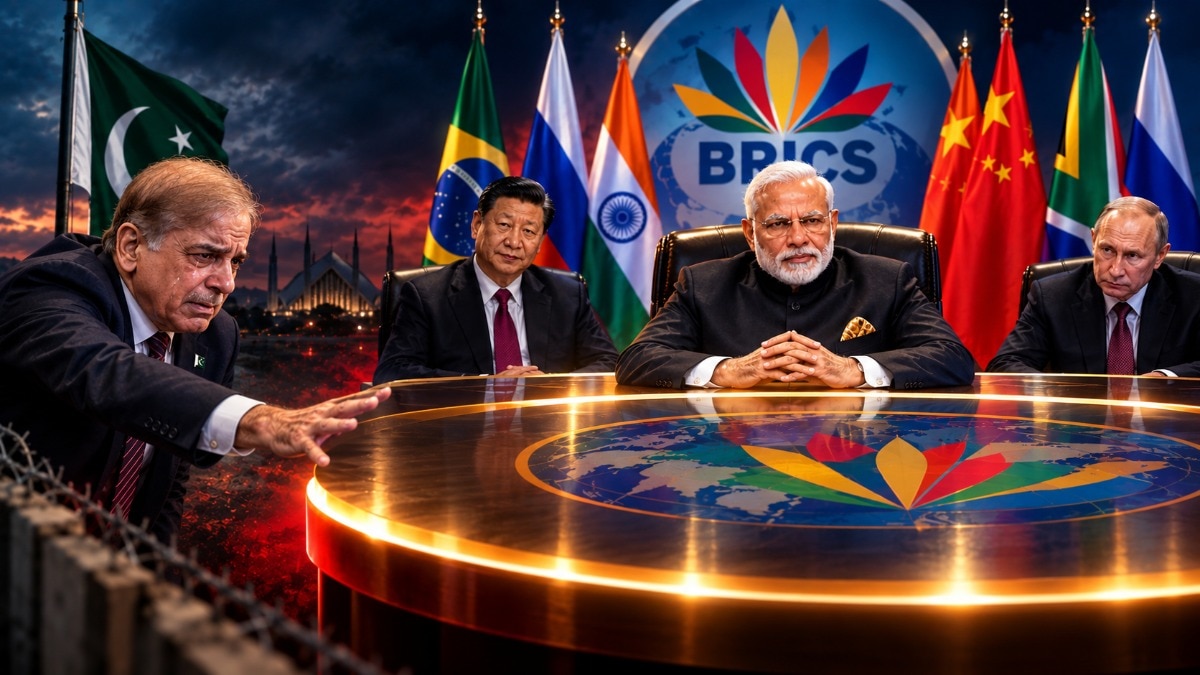
Pakistan sees BRICS as a route to greater economic influence, but its membership bid faces India's opposition, weak domestic fundamentals and the difficult reality that diplomatic support from China and Russia cannot override consensus.Pakistan wants a place in BRICS alongside China, Russia and India (AI Generated)Pakistan wants a place in BRICS alongside China, Russia and India, but its ambitions face a major obstacle. With expansion requiring consensus, New Delhi’s opposition could keep Islamabad outside the bloc. Pakistan applied to join BRICS in 2023, hoping to gain access to a powerful economic grouping that has expanded far beyond its original membership. The bloc now comprises 11 countries and represents almost half of the world’s population and around 40 per cent of global GDP.For Islamabad, the economic case is compelling. BRICS countries account for a significant share of global oil and food production, while its members already represent an important market for Pakistani exports. Pakistan’s textile exports reached nearly $18 billion last year, while its trade with China continues to grow. Mining also offers potential. Pakistan’s copper exports to China have crossed $1 billion, while aluminium ore exports have recorded a dramatic rise. Islamabad could therefore argue that its natural resources, manufacturing base and strategic location could add value to the bloc. But economics may not be enough.BRICS expansion is based on consensus, meaning every existing member must agree to the admission of a new country. That gives India a decisive role in Pakistan’s application. New Delhi has repeatedly linked its concerns over Pakistan to terrorism and security. Islamabad, meanwhile, has accused India of deliberately blocking its ambitions. Regardless of the competing narratives, the diplomatic mathematics remains unchanged. If India says no, Pakistan cannot enter.Pakistan also faces questions over its economic resilience. Growth remains modest, per capita income is relatively low and the country continues to rely heavily on international financial assistance. Repeated IMF programmes have highlighted persistent structural weaknesses, including debt pressures, currency instability and balance of payments problems.The New Development Bank could offer another source of financing, and Pakistan has reportedly explored acquiring shares worth more than $580 million. But membership or participation in the institution would not eliminate its dependence on the IMF.China and Russia may support Pakistan’s BRICS ambitions, but their backing alone cannot overcome India’s opposition.For now, Pakistan has the ambition, strategic importance and economic potential to make its case. Yet unless its economy strengthens and India changes its position, its BRICS bid remains stuck outside the door.- EndsPublished By: indiatodayglobal Published On: Sep 8, 2026 22:50 IST
Can Pakistan really join BRICS when India holds the veto?
Full Article
Original Source
Read the full article at Indiatoday →KhanList aggregates and links to publicly available news content. We do not host full articles from third-party sources. Always verify important information with original sources.