
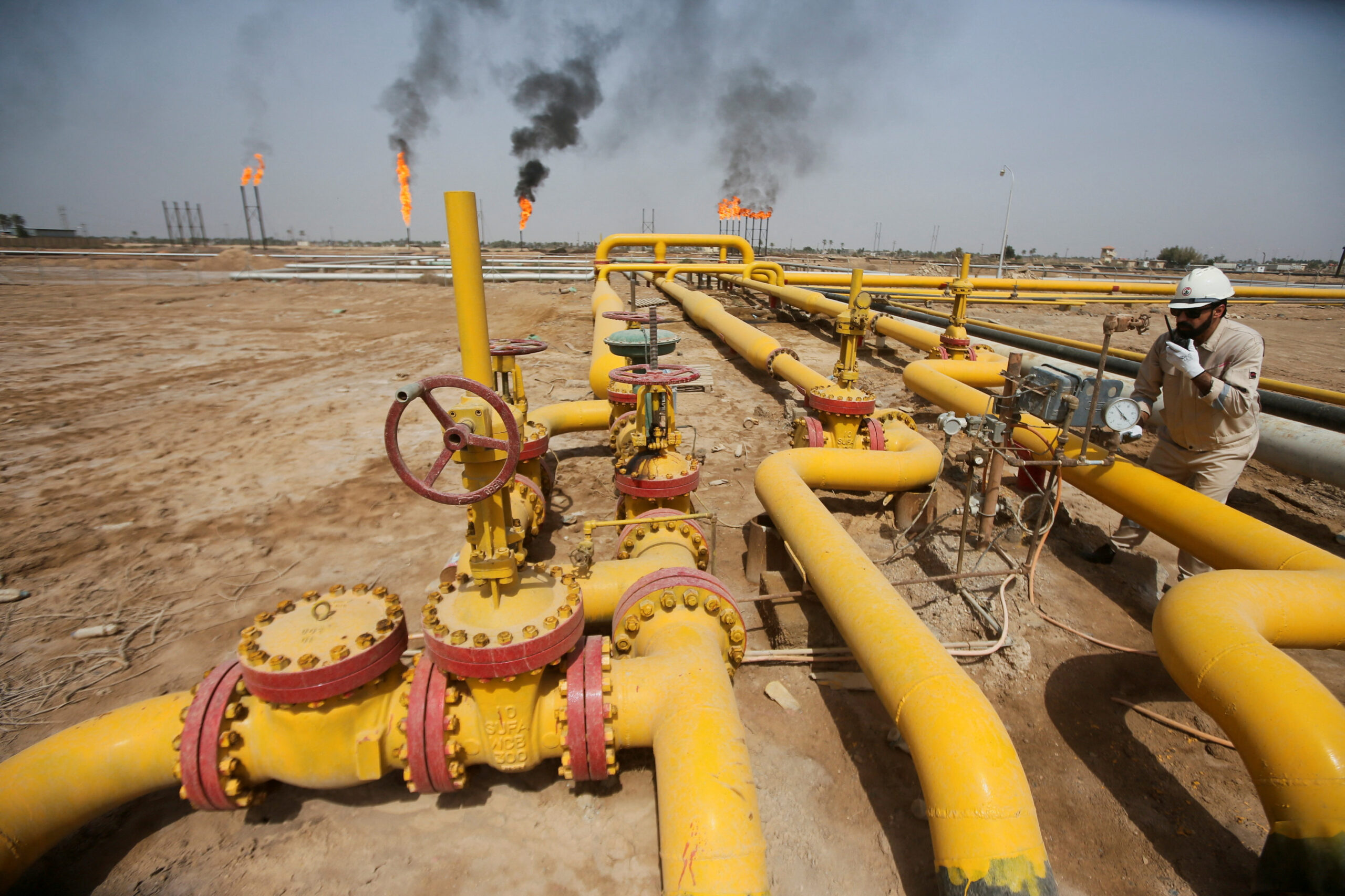
As Iraq and the United States enter a new phase in their relationship, oil is assuming a more central role. During Prime Minister Ali al-Zaidi’s first visit to the White House in July, President Donald Trump framed the shift explicitly: as US forces withdraw by September 30, American oil companies should take their place. Recasting the relationship on trade and investment is essential, but delivering that transition will be difficult. Zaidi must establish his authority within a political system still shaped by Iran’s influence, while convincing foreign investors that Iraq can offer a commercially viable and secure operating environment. The timing is critical. As the Zaidi government faces external pressures from the ongoing US-Iran conflict and moves towards disarming Iran-backed Iraqi militias, it has a narrow window to attract American investment into its oil sector and secure US backing for plans to diversify its export outlets. This has only become more urgent after Iran’s closure of the Strait of Hormuz exposed the vulnerability of Iraq’s oil-dependent economy. SIGN UP FOR THIS WEEK IN THE MIDEAST NEWSLETTER For two decades, US policy toward Iraq has been dominated by security. After the 2003 invasion, Washington’s state-building ambitions were overtaken by insurgency, sectarian conflict, and regional interference. The 2011 withdrawal limited the relationship further, while the campaign against the Islamic State of Iraq and al-Sham (ISIS) and the subsequent rise of the militias reduced Iraq to a component of Washington’s wider Iran policy. Zaidi has pledged to move the relationship “beyond crisis management to opportunity creation.” Previous Iraqi leaders pursued similar resets while balancing US and Iranian influence. With the US-Iran war ongoing, that balance now appears increasingly untenable. Over the weekend, Saudi Arabia was forced to shut down its vital east-west oil pipeline after drones launched from Iraq severely damaged the system. Throughout the conflict, Iran-backed militias have used Iraqi territory to target Gulf states, the Kurdistan Region, and US interests, while Baghdad’s inability to restrain them has raised questions about sovereignty and the state’s monopoly over the use of force. Washington has responded with military strikes, temporary restrictions on dollar transfers, and sanctions against a senior Iraqi oil official—signaling a willingness to pressure the Iraqi state in addition to Iranian proxies. In Baghdad, however, perceptions of an increasingly transactional US foreign policy are shaping the political calculus. Trump views international partnerships through a commercial lens, prioritizing opportunities for US businesses at home and abroad. For Iraq’s more pragmatic Shia leaders, that approach offers an entry point to reset relations. But Iraq’s attempt at realigning relations with the US depends heavily on reining in the militias and securing favorable commercial terms for oil companies and export pipeline investors, all within a limited timeframe before the US potentially loses interest. An oil sector reset Baghdad increasingly believes that opening the oil sector to US companies could help shield Iraq from further American pressure. This is why Zaidi’s visit to Washington was dominated by dealmaking, with preliminary agreements initially pegged at more than $60 billion, primarily in the oil sector, and later inflated to $200 billion. The entry of US companies is also central to the Zaidi government’s target of raising Iraq’s near-term production capacity from five million barrels per day (b/d) to seven million b/d by 2030. More importantly, it could reverse the optics of an oil sector that has stagnated in recent years. Previous governments struggled to deliver major capacity and infrastructure projects. Although oil revenues account for more than 90 percent of state income, the sector must compete for funding against rising public sector salaries and welfare spending. Baghdad’s failure to offer commercially attractive terms to international oil and gas companies has further narrowed the pool of available capital. Over the past decade and a half, Iraq has largely fallen out of favor with major Western oil firms. Technical service contracts limited profit margins, centralized management slowed decision making, and payment delays discouraged foreign operators from investing in their assets, capping production gains. These commercial challenges, more than the security risks in southern Iraq, prompted several leading companies to withdraw. Statoil—now Equinor—exited in 2012, followed by Occidental in 2016, Shell in 2018, and ExxonMobil in 2024. Chinese state- and private-owned companies, more willing to accept low-margin oilfield management contracts, filled the gap and came to dominate multi-billion-dollar project awards that often lacked transparency. The Western exodus also damaged the sector’s reputation. The oil ministry began changing course in 2018 when it introduced its ”profit sharing” contracts, designed to distribute risk and reward more evenly with foreign companies. The turning point came in 2023, when the new model helped Iraq sign France’s TotalEnergies to the $27 billion Gas Growth Integrated Project in Basra, followed by the award of the giant Kirkuk oil field redevelopment to BP in 2025. The missing piece was American firms. Since Exxon’s departure, Iraq has been eager to bring US oil companies back, viewing their presence as a springboard for resetting ties with Washington and rebuilding the sector’s reputation. A US corporate presence could also reduce Washington’s mounting pressure on Baghdad, since Trump’s first presidency, to reduce Iraq’s dependence on energy imports from Iran. Zaidi is now picking up where his predecessor left off. Iraq is seeking to bring back ExxonMobil to potentially develop the 450,000 b/d Majnoon oil field in Basra and Chevron into the nearby 480,000 b/d West Qurna-2 field, where Russia’s Lukoil was ousted after US sanctions. Securing either company would signal renewed confidence in Iraq’s oil industry. But the deciding factor remains Baghdad’s willingness to offer contractual concessions and avoid past mistakes, particularly the tendency to prioritize resource nationalism over durable international partnerships. Zaidi and American diplomatic pressure have pushed the oil ministry toward preliminary commercial terms with Chevron, while progress is being made with other US firms such as HKN and Halliburton. Iraq’s preference for American firms and the US government’s support for them are also pushing non-US operators to seek American partners. BP recently brought ConocoPhillips into Kirkuk, for example. If Iraq secures Exxon and Chevron, along with other planned projects with American operators, US firms could operate at least 1.5 million b/d of Iraq’s production, surpassing Chinese-operated capacity. The Syria connection Baghdad also sees an opportunity to align with the Trump administration’s Syria policy to strengthen the US-Iraq reset. Washington supports the entry of US oil companies into Syria and backs Damascus’s ambitions to become a new hub for Middle East energy exports after the Hormuz crisis. Facing the collapse of exports through the Gulf, Iraq began trucking fuel oil by land in early April for re-export from Syria’s Baniyas oil terminal on the Mediterranean. These exports have served as a test case for US support for a new two million b/d oil export pipeline from Iraq to Syria. Such a project could support stabilization by providing transit fees and Iraqi crude feedstock for Syrian refineries, helping Damascus reduce its import bill and export its own excess oil volumes. Flourishing Iraq-Syria ties also create opportunities for American companies. Smaller US operators in Iraqi Kurdistan are expanding their presence in northeast Syria. ConocoPhillips is considering developing the Akkas gas field in Anbar, which could later create synergies with its Syrian gas assets across the border. An alternative export outlet via Syria would also strengthen the investment case for Exxon, Chevron, and other US companies in Iraqi oil fields. For Baghdad, the strategic necessity is evident. Iraq desperately needs an alternative route to market as the future of commercial shipping through Hormuz remains uncertain. The closure of the strait has cut off more than 90 percent of Iraqi oil exports and exposed the weakness of Iraq’s domestic pipeline system, which can currently support less than 250,000 b/d of flows from the south to Turkey via the Iraq-Turkey Pipeline (ITP). Baghdad has signed a deal with a Qatari-US consortium, including Chevron, to study two new pipeline connections from Haditha in Anbar: one west to Baniyas and another north to Ceyhan. The new lines would be underpinned by the long-planned 2.25 million b/d Basra-Haditha pipeline, a $4.6 billion project that would serve as the backbone for Iraqi oil exports and improve crude supply to domestic refineries. The oil ministry has brought in US services firm KBR as a consultant on the Basra-Haditha project and expects all new pipelines to cost at least $15 billion. For Iraq, the investment is strategically justified, given that the conflict has so far resulted in the loss of at least $40 billion in potential oil export revenues. US participation could provide Iraq with both capital and a way to involve Washington in security arrangements around pipeline corridors with Syria, much of which will pass through territories in both countries that are vulnerable to ISIS and Iran-backed militia attacks. Still, pipeline projects take years to materialize, and cooperation with Syrian President Ahmed al-Sharaa will face opposition within elements of Iraq’s Shia political class. A Syrian outlet would also strengthen Iraq’s negotiating position with Turkey as both sides discuss the renewal of the 1973 ITP treaty. Ankara unilaterally exited the agreement last year. With Baghdad lacking alternative pipeline options, Turkey has imposed harsh terms under a new interim one-year deal, ending Iraq’s exclusive access to the system and raising transit fees. A narrow window Zaidi’s task is more difficult than that of his predecessors. Although Zaidi has received praise from Trump, US support is not guaranteed, particularly given the president’s unpredictable style and shifting dynamics in the region and beyond. The window to engage the Trump White House may be short-lived. By January, Trump could face a Democrat-controlled Congress that is more inclined to scrutinize Middle East dealmaking. By 2029, Trump will leave office. While the next president might support expanding economic ties with Iraq, the momentum could fade, and decision making might become less personality driven. Nonetheless, the global energy crisis triggered by the Hormuz closure highlights to Washington the critical need to establish secure export routes from the Middle East. Alternative corridors will take years to complete, but will likely garner bipartisan support in Washington and endure beyond the Trump presidency, given that they would reduce Iran’s leverage over this vital energy chokepoint. But the Iraqi government must act quickly while there is still interest and goodwill to see these projects through—and to ensure they come online in a timely fashion. The Basra-Haditha pipeline and related facilities are projected to take up to four years to complete, not including the new cross-border export pipeline extensions to Syria and Turkey. Syria’s existing pipeline infrastructure is nearly nonexistent due to extensive damage from fourteen years of civil war and will need to be built from scratch. The most important test is security. Zaidi needs to build a national consensus around the disarmament of militias and their disassociation from the state. Failing to do so leaves any expansion of US commercial presence in Iraq’s oil sector exposed to attacks, giving the groups a new way to pressure both Baghdad and Washington. If Zaidi manages to balance commercial concessions with national control, restrain militias, and pair oil deals with export diversification projects, he could transform US-Iraq relations into a strategic economic partnership that may last beyond the Trump administration. If not, this attempt at a reset might just be another fleeting effort to reshape a relationship still dominated by security concerns, Iran’s influence, and Iraq’s internal weakness. Yesar Al-Maleki is a nonresident senior fellow with the Iraq Initiative at the Atlantic Council’s Middle East programs. He is also a Gulf analyst at the Middle East Economic Survey. Image: A worker checks an oil pipeline at Nahr Bin Umar oil field, north of Basra, Iraq March 22, 2022. REUTERS/Essam Al-Sudani
Can oil deals reset US-Iraqi relations?
Full Article
Original Source
Read the full article at Atlanticcouncil →KhanList aggregates and links to publicly available news content. We do not host full articles from third-party sources. Always verify important information with original sources.