
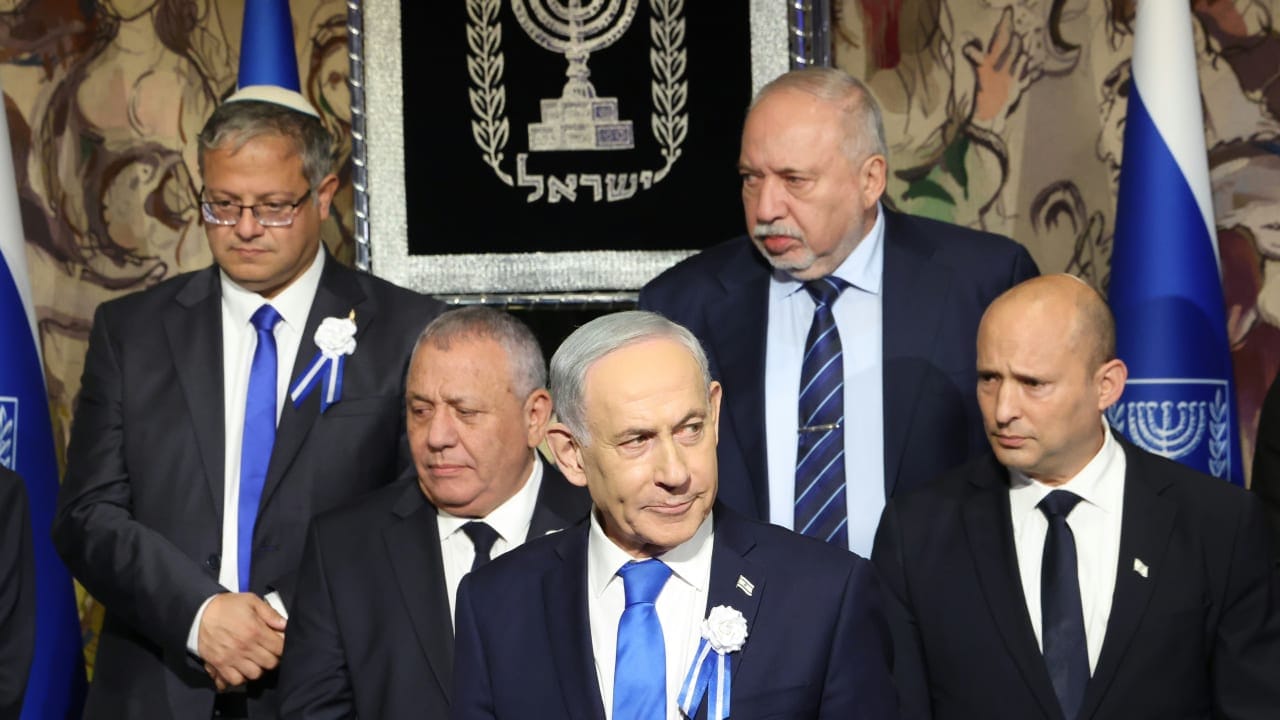
President Isaac Herzog has tasked Gadi Eisenkot with forming Israel's next government, but Benjamin Netanyahu remains prime minister, retaining the powers of his office, overseeing the defense establishment, and directing Israeli policy toward Iran.The unusual political situation following the elections raises questions not only about who will succeed in forming a government, but also about who has the authority to make what could be the most consequential decision of this period: renewing Israel's military offensive against Iran, a move that could trigger another regional war.Netanyahu's position as head of a caretaker government might appear to limit his ability to make far-reaching decisions. However, an examination of Basic Law: The Government, along with Israel's legal and military precedents, presents a more complex picture.A caretaker government is not legally barred from going to war, and previous caretaker governments have overseen major military operations. The central questions are what circumstances justify such action, how the decision must be made, and whether an urgent security threat makes postponement impossible.The issue has become particularly significant amid an emerging divide between Jerusalem and Washington.Israel Air Force fighter jets on their way to the waves of strikes in Iran (credit: IDF SPOKESPERSON UNIT)US President Donald Trump, who previously supported extensive military action against Iran, has said in recent days that he sees no need to resume strikes at this stage. His administration is pursuing a possible agreement with Tehran, while Netanyahu maintains that overthrowing the ayatollahs' regime is the only way to permanently eliminate the Iranian threat.Trump seeks an agreement, Netanyahu calls for regime changeIn an interview with CBS's 60 Minutes broadcast earlier this week, Trump was asked whether he intended to escalate the war against Iran following the US midterm elections. He said he had no desire to do so and saw no reason to escalate further.Later, during a meeting with Qatari Prime Minister and Foreign Minister Mohammed bin Abdulrahman Al Thani at the White House, Trump reiterated that additional military action did not appear necessary at this stage.The president noted that Iran was engaged in talks with the United States and expressed hope that an agreement could be reached. He stressed, however, that the US military remained prepared to act if circumstances changed.Secretary of State Marco Rubio has adopted a similar position, arguing that the economic pressure Washington is exerting on Iran through sanctions and a naval blockade has been so effective and damaging that further military strikes are currently unnecessary.Rubio predicted that the effects of this pressure on the Iranian regime would become clearer in the coming weeks and months.Nevertheless, he acknowledged that a breakthrough in negotiations was not imminent, partly because of Iranian demands that Washington considers unacceptable. The military option, therefore, remains on the table.Meanwhile, Vice President JD Vance has emerged as a central figure in efforts to secure a diplomatic agreement.Over the past two weeks, Vance has been personally involved in indirect contacts with Iran, speaking almost daily with the Qatari prime minister, Pakistan's army chief, and other mediators.The administration is also considering direct talks between US and Iranian officials at the working level, as well as a possible meeting between Vance and senior Iranian officials.Netanyahu, by contrast, continues to advocate a much tougher approach.In his address to the Knesset on Wednesday, he called for the formation of a national unity government in response to the renewed Iranian threat, arguing that the only way to eliminate it permanently is to overthrow the ayatollahs' regime.He also warned that the international community could come to accept a resumption of Iran's nuclear program.Netanyahu and US Defense Secretary Pete Hegseth are among those who favor renewed military operations against Iran, while Vance and US envoy Steve Witkoff prefer to explore the possibility of reaching an agreement.The Financial Times reported that Arab leaders are concerned Netanyahu is pressuring Trump to resume the military campaign.A source familiar with the discussions claimed that Netanyahu speaks frequently with the US president and has repeatedly urged him to launch another strike.However, a source familiar with the situation in Israel offered a different assessment, saying that although Netanyahu favors renewed military action, there is currently little indication of a concerted effort to persuade Trump to pursue it.These reports do not establish that Netanyahu has decided to launch another offensive, but they illustrate the disagreements over how the confrontation with Iran should be brought to an end.Security cabinet has not met for more than a monthThe possibility of renewed military action has also raised questions about the functioning of Israel's security cabinet.The cabinet is expected to convene this coming Sunday, November 15, for the first time in more than a month. Its last meeting took place on October 5, before the Knesset elections.Meanwhile, the defense establishment has been instructed to increase its readiness for a possible strike on Iran, even though the security cabinet has not convened during this period.This does not mean that a new decision to go to war has been made. It does, however, raise questions about which forums are conducting security discussions and how decisions are being made while the government serves in a caretaker capacity.Faction leaders pose for a group photo following the swearing-in of the 26th Knesset at the Knesset in Jerusalem, November 10, 2026. (credit: CHAIM GOLDBERG/FLASH90)Can a caretaker government launch a war under Israeli law?The central legal provision governing this question is Section 40 of Basic Law: The Government.The section stipulates that Israel may not initiate a war or undertake significant military action likely to lead to war with a probability approaching certainty without a government decision.The law also allows the government to delegate this authority to the Ministerial Committee on National Security Affairs, commonly known as the security cabinet, when the prime minister determines that doing so is necessary for reasons of national security, foreign relations, or secrecy.The provision also clarifies that these restrictions do not prevent other military actions required to defend the state and protect public security.But how do these rules apply to a caretaker government?Section 40 makes no distinction between a regular government and a caretaker government. Furthermore, Section 30 of the Basic Law stipulates that an outgoing government continues to perform its duties until a new government is formed.This means Netanyahu and his ministers retain their executive powers despite the election results and Herzog's decision to task Eisenkot with forming the next government.Nevertheless, those powers are not unlimited.Supreme Court rulings have established that an outgoing government must exercise restraint and act reasonably and proportionately, taking into account the change in its democratic legitimacy.The more urgent the public need for action, the less restrictive the obligation to exercise restraint may become. In the face of an immediate security threat, a caretaker government retains considerable freedom to act.However, a more difficult legal and public question arises when the government considers initiating a military operation that could be postponed without compromising operational objectives.Another important distinction concerns the prime minister's personal authority.The prime minister cannot independently authorize every decision to launch a war. If a proposed military operation falls under Section 40(a), it requires either a government decision or a decision by the security cabinet acting under authority lawfully delegated to it.Olmert, Netanyahu, and Lapid: Previous caretaker governments have launched military operationsIsraeli history offers several significant precedents for military action under caretaker governments.In December 2008, then-prime minister Ehud Olmert headed a caretaker government following his resignation and the failure to form an alternative coalition.During that period, Israel launched Operation Cast Lead in the Gaza Strip, following sustained rocket fire against southern Israeli communities. The operation developed into a military campaign that lasted approximately three weeks.A second precedent came in May 2021, following elections to the 24th Knesset, while negotiations to form a new government were still underway.Netanyahu himself was serving as caretaker prime minister when Israel launched Operation Guardian of the Walls.The fighting began after Hamas fired rockets toward Jerusalem and other parts of Israel. The government responded with extensive strikes in the Gaza Strip, and the campaign lasted 11 days.This precedent is particularly relevant because it demonstrates that a caretaker government can oversee a major military campaign.However, Operation Guardian of the Walls was launched in response to rocket attacks, rather than as a preemptive decision to begin a new war against another country.Another example came in August 2022, when caretaker prime minister Yair Lapid and defense minister Benny Gantz led Operation Breaking Dawn against Palestinian Islamic Jihad in the Gaza Strip.Unlike Guardian of the Walls, Breaking Dawn began with an Israeli-initiated strike, opening with the killing of a senior Palestinian Islamic Jihad commander following security warnings.The security cabinet was not convened before the operation because Attorney-General Gali Baharav-Miara accepted the assessment of security officials that the operation was not expected to lead to war with a probability approaching certainty.Together, these three cases demonstrate that caretaker governments are not prevented from using military force. They also underscore the importance of distinguishing between a response to an immediate threat, a limited military operation, and the initiation of a broader war.A renewed war against Iran, particularly one intended to overthrow the regime in Tehran, could differ substantially from these precedents in both scope and consequences.Eisenkot warns Netanyahu against decisions that can be postponedThe debate took on a direct political and legal dimension on Wednesday night when Eisenkot sent Netanyahu a letter demanding restraint in security decisions during the caretaker period.Eisenkot reminded Netanyahu that Herzog had tasked him with forming the next government after receiving recommendations from 67 Knesset members, compared with 46 who recommended Netanyahu.Although those recommendations do not guarantee that Eisenkot will succeed in forming a coalition, they reflect a significant shift in the political balance of power.Eisenkot warned against deploying security forces in the absence of a direct and immediate threat that cannot be postponed, arguing that such action could damage Israeli democracy and undermine public confidence in state institutions.He called on Netanyahu to refrain from dangerous moves that could be delayed until a new government is sworn in and warned against placing senior defense officials in a position where they could face a constitutional conflict.Eisenkot separately approached Baharav-Miara, asking her to examine the caretaker government's powers and ensure that he receives regular security briefings in light of his mandate to form the next government.The Prime Minister's Office strongly rejected Eisenkot's claims.In its response, the office said that all decisions made by the Netanyahu-led government were based exclusively on security considerations and had been fully coordinated with the defense establishment.It accused Eisenkot of attempting to introduce political considerations into security discussions and renewed its call for him to join a national unity government.The central question: An immediate threat or a war that can be avoided?The situation also presents a diplomatic paradox.While Netanyahu emphasizes the need to complete the military campaign against Iran and overthrow the regime, Trump has argued that renewed strikes are not currently necessary.At the same time, the US president has not adopted an unequivocal position that the campaign must end at any cost.Speaking at a Veterans Day ceremony at Arlington National Cemetery on Wednesday, Trump said the United States wanted a complete victory over Iran, rather than a 93% victory, and added that the confrontation would end soon.The military option therefore remains available to both Israel and the United States.For Netanyahu, the question surrounding any further major military operation against Iran is not simply whether Israel has the operational capability to carry it out, but whether sufficient security and legal grounds exist to justify such an operation while his government is serving in a caretaker capacity.Netanyahu continues to exercise the powers of prime minister, while Eisenkot holds the mandate to form the next government.Neither, however, knows what the next coalition will look like or when it will be sworn in.Under these circumstances, the distinction between a military operation intended to prevent an immediate threat and a broader initiative to reshape the regional order could become the decisive issue.Israeli law does not prohibit a caretaker government from going to war. But because it grants such a government extensive authority, it is all the more important that any decision to launch a war follows proper procedures, rests on a clear security justification, and considers its potential consequences for Israel and the wider region.
Can a transitional government start a war with Iran? - explainer
Full Article
Original Source
Read the full article at Jpost →KhanList aggregates and links to publicly available news content. We do not host full articles from third-party sources. Always verify important information with original sources.