
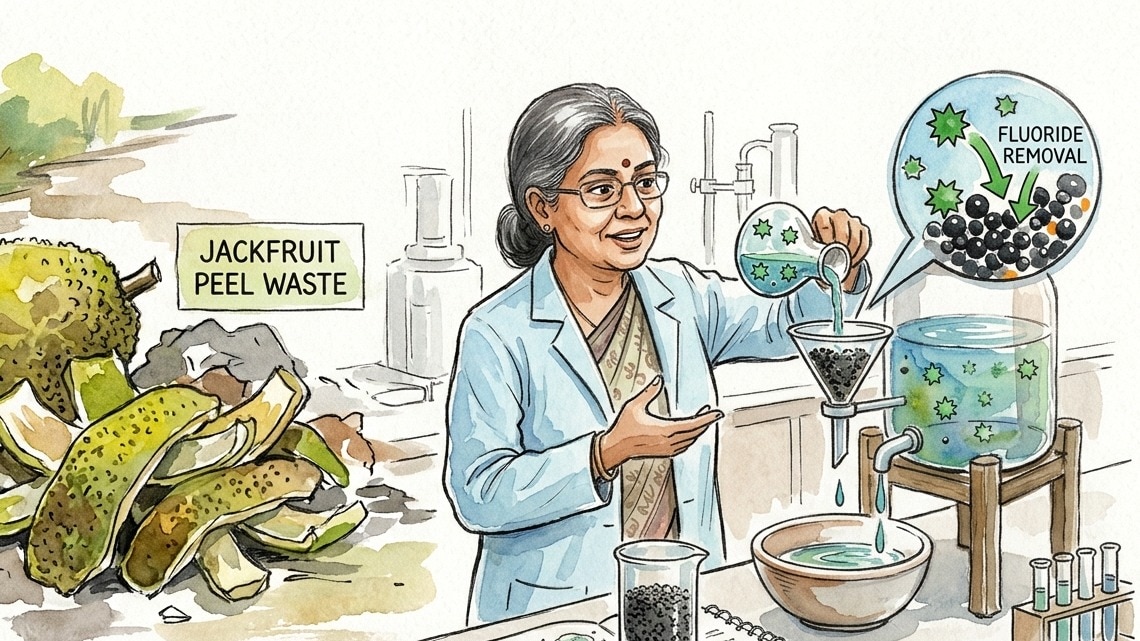
NIT Rourkela researchers have used modified jackfruit-peel carbon to remove excess fluoride from water. The patented laboratory-stage technology could give agricultural waste a role in addressing water-quality challenges.This NIT Rourkela innovation uses jackfruit waste to tackle fluoride in water (AI generated image)New Delhi,Oct 26, 2026 10:30 ISTThe next time you eat jackfruit, spare a thought for its thick, often-discarded peel. Researchers at the National Institute of Technology (NIT) Rourkela have found a potential use for this agricultural waste: helping remove excess fluoride from contaminated water.The researchers developed a material using activated carbon made from jackfruit peels and modified it with zirconium. In laboratory experiments, the material removed more than 90% of fluoride in about 10 minutes under the conditions tested.It is an unusual meeting of food waste and water science, with the potential to offer another approach to a problem affecting drinking water quality in parts of India.HOW DOES A JACKFRUIT PEEL CLEAN WATER?The secret lies in what happens to the peel after it is discarded. Researchers convert it into activated carbon and modify the material with zirconium to improve its ability to capture fluoride from water. The team, comprising Professor Susmita Mishra of NIT Rourkela's Department of Chemical Engineering and Dr Pratima Minz, a research graduate at the institute, tested the material on water containing fluoride concentrations of around 1–5 milligrams per litre.The experiments recorded removal efficiencies exceeding 90%, reaching 97% within 10–20 minutes under the tested conditions. The team has also secured a patent for the technology.WHY DOES REMOVING EXCESS FLUORIDE MATTER? Fluoride occurs naturally in water, but long-term excessive exposure can lead to fluorosis, a condition that affects teeth and bones in both children and adults.Existing treatment methods, including reverse osmosis, ion exchange, and activated alumina, have operational and cost limitations. Reverse osmosis, for instance, can generate wastewater and remove beneficial minerals.Using agricultural waste as a raw material offers researchers another route to explore. The team estimates the material's preparation cost at approximately Rs 37 per gram, based on the electricity and chemicals used in its synthesis.CAN IT BECOME A HOUSEHOLD WATER PURIFIER?Not just yet. The technology has reached Technology Readiness Level 4 (TRL 4), meaning it has been validated in a laboratory environment.The researchers plan to develop a physical prototype and assess its long-term performance, operating costs, and suitability for practical use. Further testing will be necessary before the material can be considered for household or community-level water treatment.For now, the jackfruit peel has not become a ready-to-use purifier. But the research offers an intriguing possibility: waste that would ordinarily end up in the bin could one day help tackle a serious water-quality challenge.- Ends
Can a discarded jackfruit peel help clean your water? NIT Rourkela has an answer
Full Article
Original Source
Read the full article at Indiatoday →KhanList aggregates and links to publicly available news content. We do not host full articles from third-party sources. Always verify important information with original sources.