
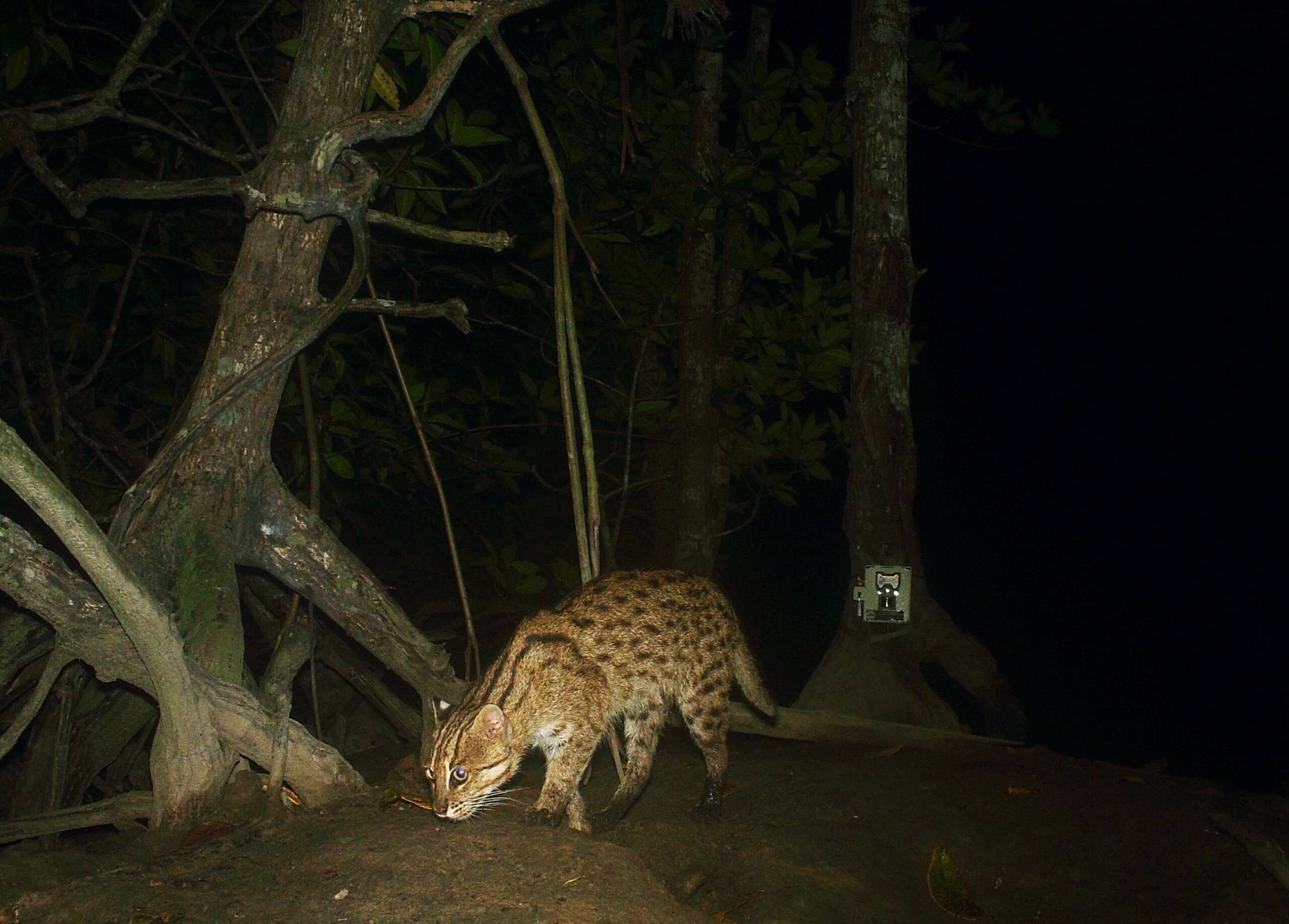
Cambodia’s mangrove forests and the wetlands associated with them provide critical refuge for several threatened and elusive species, including fishing cats and hairy‑nosed otters, according to a recent study. Researchers from the Phnom Penh-based private company Fishing Cat Ecological Enterprise (FCEE) deployed camera traps across 156 coastal and riverine mangrove sites within the Peam Krasop Wildlife Sanctuary and the adjacent Koh Kapik Ramsar site between 2017 and 2023. Both the sanctuary and the Ramsar site form Cambodia’s largest mangrove expanse. The camera footage revealed that the mangrove forests are a rich habitat of threatened species: Fishing cats (Prionailurus viverrinus) slipping through mangrove thickets away from shores, smooth‑coated otters (Lutra perspicillata) patrolling fringe river channels, leopard cats (Prionailurus bengalensis) and hairy‑nosed otters (Lutra sumatrana) favoring mangroves by rivers, and large‑spotted civets (Viverra megaspila) moving through swamp forests dominated by paperbark trees (Melaleuca spp.). Researchers also found that four threatened species had declined over the seven-year study period. These included the endangered long‑tailed macaque (Macaca fascicularis) and large‑spotted civet, and the vulnerable fishing cat and smooth‑coated otter. Only the common palm civet (Paradoxurus hermaphroditus), an adaptable species, showed signs of increase. The critically endangered Sunda pangolin (Manis javanica) and the endangered hairy‑nosed otter remained difficult to detect. “Our results also showed that it’s essential to protect not just the mangrove forests, but [also] the surrounding Melaleuca forests which are important for the Endangered large-spotted civet, and the riverine mixed mangroves which are critical for the Endangered hairy-nosed otter, considered the rarest otter in the world,” the study’s corresponding author and FCEE director Vanessa Herranz Muñoz told Mongabay via email. A 2023 biodiversity survey by the conservation NGO Fauna & Flora and the FCEE, in which Herranz Muñoz was also involved, identified more than 700 unique species in Pream Krasop and Koh Kapik. Herranz Muñoz said the research team initially focused on the fishing cat, but later included other mammal species to ensure their conservation as well. The team mapped the various species’ presence across habitat types and found that fishing cats, smooth-coated otters and macaques showed tolerance of human proximity, while hairy-nosed otters, large‑spotted civets, and Sunda pangolins were more likely to stay away from settlements. “We found that fishing cats, smooth-coated otters and long-tailed macaques were often photographed not too far from villages, which is great news,” Herranz Muñoz said. “It means that there is peaceful co-existence between the local communities and these species, rather than hunting or conflicts near villages.” However, the researchers also expressed concerns about threats from human-wildlife conflict, poaching, and loss of forest habitat due to fire and urbanization. “The Cambodian government, conservation organisations and the local community need to work together to ensure all these habitats are protected from loss or degradation,” Herranz Muñoz said. Banner image: A fishing cat in the Koh Kapik Ramsar site in Cambodia. Image courtesy of the Fishing Cat Ecological Enterprise. Credits Topics
Cambodia’s mangrove forests offer vital refuge for threatened wildlife, 7-year study finds
Full Article
Original Source
Read the full article at News →KhanList aggregates and links to publicly available news content. We do not host full articles from third-party sources. Always verify important information with original sources.