
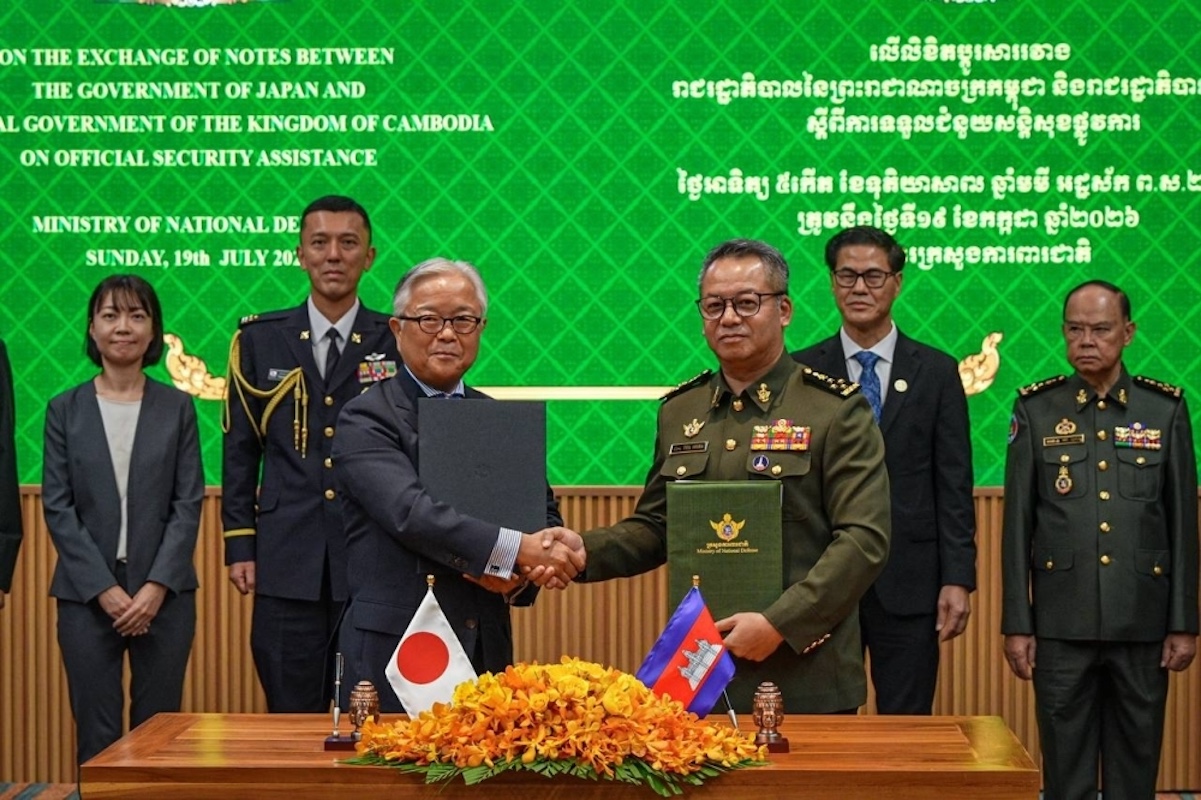
In February 2026, weeks after Cambodia’s National Assembly approved a draft law to ratify the 1982 UN Convention on the Law of the Sea (UNCLOS), a convention Phnom Penh signed in 1983 but never ratified, Japan unveiled plans to extend Official Security Assistance (OSA) to Cambodia. The announcement did not come out of nowhere and followed a year of quiet groundwork. Cambodian Prime Minister Hun Manet met then-Prime Minister Ishiba Shigeru in Tokyo in May 2025, after Japanese minesweepers made the first foreign port call at Ream Naval Base since its reconstruction. Cambodia’s army commander and Japan’s Ground Self-Defense Force chief of staff exchanged visits and agreed potentially to establish an army-led signal school. Cambodia finally became the 13th OSA recipient on July 19, receiving 500 million yen (US$3.2 million) for a communications school and patrol boats for the Royal Cambodian Navy. Most of the commentary since has asked whether the equipment matches Cambodia’s actual threats. The more revealing question is why Phnom Penh wanted the package at all. Since 2023, OSA has supported countries Japan considers like-minded amid what Tokyo calls a deteriorating Indo-Pacific security environment, a concern central to the 2022 National Security Strategy. In practice, the program has targeted China. Cambodia’s security issues lie elsewhere. Unresolved border demarcation with Vietnam, Thailand and Laos keeps territorial security at the center of Phnom Penh’s strategic calculations. Recent border clashes with Thailand have reinforced this focus. Cambodia’s Defense Policy 2022 extends this land-first orientation to the sea, tasking maritime forces with piracy, trafficking, transnational crime and illegal fishing rather than naval deterrence. Illegal, unreported and unregulated (IUU) fishing off Sihanoukville, Kampot and Koh Kong has depleted stocks that coastal households depend on, and Cambodia still scores 2.39 out of 5.00 on the IUU fishing index. UNCLOS ratification then added a legal duty to monitor waters Cambodia lacks the capacity to watch. A state with these priorities has little reason to build its security policy around the maritime contest that shapes most of OSA. Nor does a patrol boat do much about any of this. A hull can only intercept what someone else has already found, and Cambodia has very little that finds anything: no coastal radar chain, no vessel monitoring that can separate a licensed trawler from an unlicensed one. The communications school helps units talk to one another, not to see things. Phnom Penh accepted the package anyway, and that is the part worth reading closely. What Cambodia acquired was standing and a wider range of strategic options. The Ream port call carried the signal. For years, the controversial base was the central exhibit in the argument that Cambodia had effectively handed military control of its coastline to China. The government’s answer was to open it to Japanese vessels first. UNCLOS ratification worked the same way. The convention gives Cambodia legal standing over the maritime zones it claims, and joining it placed Phnom Penh inside a framework Japan has promoted across the region. Neither decision was costless, and the government made both knowing how each capital would read them. Neither move was a step away from China, either. Chinese finance still builds the roads, the canal and the ports. Golden Dragon remains by a wide margin Cambodia’s largest joint military exercise. Nothing in the Japanese package substitutes for any of that, and Phnom Penh has never asked it to. At the same time, China remains Cambodia’s largest source of foreign investment and its largest bilateral creditor, and no combination of partners now on offer could replace it within a decade. Cambodia is not switching patrons so much as strategically adding names to a list that had recently grown too short. When Hun Sen, the prime minister, asked in May 2021, “If I don’t rely on China, who will I rely on?”, he was describing a shortage of options, not professing loyalty to a single patron. Cambodia has been working on that shortage of partners ever since. Japanese security assistance sits alongside other efforts to hold onto European market access, settle tariff terms with the US and prepare for greater diversification with the nation’s upcoming graduation from least developed country (LDC) status. None of these replaces China’s position and influence in Cambodia. Together, they change what Phnom Penh is able to decline. Concentration is costly at home, too. Garment exports, tourism and construction carry the growth model, and all three depend on decisions taken elsewhere. With a single patron, Phnom Penh has little to bargain with when terms are set. Every additional partner raises the price of assuming Cambodia has nowhere else to go apart from reliance on China. The diplomatic return matters as much as the economic one. Cambodia has spent more than a decade answering for its 2012 ASEAN chairmanship, where it was perceived as bending to Beijing’s will. Each new partnership wears down that history and reputation. This is where Japan’s package could matter more than its contents suggest. Radar and surveillance would let Cambodia see its own waters, which UNCLOS ratification now obliges it to do and which patrol boats cannot do alone. That layer costs more on both sides: sustained financing from Tokyo and an organization in Phnom Penh able to absorb it, which is why the second phase of OSA will say more than the first. Japan has already built that capacity in the Philippines and Malaysia, and doing the same here would make the assistance more operational. The opening deserves to be treated as the start of something durable, not a box ticked at the 13th recipient. Assistance that fits Cambodia’s real problems earns a relative standing that ceremony cannot, and Phnom Penh will keep every arrangement that works while newer ones mature. Tokyo has a chance to become one of the partners Cambodia counts on, rather than one it merely thanks.
Cambodia’s Japan security aid is a hedge, not a pivot from China
Full Article
Original Source
Read the full article at Asiatimes →KhanList aggregates and links to publicly available news content. We do not host full articles from third-party sources. Always verify important information with original sources.