
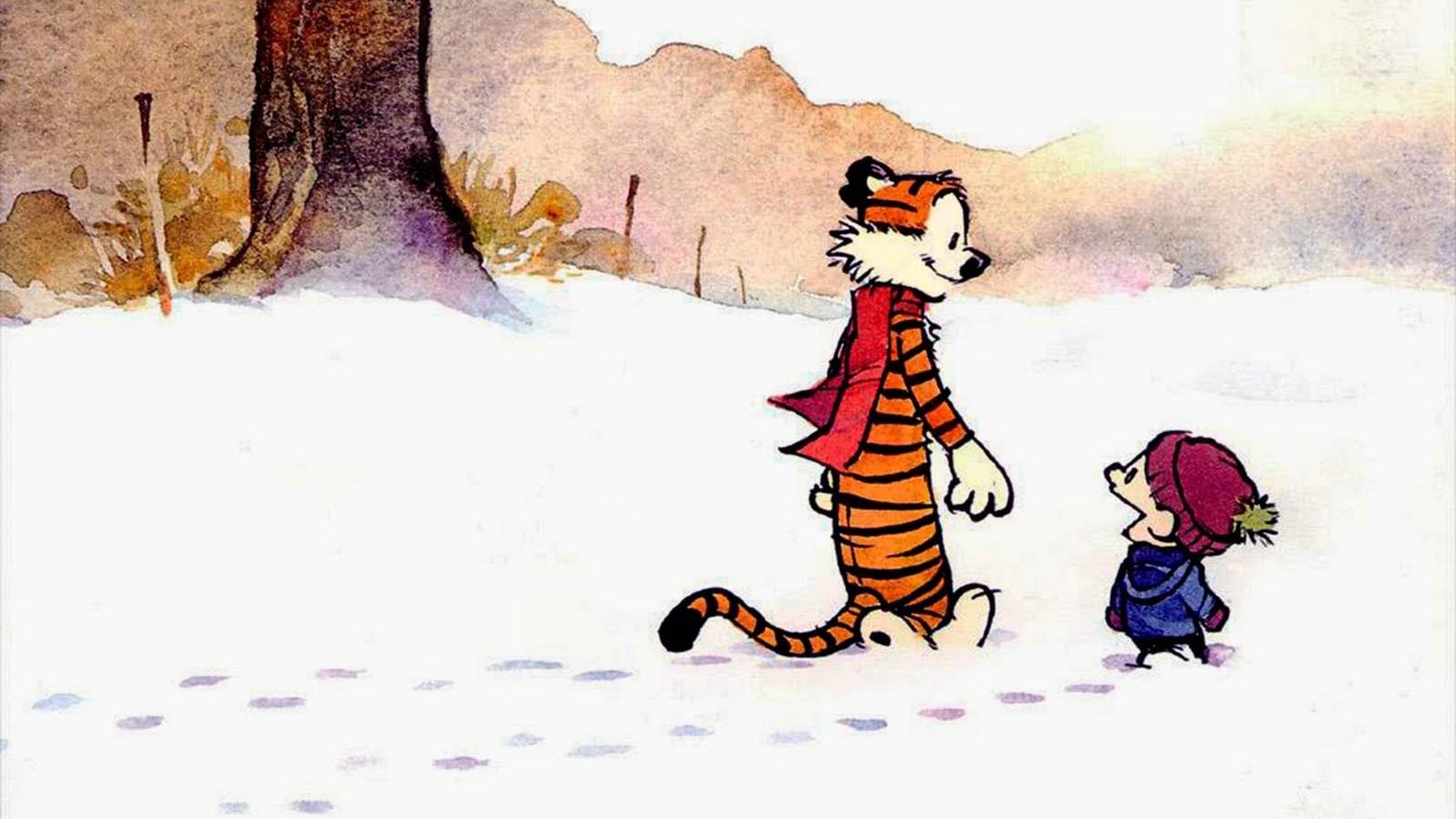
Published Nov 14, 2026, 6:00 PM EST Ambrose Tardive is an editor on ScreenRant's Comics team. Over the past two years, he has developed into the internet's foremost authority on The Far Side. Outside of his work for ScreenRant, Ambrose works as an Adjunct English Instructor. You have to wonder what kind of person Calvin from Calvin and Hobbes grew up to be. He was such a wise-beyond-his-years kid, in some ways, and totally oblivious like any normal 6-year-old in other ways. He was prone to these profound epiphanies, in between hyperactive outbursts, but he would forget the life lessons he inadvertently spouted as quickly as they came out of his mouth. As he got older, did Calvin remain the iconoclast and individualist that he was at six? Or did he become just another face in the crowd, instead of a fly in the ointment? Those questions come to mind especially when encountering Calvin's greatest quotes, including the unforgettable mic drop moment where he used "Show and Tell" to explain what he liked least about going to school. Calvin was always a loner. After all, his best friend at six was still a stuffed tiger, and he preferred to live in his own fantasy world rather than reality. Usually, not counting the reader, he usually directed his musings at an audience of one, Hobbes, which is to say himself, or his Mom, or his Dad. In this 1993 Calvin and Hobbes, though, he has a captive audience of an entire classroom, and he makes the most of it with a pitch-perfect rhetorical performance. What does Calvin bring to class for "Show and Tell"? "A tiny miracle of nature: a single snowflake." Wait until you see where he goes with this one. It is laugh-out-loud funny where the strip ends up, but it is also Calvin and Hobbes' most meaningful commentary on individuality vs. being part of a group. Calvin Explains His Stance On Individuality & Roasts His Classmates In One Hilarious Line This Calvin and Hobbes strip, which we'll call "Snowflake Show & Tell," was published on February 4, 1993. It was a Thursday, so it was a standard four-panel black-and-white comic. In the first panel, Calvin reveals he brought a snowflake to class. Just one. That's what he's showing, but the "tell" part is the important part, because Calvin has to explain why he brought the snowflake in. "I think we might all learn a lesson" he says in the second frame, "from how this utterly unique and exquisite crystal..." The sentence trails off, to be completed in the adjacent panel. It is designed this way to inject a micro-beat of suspense, of anticipation, into the reading experience, as the reader's eyes move left-to-right between the second and third panel. Where is Calvin going with this? Looking down at the snowflake with an oddly sad expression on his face, Calvin completes his thought, noting how the flake "turns into an ordinary boring molecule of water just like every other one when you bring it in the classroom." That's the first jab of a one-two punchline. As accidentally profound as this might sound, it is the product of Calvin not taking the assignment, or his education, seriously at all. Partly because he doesn't appreciate why it is important, but also partly because he feels out of place and alienated there. Calvin's "Snowflake Show & Tell" Quote Is A Perfect Rallying Cry For Outcasts The mic drop moment in "Snowflake Show & Tell," as we called it early, and the second part of this Calvin and Hobbes punchline, come in the fourth panel. Having made his point about how school melts away individuality, Calvin insults the whole class and bails. "I'll be leaving you drips and going outside," he says, tossing the container with the former snowflake, now water, over his shoulder and heading for the door as the teacher shouts after him. Would Calvin have stayed a "unique" snowflake, or would the heat of society have melted into a water molecule, as he got older? That's a great way to wrap up the scene, but the real star of the show is the third panel. Calvin's analogy. What makes it especially funny is that it is a little bit counterintuitive. The snowflake melting can be an analogy for the weakness of the individual when separated from the mass, from civilization, community, family, etc. Here, Bill Watterson flips it, making the act of melting stand in for losing originality and beauty by lapsing into an "ordinary, boring" state. That's something anyone who considers themselves a non-conformist can relate to. To be part of any group, even a counterculture, is to give up a certain distinctiveness. To accept other people's ideas and opinions, their fashion and their language, as one's own. Even at six years old, that's something Calvin pushed back against in cartoons like this one. So, back to the question of what adult Calvin might be like. It's a good thing we'll never actually know, but it is still something worth pondering over now and then. Would Calvin have stayed a "unique" snowflake, or would the heat of society have melted into a water molecule, as he got older? In a way, this thought experiment is kind of a litmus test for Calvin and Hobbes readers themselves.
Calvin And Hobbes Best Quote On Being Different Is Still Flawlessly Brilliant
Full Article
Original Source
Read the full article at Screenrant →KhanList aggregates and links to publicly available news content. We do not host full articles from third-party sources. Always verify important information with original sources.