
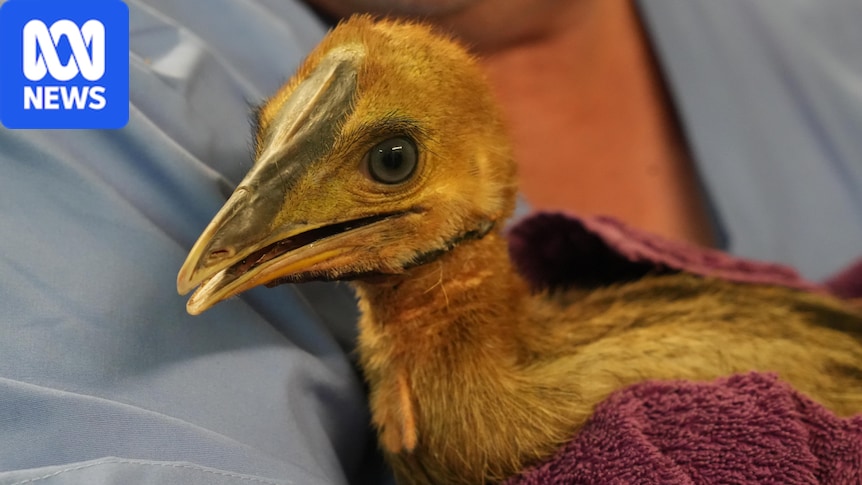
Cassowary advocates in Far North Queensland are questioning why a successful AI road sign trial hasn't been rolled out, as road deaths of the endangered bird almost double this year.Figures from the Department of the Environment, Tourism, Science and Innovation showed at least 22 cassowaries have been killed on Queensland roads so far in 2026.It is a jump from between 11 and 13 road deaths each year since 2022.Tropical Vets director Graham Lauridsen, who treats injured cassowaries, said the region had a cluster of fatalities earlier this year."There was a spate of deaths, sort of one after the other every week there for probably six or so weeks," Dr Lauridsen said.Locals living on cassowary country had hoped a solution was in sight.As hatching seasons comes to an end, more chicks and dads are expected on the roads. (Supplied: Jeff Larson)In July 2025, the Department of Transport and Main Roads (TMR) announced a trial, using artificial intelligence (AI) to detect cassowaries and activate a warning sign, had been successful.The technology was installed for three months on the Kennedy Highway at Kuranda, north-west of Cairns, with 97 per cent accuracy in identifying the birds and a 31 per cent decrease in birds fatally struck, the department said.After the trial, the Cassowary Recovery Team (CRT), a network of groups, experts and government staff who work with the birds, held a workshop to identify five road strike hotspots where signs could be installed.Liz Gallie, on the Cassowary Coast about 140 kilometres south of Cairns, said she understood the signs would be rolled out there next.The government announced the trial of the Ai signs was a success last year. (Supplied: TMR)"We were very excited that this is going to move forward … and so we're waiting and nothing is happening," the president of Mission Beach Cassowaries said.In correspondence seen by the ABC, Ms Gallie wrote to the minister in September with a reply in October saying more trials were needed but no plans had been made."We know where they're getting killed, we've got the technology, we just need it at Mission Beach," she said.Liz Gallie said every cassowary death impacted the Mission Beach community. (ABC Far North: Rosanne Maloney)Ms Gallie said every cassowary death affected members of the community."We just keep hearing when they're killed and it's like, 'Oh, not another one' — it hurts."Project stalledDr Lauridsen, who is also part of the CRT, said he also understood there had been no further plans to utilise the AI technology, but now was the time to act as hatching season ended.Liz Gallie says cassowaries are also a major tourism drawcard for the region. (ABC Far North: Rosanne Maloney)"This time of year, there's chicks on the road," he said."As soon as it can happen, it will absolutely have the potential to save lives."Dr Lauridsen said better reporting and a healthier population after several years without major cyclones may partly explain the rise in reported deaths.Graham Lauridsen said there had been a spate of cassowary road incidents this year. (ABC Far North: Rosanne Maloney)But he said that was no reason to halt efforts to protect the birds."If you stop, you'll regress, we'll be back where we were," he said."We know that cassowaries are going to have to cross the road perhaps more than they've done before."Having that technology where we know the hotspots are would be great."Graham Lauridsen said the birds were likely drawn to roads due to people feeding them. (Supplied: Graham Lauridsen)Dr Lauridsen said the AI signs avoided the complacency drivers developed with static signs.The signs also helped mitigate costs toward cassowary conservation and rehabilitation, he added.Community awarenessA TMR spokesperson said investigations were ongoing into how the AI road signs could be "incorporated into ongoing work to increase cassowary safety", but there was no further funding allocated or trials planned."The Queensland government is continuing to implement a community awareness program, including two [static] roadside billboards on the Bruce Highway near Tully and Innisfail, encouraging drivers to slow down and be aware of cassowaries," the spokesperson said.The AI road signs detect traffic, which triggers the sign to flash a warning. (Supplied: TMR)Jax Bergersen from the Kuranda Conservation Community Nursery said everyone involved in the CRT was frustrated after having high hopes for the signs."I'm afraid nature, the environment, is the thing that's put at risk," she said.
Calls for AI road signs after increased cassowary road deaths
Full Article
Original Source
Read the full article at Abc →KhanList aggregates and links to publicly available news content. We do not host full articles from third-party sources. Always verify important information with original sources.