
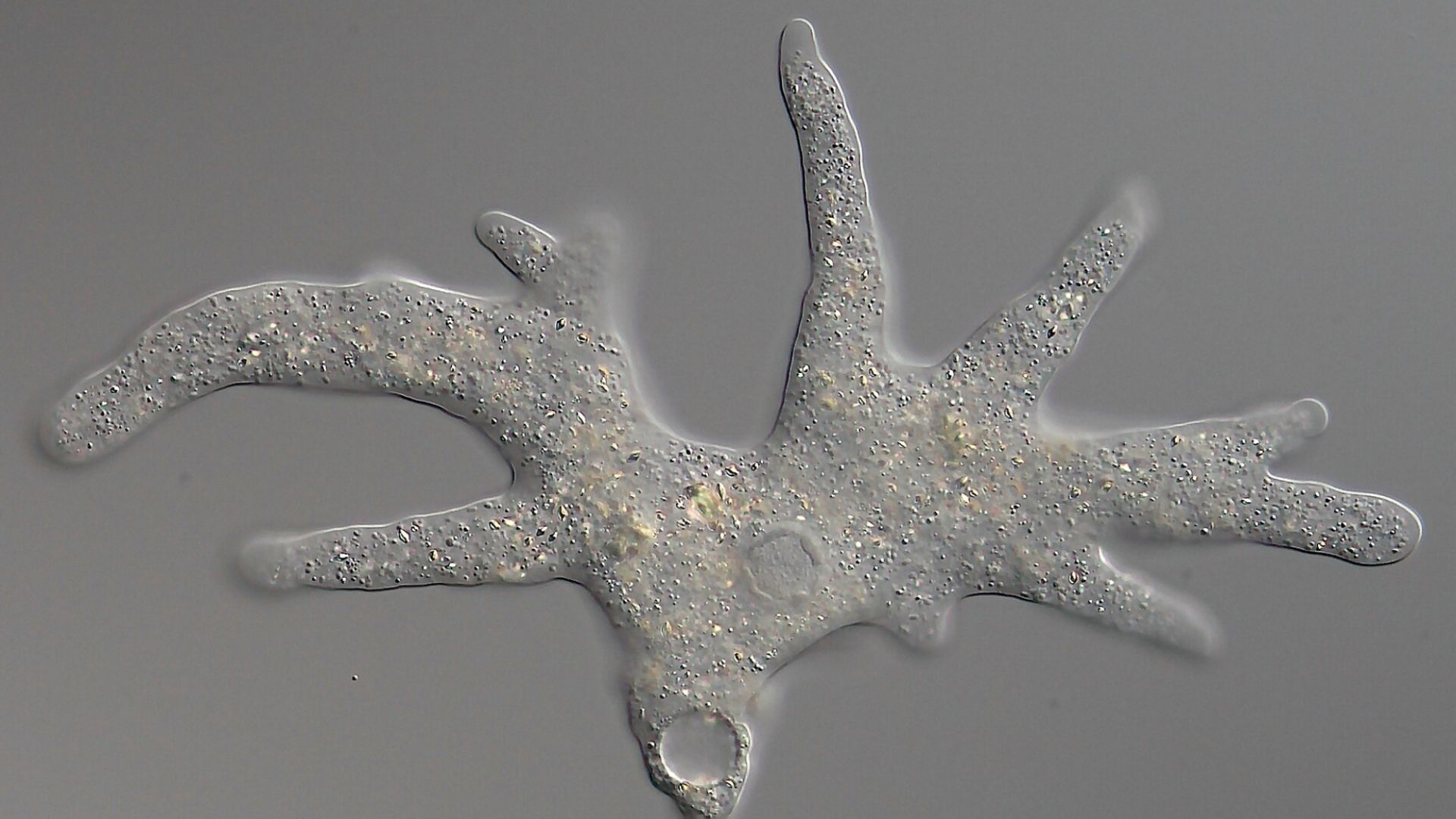
A single-celled organism collected from a steaming creek in California can reproduce at temperatures that would stop any other known complex life form. Researchers discovered the amoeba in Lassen Volcanic National Park and found that it could divide at up to 145°F. The team named the new species Incendiamoeba cascadensis, or “fire amoeba of the Cascade mountain range.” Their findings raise the known temperature limit for reproduction in eukaryotes – the group that includes animals, plants, fungi, and amoebas. A discovery in a steaming creek Syracuse University microbiologist Angela Oliverio and her colleagues collected water from a geothermal tributary of Hot Springs Creek. In the lab, PhD student Beryl Rappaport examined the samples under a microscope and spotted a cell changing shape and moving through the water. “That’s definitely an amoeba. That’s characteristic amoeba movement,” she said. Rappaport used extra-long barbecue tongs to lower the sample vials into the steaming water. The team’s tests showed that the organism could reproduce at temperatures up to 145°F and remain active at up to 147°F. It also recovered after exposure to 158°F when returned to cooler conditions. Reproducing at 145°F and recovering from a hotter exposure are separate findings: the amoeba does not multiply at 158°F. Genetic analysis confirmed that the researchers had found a previously undescribed species. How does the fire amoeba handle heat? High temperatures can damage the proteins and membranes that cells need to function. By comparing the fire amoeba’s genome with those of other amoebas, the researchers identified features that may help it keep those cellular components stable. The result is striking because eukaryotes have more complex cell structures than bacteria and archaea, some of which live at or above water’s boiling point. Those organisms have long held the most extreme heat records, while the temperature limits of many microscopic eukaryotes remain poorly understood. “So few have been described, especially in detail. We have a lot to learn from them,” Rappaport said. The new species suggests that scientists may find other heat-tolerant eukaryotes by looking more closely at geothermal environments. What the discovery could mean For Oliverio, the record matters because it shows that a previously assumed boundary can be crossed. “It wasn’t so much the incremental amount that this record was broken by, as much as the proof that it was possible,” she said. Understanding how the amoeba protects its cells could eventually inform research into temperature-stable medicines or heat-resilient crops. Those applications remain possibilities, however; the researchers have identified an organism with unusual abilities, not a ready-made way to transfer them to other species. The discovery also gives scientists another example to consider when asking where life might persist beyond Earth. For now, its clearest lesson comes from a small California creek: even among complex cells, researchers are still finding organisms that push the known limits of life. The findings were published in the journal Cell. Get the latest in engineering, tech, space & science - delivered daily to your inbox.Atharva is a full-time content writer with a post-graduate degree in media & amp; entertainment and a graduate degree in electronics & telecommunications. He has written in the sports and technology domains respectively. In his leisure time, Atharva loves learning about digital marketing and watching soccer matches. His main goal behind joining Interesting Engineering is to learn more about how the recent technological advancements are helping human beings on both societal and individual levels in their daily lives.
California’s ‘fire amoeba’ reproduces at 145°F, sets new heat record for complex life
Full Article
Original Source
Read the full article at Interestingengineering →KhanList aggregates and links to publicly available news content. We do not host full articles from third-party sources. Always verify important information with original sources.