
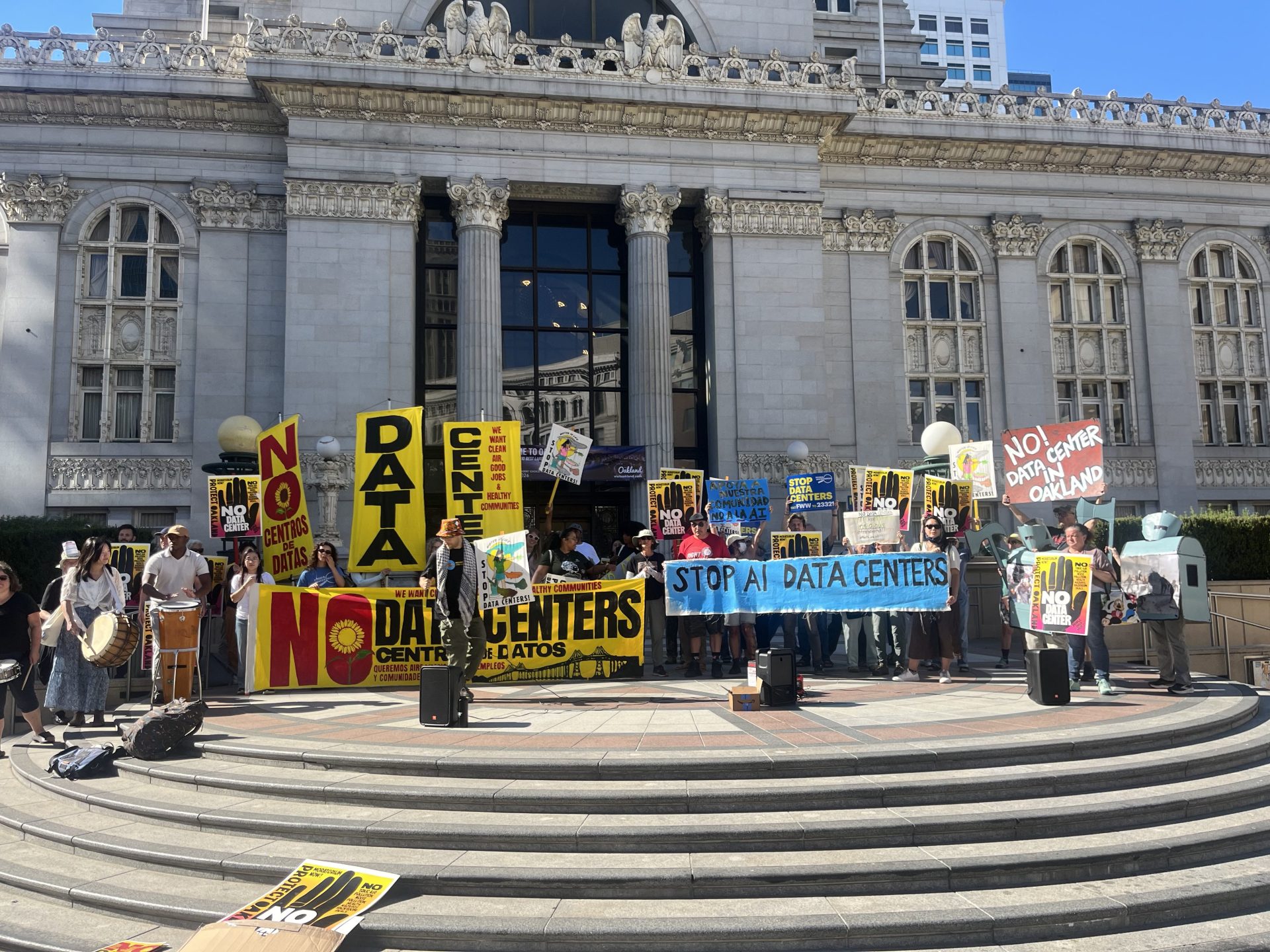
Oakland, California – Protesters dressed as cardboard robots chanted and danced to a drumbeat as they protested against new data centres outside Oakland City Hall last month.Their concerns largely focused on how the centres — which process large amounts of digital information — might strain the energy grid.Recommended Stories list of 3 itemslist 1 of 3Supreme Court rejects Trump request to set aside California ballotslist 2 of 3Mamdani’s progressive allies vie for seats in Congresslist 3 of 3Trump makes final midterms pitch at Lincoln Memorial Reflecting Poolend of listThe result, they argued, would not only be environmental harm but also sky-high electricity bills for local households.“Power prices have gone up so much in Oakland that some people are thinking of shutting off their power,” said Carlos Gutierrez, an activist for Communities for a Better Environment, an environmental justice group.“And the city is planning to provide power to a data centre instead.”Opposition to data centres is growing across the United States, as residents express concern about their rapid expansion.More than 3,000 data centres already operate in the country, with more than 1,500 others in development, according to the Pew Research Center.But the backlash is perhaps most striking in California’s San Francisco Bay Area, a region considered to be the heart of the artificial intelligence (AI) boom.Major AI companies such as Anthropic, OpenAI and Meta are based in the Bay Area, and the industry’s growth has been credited with fuelling a local economic renaissance.Data centres house the advanced computer chips and servers needed to run AI-powered services such as Anthropic’s Claude and OpenAI’s ChatGPT.But they also require 24-hour power and a large supply of water to cool their processors.Even with such cooling technology, data centres are notorious for emitting heat, leading to an increase in land surface temperatures as high as 9 degrees Celsius (16 degrees Fahrenheit).A couple sits on the steps of Oakland City Hall in California next to a sign that reads, ‘No data center in Oakland’ [Saumya Roy/Al Jazeera]A midterm election issueConcerns about the cost of rapid data centre growth, both environmentally and financially, have catapulted the issue into the discourse around Tuesday’s midterm elections.In the final two months before the vote, at least seven Bay Area cities, including San Francisco and Richmond, have passed temporary moratoriums on data centre construction.They include Oakland, which passed a data centre moratorium on October 6, after days of protest.Local politicians competing in Tuesday’s midterms have also used the topic as a wedge issue, to rally support among certain pockets of voters.One of the most closely watched races in the Bay Area is for the seat left vacant by longtime Democratic leader Nancy Pelosi. After 39 years in the House of Representatives, Pelosi is retiring at the end of the year.Two Democrats are competing in Tuesday’s election to fill her position in Congress: San Francisco Supervisor Connie Chan and state Senator Scott Wiener.Each one has staked out a different position on AI data centres. Wiener, for instance, opposes any ban on data centres.“A blanket data centre moratorium could undermine AI regulation,” he told the publication Mission Local.Chan, meanwhile, has pledged to seek a nationwide moratorium on data centres, at least until responsible AI regulation is put in place.“Let’s start with a moratorium on data centres. Allow us to have that moment to regulate artificial intelligence,” she said at a debate in October.Chan played a leading role in passing San Francisco’s moratorium in early October.A poll from the University of Southern California showed Wiener leading Chan 47 percent to 41, as of mid-October.Congressional candidate Connie Chan, left, stands next to outgoing US Representative Nancy Pelosi and former San Francisco Mayor Willie Brown at a campaign event in San Francisco, California, on May 29, 2026 [File: Manuel Orbegozo/Reuters]Navigating public backlash“Right now, data centre opposition is an issue that unifies the US public like no other,” said Shum Preston, a political analyst based in San Francisco.So far, there has been relatively little opposition to the data centre moratoriums in local hearings. But he speculates that there may be several reasons for the lack of pushback to the bans.Among them are the surveys indicating widespread public backlash to data centre creation.An October CNBC poll found that 63 percent of registered US voters oppose building data centres within 16 kilometres, or 10 miles, of their homes.“Data centres poll very poorly, and developers probably don’t want to put their supervisor friends in trouble ahead of elections. So they probably let this pass,” Preston said.He also signalled that the short-term nature of the moratoriums may be a factor.Certain Bay Area cities like San Francisco, Brisbane and Oakland paused construction on data centres for 45 days, with the option to extend the ban later.Opponents of the moratoriums “will be more vocal when” the 45 days end, Preston said. By that time, the heat of the midterm election season will also have settled, he added.“That’s when the hearings will get more contentious,” he said.Opponents of data centres have cited environmental costs as well as higher utility bills as reasons to ban their construction [Saumya Roy/Al Jazeera]Not long enough?Another hurdle facing the moratoriums is the lack of transparency surrounding data centre construction.Supervisor Shamann Walton, who sponsored San Francisco’s moratorium ordinance, has argued that the city’s definition of “data centres” is outdated.Created in 2001 — long before the AI boom — the city planning code defines data centres as “internet service exchanges”, a definition that may not accurately characterise the technology today.Walton said the outdated language has made it hard for authorities to count how many data centres exist in the city.Not being able to identify data centres can also prevent city officials from monitoring their power and water usage.“We cannot use 2001 rules to regulate 2026 technology,” he said in a September 14 statement.Another issue is the time it takes to carry out the necessary environmental assessments. The moratoriums may not offer enough time for a comprehensive review.“Forty-five days is hardly enough time to document and study the impacts and then frame regulations,” said Roger Lin, senior attorney at the Center for Biological Diversity, a US environmental nonprofit.He added that legal barriers limit access to such information from the data centres themselves.“Data centres often have nondisclosure agreements, so even local air quality boards may not know the impact of data centres on air quality,” said Lin.Supporters tout economic benefitsStill, AI industry supporters have touted the growth of the data centres as evidence of a flourishing industry, with positive downstream effects for US communities.Anthropic, for instance, is preparing an initial public offering (IPO) that is likely to raise billions of dollars.But critics warn that the company’s growth may not translate into an economic boom for the San Francisco Bay Area overall.Instead, residents fear unequal economic growth that primarily benefits the wealthy. Already, San Francisco faces some of the highest and fastest-growing home rental prices in the country.At a hearing at San Francisco City Hall, a resident vented their frustrations about the data centres to the supervisors.“This city is less for humans and more for robots and billionaires,” the resident said.
California’s Bay Area debates data centres ahead of US midterm elections
Full Article
Original Source
Read the full article at Aljazeera →KhanList aggregates and links to publicly available news content. We do not host full articles from third-party sources. Always verify important information with original sources.