
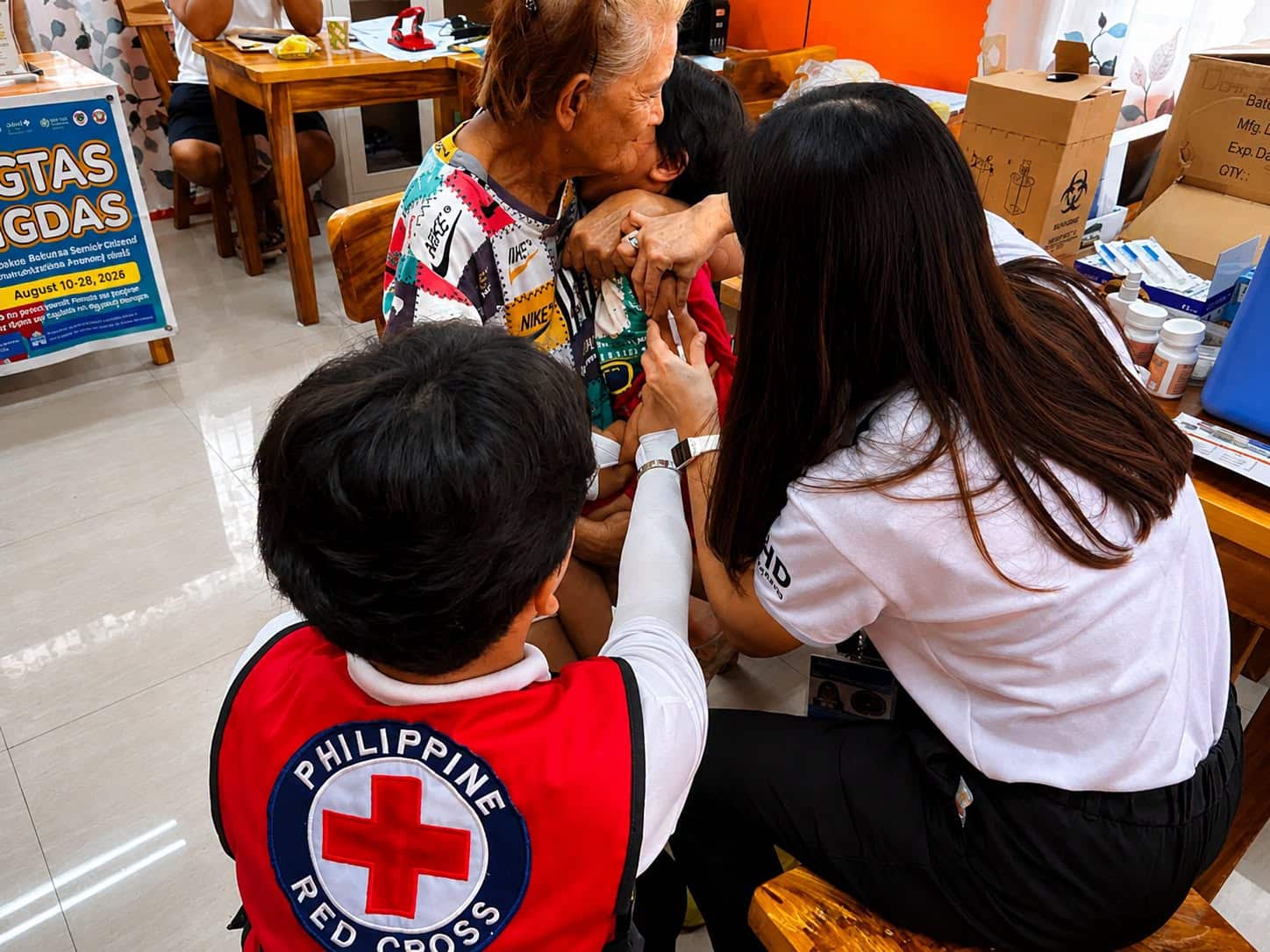
A health worker administers a measles-rubella vaccine to a child during the Ligtas Tigdas 2026 campaign in the Calabarzon region. (Photo courtesy Philippine Red Cross) LUCENA CITY — The measles-rubella vaccination campaign in the Calabarzon region reached 56.8 percent of its target population in 20 days , according to the Department of Health Center for Health Development (DOH-CHD) Calabarzon. Based on the agency’s accomplishment tracker, 758,454 children had received measles-rubella (MR) vaccines as of 10 p.m. Friday. The DOH-CHD had targeted 1,335,685 children 6 to 59 months old across Calabarzon under the Ligtas Tigdas 2026: Measles-Rubella Supplemental Immunization Activity (MR SIA). Article continues after this advertisement Meanwhile, 674,754 children had received vitamin A supplementation, equivalent to 47 percent of the region’s target population of 1,436,443. The MR SIA was originally scheduled from Aug. 10 to 28 but was extended until Sept. 4 due to heavy rains brought by the enhanced southwest monsoon, or “habagat,” in recent weeks. Despite falling short of its target, the DOH-CHD described the campaign as a success, citing the collective efforts of health workers, partners and communities. “Ligtas Tigdas is a success shared by everyone. Every vaccine administered, every piece of information shared, and every child protected is the result of our collective action and concern for their well-being,” the agency said. The DOH-CHD also thanked its partners, particularly the Philippine Red Cross, for helping implement the vaccination campaign. Article continues after this advertisement “As this campaign comes to an end, let us continue working together to protect the health of every child in Calabarzon,” the agency said. Among the provinces and cities in the region, Laguna recorded the highest vaccination coverage, with 192,027 children, or 71.7 percent of its target population of 267,908, vaccinated. Article continues after this advertisement It was followed by Cavite (199,834 of its 368,263 target children vaccinated, or 54.3 percent), Batangas (139,300 of 258,969, or 53.8 percent), Quezon (98,977 of 188,245, or 52.6 percent), Lucena City (14,290 of 27,987, or 51.1 percent) and Rizal (114,026 of 224,313, or 50.8 percent). Despite health authorities’ assurance that measles-rubella vaccines are proven safe and effective and provide the best protection against the diseases and their potentially serious complications, misinformation and misconceptions circulating on social media have posed challenges to the immunization campaign. Measles and rubella are caused by different viruses. Measles is caused by the rubeola virus, while rubella is caused by the rubella virus. Both are highly contagious diseases but can be prevented through vaccination. Your subscription could not be saved. Please try again. Your subscription has been successful. DOH data showed that the Philippines recorded 1,627 measles and rubella cases from Jan. 4 to March 21 this year, a 45 percent increase from the 1,121 cases reported during the same period in 2025. /gsg
Calabarzon measles-rubella vaccination hits 56.8% of target population
Full Article
Original Source
Read the full article at Newsinfo →KhanList aggregates and links to publicly available news content. We do not host full articles from third-party sources. Always verify important information with original sources.