
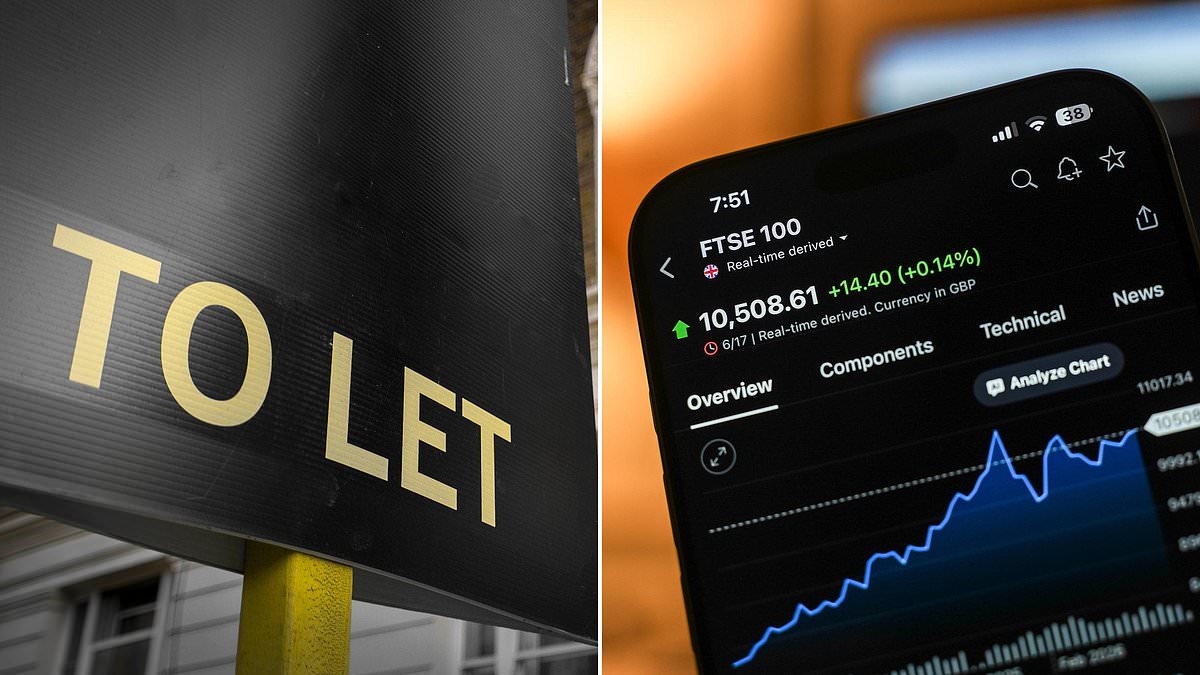
Landlords who bought buy to let property 30 years ago are likely to have made more money than those who invested in the stock market, analysis has revealed. Every £1 invested in UK buy to let property in late 1996 has generated £22.30 in total returns, according to the property firm Hamptons. This is after factoring in house price growth and net income from rent, and deducting running costs.It represents a total return of 2,130 per cent over three decades, narrowly outpacing the total return of 2,105 per cent on the S&P 500 index during that time, when factoring in capital growth plus dividends reinvested.The S&P 500 index tracks the share prices of 500 of the largest publicly traded companies in the US.Based on Hamptons' analysis, it means the average £10,000 buy-to-let investment since 1996 has returned £223,000 compared to £220,500 for those who invested the same amount in the S&P 500 index.Both property and US equities have delivered nearly three times the total returns generated by the FTSE 100, which lists the biggest 100 companies by market value on the London stock exchange. Safe as houses? £1 invested in UK buy to let in 1996 has generated £22.30 in total returns by 2026, nearly tripling the FTSE 100 return of £8.96 during that same time, says HamptonsThe FTSE 100 index has delivered £8.96 for every £1 invested in 1996, which is a 796 per cent return over 30 years.Meanwhile gold has returned £7.36 for every £1 invested in 1996 representing a 636 per cent over the same 30-year timeframe.Unlike many investments, the majority of buy to let returns have come from income from rent rather than capital growth alone.Over the last 30 years, nearly 62 per cent of total returns have come from rents paid by tenants, while the remaining 38 per cent has come from rising property prices.Stock markets now taking the lead More recently, stock market returns have outpaced buy to let profits. Higher property taxes and stricter regulations mean cumulative returns over the last five years from the S&P 500 stand at 75 per cent, the FTSE 100 at 73 per cent and residential buy-to-let at 41 per cent.The analysis does not take into account the different tax implications for property and stocks and shares.Many stock market investors will have benefited from being able to invest using an Isa, with the product first launching on April 6, 1999. These have shielded many UK investors from being taxed on both the income and capital gains generated from investments held within their Isa.In contrast, buy to let investors will typically have had to pay income tax on rental profits and capital gains tax when they sell.Buy to let is also a very different game today with much more regulation and higher tax implications.In 1996, the first wave of landlords was largely comprised of homeowning baby boomers in their 30s and early 40s looking to build long-term wealth through property ownership. Average house prices at the time stood at just £54,900.Today’s landlord looks markedly different. The average investor age has risen to 51 years, reflecting far higher capital barriers to entry created by rising house prices and larger deposit requirements. The average buy to let purchase now costs £360,600, more than six times its 1996 equivalent.'When the buy to let mortgage was launched in 1996, few predicted it would become one of the largest wealth-creation engines of modern British history,' said Aneisha Beveridge, head of research at Hamptons.'It opened the door to a new breed of middle-class investor seeking bricks-and-mortar security when buying property outright was out of reach. 'While these investors were in their 30s back in the 1990s, many remain landlords in their 60s today.'The number of younger landlords dabbling in buy to let on the side of a day job is increasingly rare.Many of today’s largest portfolios often started off life in the late 1990s, according to Beveridge, having accrued substantial equity through successive house price booms, creating equity which has often been reinvested. She adds: 'For a growing number of landlords, those properties are now part of a wider family business that is likely to be passed down to the next generation rather than being sold off in the face of rising tax rates.'Best mortgage rates and how to find them Mortgage rates have shot up again due to inflation triggered by the conflict with Iran reversing hopes that the Bank of England would cut rates. This means those remortgaging or buying a home face higher costs.That makes it even more important to search out the best possible rate for you and get good mortgage advice, whether you are a first-time buyer, home owner or buy-to-let landlord.This is Money's partner L&C can help you with its fee-free mortgage service.> Compare mortgage rates> Find the right mortgage for you To help our readers find the best mortgage, This is Money has partnered with the UK's leading fee-free broker L&C.This is Money and L&C's mortgage calculator can let you compare deals to see which ones suit your home's value and level of deposit.You can compare fixed rate lengths, from two-year fixes, to five-year fixes and ten-year fixes.If you’re ready to find your next mortgage, why not use This is Money and L&C’s online Mortgage Finder? It will search 1,000s of deals from more than 90 different lenders to discover the best deal for you.> Find your best mortgage deal with This is Money and L&C Mortgage service provided by London & Country Mortgages (L&C), which is authorised and regulated by the Financial Conduct Authority (registered number: 143002). The FCA does not regulate most Buy to Let mortgages. Your home or property may be repossessed if you do not keep up repayments on your mortgage.
Buy to let property has made bigger returns in the last 30 years than money held in stocks or gold
Full Article
Original Source
Read the full article at Dailymail →KhanList aggregates and links to publicly available news content. We do not host full articles from third-party sources. Always verify important information with original sources.