
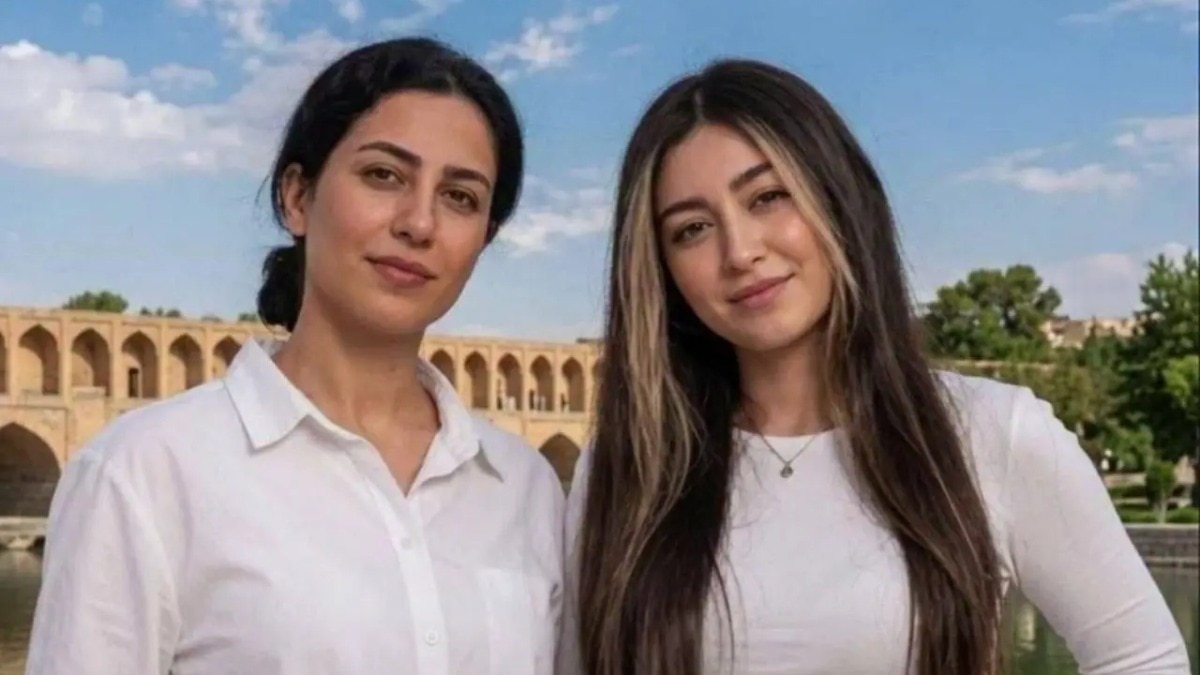
For four months, Marzieh Nourmohammadi searched hospitals, government offices, courts and prisons across Isfahan for her twin daughters, not knowing whether the then 19-year-old high school students were alive.The sisters had been taken from their beds by masked men after joining anti-government protests in Isfahan in January, along with nearly 1.8 crore others. The men were later identified as members of Iran’s Islamic Revolutionary Guard Corps. The twins were taken away with bags over their heads and their family was given no explanation about where they had been taken.Months later, a phone call finally came. "We have your girls, come to see them at the prison," the family was told, according to their US-based cousin Masoud Nourmohammadi.When their mother was finally allowed to see them at Dowlatabad prison in Isfahan in May, she could barely recognise her own children. "She did not recognise her own children," Nourmohammadi said. "She could only tell it was them when they started talking and she recognised their voice".The sisters' faces were swollen and bruised. Their elbows, knuckles and feet were injured, while patches of hair were missing from their scalps, according to the family's account. Nourmohammadi said guards had allegedly dragged the women from one cell to another by their hair. "They had swollen faces and bodies, broken knuckles and elbows and they didn't even have hair because the guards would drag them by the hair when they were in prison,” he told The Washington Post.Now, the family is facing a still more devastating prospect.Taraneh has been sentenced to death over her participation in the January protests, while Romina has received a 27-year prison sentence.The sisters' family has appealed and has now turned to the United Nations, asking for intervention before Taraneh's execution can be carried out. Taraneh Rahimi posing in Chadegan in the Iranian province of Isfahan. (Photo: AFP) A formal "submission of information" concerning the case was submitted to the UN through its special procedures by British human rights lawyers acting for the family. Such a submission can lead to a formal request by the UN to a member state for an explanation and action if the case is found to involve human rights violations."Turning to the United Nations is not something I ever wanted to have to do," Nourmohammadi said."I am simply asking the international community to help ensure that Taraneh and Romina receive the basic rights that every human being is entitled to a fair process, protection from torture and abuse, access to medical care and legal counsel and the right to have their cases genuinely reviewed."Taraneh is facing the death penalty and Romina is facing decades in prison. They are young women who should be thinking about their futures, not whether one sister will be executed and the other will spend the best years of her life behind bars."They are my family and I will continue to use every peaceful and legal avenue available. I ask the United Nations to stand with them before it is too late – especially for Taraneh," he told The Guardian.FROM HIGH SCHOOL TO A PRISON CELLTaraneh and Romina had been students when they joined protests that swept across Iran in January.According to their relatives, they took part in demonstrations in Isfahan on January 8 and 9, chanting anti-government slogans around Shohada Square. They had not previously participated in protests, the family says.The protests had spread across Iranian cities, with demonstrators calling for political change amid wider economic and social grievances.The twins were among 16 defendants later detained in connection with unrest around Shohada Square. During the protest there, two people died -- a member of the Revolutionary Guard and a homeless man.The defendants were accused of involvement in making Molotov cocktails and attacking Iranian security forces. They were also charged with moharebeh, or "waging war against God", a capital offence in Iran.The family disputes the allegations against the sisters and says there was no evidence that either woman had participated in violence.A video of Taraneh Rahimi, a 20-year-old imprisoned protester from Isfahan and a horse training and equestrian instructor, has been circulated on social media.Taraneh Rahimi is one of the twin sisters arrested in the case known as the "Shohada Square" (Martyrs' Square), who has pic.twitter.com/SDfTAo4L21— IranWire (@IranWireEnglish) September 2, 2026In July, the twins and the other defendants were brought before a court set up inside an Isfahan prison. At the end of August, Taraneh was sentenced to death along with nine others."There is no evidence against them and they didn't even let their lawyers read the case until two weeks after they were sentenced. They are just looking for people to hang. All [my cousins] did was protest and chant along with millions. They didn't do anything wrong," Nourmohammadi added.According to human rights activists, before the trial, lawyers for the defendants had not been given access to a substantial portion of the case file and had objected that they had insufficient time to review documents and evidence.Nourmohammadi said the family feared the normal appeal process might not protect Taraneh.CONFESSION EXTRACTED THROUGH TORTUREThe most disturbing allegations surrounding the case concern how the sisters were treated during their detention.According to their family and people familiar with the case, the twins were held separately in solitary confinement. Despite being isolated from each other, they were able to hear each other screaming and crying as they were tortured.The sisters spent their first three months in a detention centre run by the intelligence arm of the IRGC, according reports.Relatives and lawyers familiar with the case alleged that the torture included severe beatings, psychological abuse and sexual assault. They said the women were made to watch male prisoners being tortured and were tortured separately while being kept close enough to hear one another.Taraneh suffered particularly serious injuries, her family says.According to lawyers and relatives, she was repeatedly beaten with a baton on her leg, knee, hand and arm. Her knee, which had previously undergone surgery, was allegedly subjected to deliberate pressure during interrogation."They tortured her knee, elbow and knuckles," Nourmohammadi said."What went beyond even this is that the kids (arrested in the protests) were tortured in front of each other. They would torture one person after another. They made sure that Taraneh could hear Romina's screams while she was being tortured," he added.Her mother claims prison guards threatened to sexually assault Romina in front of Taraneh if she refused to sign a confession. Lawyers for Taraneh said she later told the court that admissions attributed to her had been extracted under torture.The family also alleges that the sisters were subjected to sexual abuse while in detention. Taraneh was punished by prison staff by being denied normal meals and being given leftovers from other prisoners."She was told, 'It does not matter how you die, you will be hanged anyway', her family told news agency AFP, describing what he said was continuing physical and psychological torture. Romina and Taraneh Rahimi. (Photo: X/Alex kennedy) For their mother Marzieh, the case began not with a courtroom or a death sentence, but with a frantic search for two daughters who had simply disappeared.She had raised the twins alone.After the sisters were taken, their mother went from hospitals to courts and government offices trying to find them. The family did not know where they were being held. And when the reunion happened in prison, it was devastating for her.Before their arrest, the sisters' lives were far removed from the prison cells where they now face dramatically different futures.Nourmohammadi described Taraneh as kind-hearted, an athlete and someone deeply passionate about horses. She rode competitively and trained horses and dreamed of eventually opening her own horse-training centre or stable.Romina, meanwhile, was described by her cousin as fiercely independent, brave and intelligent.The sisters had worked part-time at a shoe shop near Shohada Square, the area where the protests erupted.Their lives reflected the aspirations of many young Iranians seeking greater freedom. Romina was interested in fashion, had bleached streaks in her hair and often wore it uncovered. She also posted about smoking on social media.Nourmohammadi believes the severity of Taraneh's sentence is intended not only to punish the young woman but also to send a warning to others who might protest. He accused the Iranian authorities of using his cousins to instil fear as the government continues its crackdown on dissent.The family now waits for the appeal process while fearing that Taranehs execution could be carried out before it is completed.- Ends
Broken bones, ripped-out hair, one facing execution: Iranian twins in jail over protests
Full Article
Original Source
Read the full article at Indiatoday →KhanList aggregates and links to publicly available news content. We do not host full articles from third-party sources. Always verify important information with original sources.