
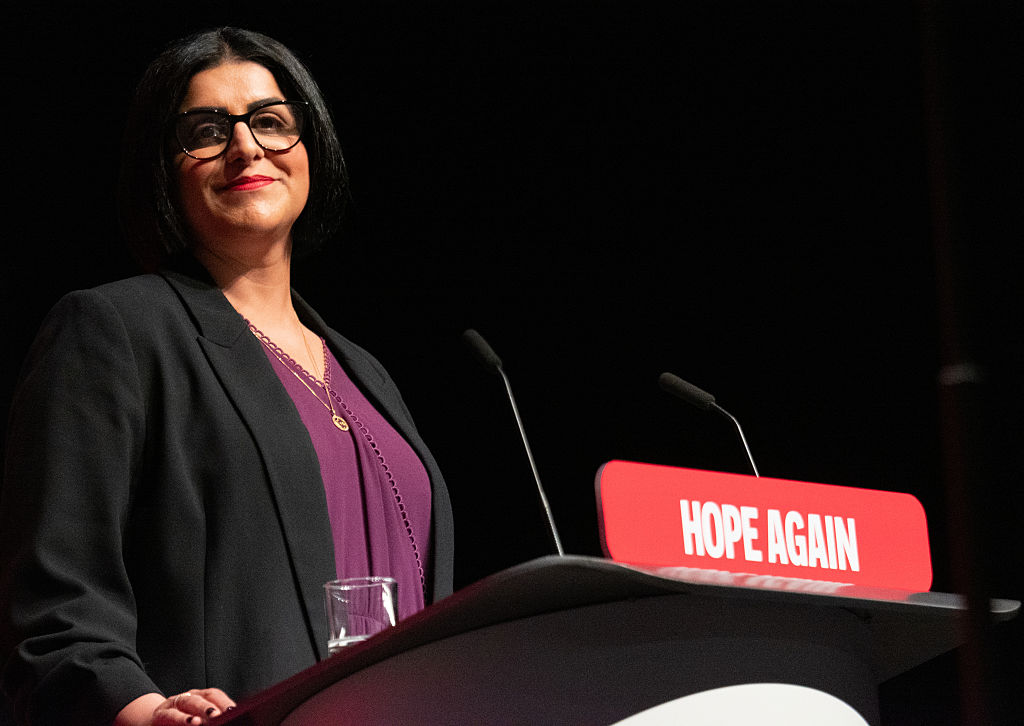
UK Special Coverage Shabana Mahmood aims to create “safe routes” for refugees. UK Special Coverage (Gary Roberts/SOPA Images/LightRocket via Getty Images) Any hopes that Prime Minister Andy Burnham’s government would get to grips with Britain’s migration crisis were dashed at the Labour Party conference in Liverpool at the end of September. To the delight of the party faithful, Home Secretary Shabana Mahmood indicated the government would instead keep Britain’s borders wide open for the foreseeable future. Mahmood suggested she would water down her own proposals to make permanent residency harder to obtain for economic migrants, and she announced the government would open new “safe routes” for refugees. Although the modern Labour Party is overwhelmingly in favor of mass migration, viewing any attempt to control the borders as borderline fascistic, there was every reason to believe Mahmood would be different. Since she was appointed as home secretary by Keir Starmer last year, she has presented herself as a no-nonsense, commonsense politician who understood the public mood. She has been championed by the Blue Labour faction of her party, which fuses traditional left economics with social conservatism and patriotism. And, as I wrote previously in The American Conservative, she has argued convincingly that tensions over migration could easily rebound onto long-settled minority communities. Indeed, Mahmood had even set out a wide-ranging set of reforms to what’s known in Britain as “indefinite leave to remain” (ILR)—a form of permanent residency for migrants, short of full UK citizenship. Last year, she proposed extending how long migrants would have to wait before obtaining ILR from five years to 10 years, and to 15 years in the case of care workers. The reforms were proposed to stave off the fiscal crisis that’s likely to result from the so-called “Boriswave” of migrants let in under Boris Johnson’s Conservatives. The 2.5 million migrants who arrived between 2021 and the 2024 election are becoming eligible for ILR and, crucially, entitled to access the welfare state. According to Mahmood’s 2026 white paper, care workers and their dependents alone would cost up to £10 billion over their lifetimes. Reform UK, the party that hopes to oust Labour in the next elections, estimates that, unless the whole system is changed, the lifetime costs of the roughly 1.6 million migrants set to be granted ILR between 2026 and 2030 could amount to as much as £154 billion. When Burnham took the reins of power at Number 10, Mahmood was one of the few cabinet ministers to be reappointed to her post. The message this seemed to send was that Burnham understood the scale of the coming disaster and that Mahmood’s reforms would go ahead. But this plan failed to survive contact with the patrician instincts of the Labour Party. Angela Rayner, former deputy prime minister, decried the proposals as “unfair” and “un-British.” More than 100 Labour MPs—around a quarter of the parliamentary party—are also opposed to the reforms and thus could have easily defeated them in the House of Commons. Hence Mahmood’s about-face at the Labour conference. Labour MPs’ hostility to the reforms exposes the chasm between the priorities of the party in power and those of the public. An unprecedentedly large cohort of migrants, most of whom are either low-skilled or dependent on family members, is about to gain permanent residency, as well as access to Britain’s suicidally generous welfare state. As well as being fiscally ruinous, this prospect—for ordinary Brits at least—feels like a violation of the social contract. Benefits that were once intended for citizens falling on hard times are about to be handed out to foreigners whose only qualification is having lived in the country for five years. Yet to the patricians and do-gooders in the Labour Party, the real “injustice” is that non-citizens may have to wait longer to access those benefits. Labour MPs have been especially exercised about the 15-year wait that was initially envisaged for care workers. So much so that Mahmood said the government would take accusations of unfairness into account when finalizing reforms. Burnham himself has mooted a carveout for carers, telling LBC that he wants to “recognise” the importance of foreign care workers and “what they are doing day in, day out” because “we cannot do without them.” Yet this is to fundamentally misunderstand why the rules on care workers needed to be tightened in the first place. Between 2021 and 2024, the health-and-social-care visa was an immigration free-for-all. In 2023, dependents brought to the UK via this visa route, for the first time on record, actually outnumbered the sponsored workers themselves, with roughly 260,000 family members for 225,000 carers. When broken down by nationality, the insanity becomes clearer. Bangladeshis brought more than five dependents per worker with them to the UK. Around 2,400 Indian care workers were joined by 10,500 family members. Just 12 health-and-care workers from Cameroon sponsored a total of 180 family members—a ratio of 15 dependents per care worker. What’s more, around 100,000 certificates to sponsor migrant care workers were granted to companies that were either struck off or suspended for underpaying workers or securing visas for non-existent jobs. Yet despite the scale of fraud and abuse that brought these people to the UK, every single one will soon be eligible to take up permanent residence and access the welfare state. They will be under no obligation to continue working in the care sector—and they will likely earn more from not working and claiming welfare. By backing away from her own reforms, Mahmood is ensuring that the costly, socially destructive impact of the Boriswave will be locked in forever. As if the ILR U-turn were not enough vandalism for one speech, Mahmood also announced to party members that new “safe routes” would be established for refugees from Palestine and Afghanistan. Although she was eager to portray this as a small intervention, leading to at most a few thousand refugees being rehoused in the UK, this promise will be impossible to keep. After all, as long as British judges take their marching orders from the European Convention on Human Rights and the UN’s Refugee Convention, then there is no upper limit whatsoever to how many people will be brought to Britain under this scheme. Subscribe Today Get daily emails in your inbox One need only look at a few recent cases of Palestinian refugees to see how Mahmood’s “safe routes” will work in practice. In February 2025, a Palestinian family of six was granted the right to join their brother in the UK under the terms of the Ukraine Family Scheme, a refugee-resettlement program established for Ukrainians with British family members. In July, a Palestinian mother of three won the right to bring 18 members of her extended family to the UK from Gaza—including her parents; a brother, his wife and four children; a sister and her four children; and another sister, her husband, and three children. The immigration-tribunal judge acknowledged that, since most of the family do not speak English and the applicant could only accommodate her own parents, they would need recourse to public funds. Whatever Mahmood says or intends for her new safe routes, she is giving an inch to activist immigration judges who are certain to take a mile. Worse still, Mahmood has granted these concessions at a time when immigration remains the most pressing issue for the British public—and is still totally out of control. Tens of thousands of men from unknown parts continue to sail unencumbered into Britain via the English Channel. Tens of thousands of “skilled worker” visas are still being doled out by businesses that are obvious fronts. Universities and colleges have been turned into visa mills, granting residency and the right to work to “master’s students” who can barely speak English. The border is already wide open, yet the government’s priority is now to prise it open further. In shelving her permanent-settlement reforms, Shabana Mahmood may have staved off a rebellion from within her own party. But it is the fury of the British people that Labour will now have to contend with. A government that puts pandering to its base ahead of the national interest will not easily be forgiven.
Britain’s Home Secretary Signals She’ll Keep the Borders Open
Full Article
Original Source
Read the full article at Theamericanconservative →KhanList aggregates and links to publicly available news content. We do not host full articles from third-party sources. Always verify important information with original sources.