
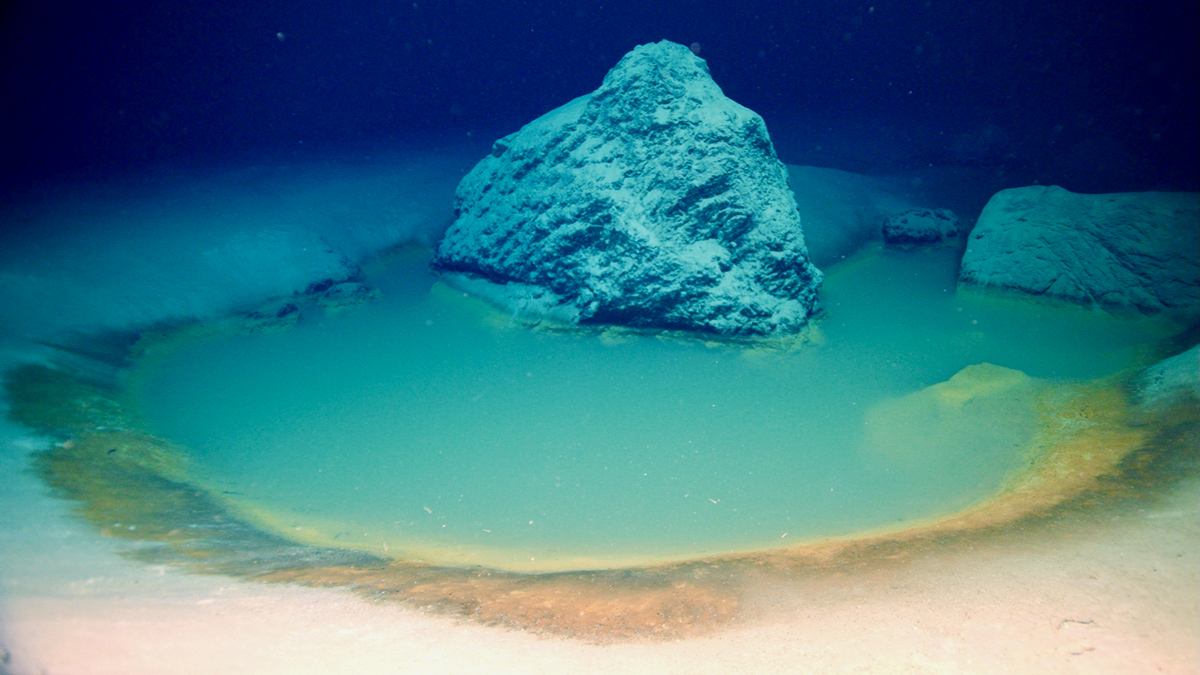
A deep-sea brine pool, one of the most extreme environments on Earth, is shown here in the northern Red Sea, surrounded by metalliferous sediments. Credit: OceanXplorer Source: AGU Advances The origins of the earliest life on Earth, prior to the rise of oxygen and photosynthesis, remain a mystery. Graveyards in brine pools at the bottom of the Red Sea may hold some answers. Brine pools are underwater ponds or lakes that sit at the bottom of the sea. They’re dark, full of salt, and devoid of oxygen. For years, they were presumed to be lifeless. But research revealed that for certain extremophiles, these brine pools aren’t inhospitable: They’re oases. And the bacteria and archaea that thrive there leave geochemical signatures long after they’re gone, Chakraborty et al. show in a new study. The researchers analyzed the geochemical composition of sediments and organic matter in an active brine pool, three nonbrine seafloor spots, and a spot they suspected was an “extinct” brine pool based on mineral rings around a depression filled with dead marine organisms. They used metagenomics and metatranscriptomics to characterize the microbial communities at the sites. The active pool, 1,770 meters below the surface of the Red Sea, was teeming with bacteria and archaea. And the sediments under the microbial mat were extremely enriched in metals like manganese, iron, molybdenum, and copper, with some areas hosting concentrations upward of 100 times higher than their non–brine pool counterparts. The extinct pool, nearly 1,400 meters below the sea surface, had similar enrichment patterns. The presence of oxidized manganese and molybdenum-enriched organic matter in the sediments of both the active and extinct brine pools will improve interpretations of similar patterns in the rock record. Metagenomic analyses of the active pool revealed manganese oxidizers such as Nitrospira. That finding, together with oxidized iron-manganese phases in the sediment, offers some evidence that microbial oxidation of Mn(II) to manganese oxides could have served as a mechanism for energy production prior to the rise of atmospheric oxygen during the Great Oxidation Event around 2.4–2.2 billion years ago. Overall, though the authors note that more research is needed, the findings support hypotheses that metal enrichment in the early oceans could have occurred independently of oxygenic photosynthesis or photoautotrophy. Chemotrophic oxidation of manganese and iron could well have been the engine of the earliest life in the oceans. (AGU Advances, https://doi.org/10.1029/2026AV002570, 2026) —Rebecca Dzombak, Science Writer Citation: Dzombak, R. (2026), Briny “death pools” hold clues to early life, Eos, 107, https://doi.org/10.1029/2026EO260301. Published on 22 September 2026. Text © 2026. AGU. CC BY-NC-ND 3.0Except where otherwise noted, images are subject to copyright. Any reuse without express permission from the copyright owner is prohibited.
Briny “Death Pools” Hold Clues to Early Life
Full Article
Original Source
Read the full article at Eos →KhanList aggregates and links to publicly available news content. We do not host full articles from third-party sources. Always verify important information with original sources.