
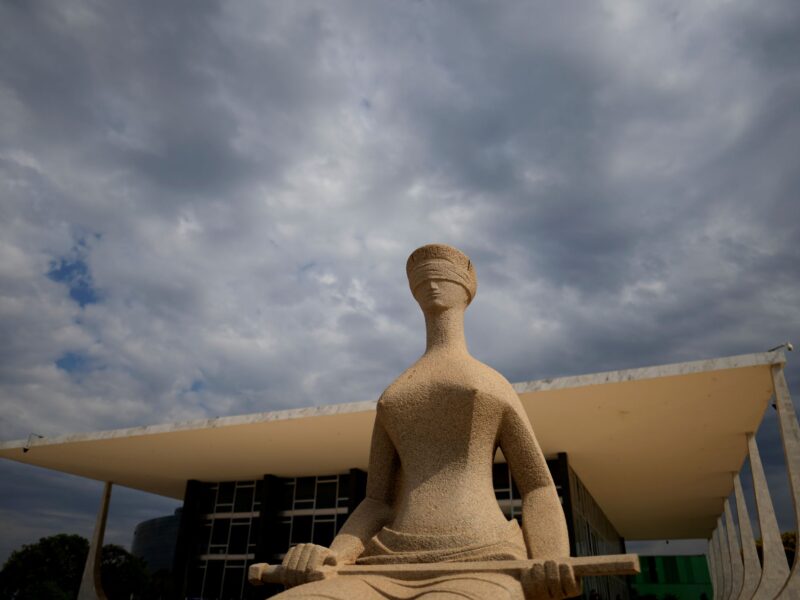
Presidential candidate Flávio Bolsonaro’s allies could curb the court’s powers and influence its makeup, with implications for judicial independence and minority rights.RIO DE JANEIRO (CN) — The right-wing majority taking office in Brazil’s Senate in 2027 could shake up the Supreme Court’s jurisdiction and composition, with consequences for judicial independence and the protection of minority rights.Removing a Supreme Court justice through impeachment requires 54 votes. At least 49 senators in the new chamber are expected to be aligned with Liberal Party of presidential candidate Flávio Bolsonaro after last Sunday’s congressional elections — enough to approve constitutional amendments if they vote together.With 19 newly elected senators, the Liberal Party now holds 28 of the chamber’s 81 seats.Bolsonaro will face President Luiz Inácio Lula da Silva in the Oct. 25 runoff. His platform includes proposals to strip the Supreme Court of jurisdiction over criminal cases involving public officials and limit rulings issued by individual justices.His allies also advocate impeaching Supreme Court justices.In September, Senate President Davi Alcolumbre said 109 impeachment petitions against members of the court were pending. The Senate has never approved an impeachment petition against a Supreme Court justice.Marjorie Marona, a political science professor at the Federal University of Minas Gerais and coordinator of the university’s Observatory of Justice in Brazil and Latin America, said impeaching a justice remains difficult, “but it is no longer unthinkable.”Marona said the election for Senate president in February will be a key moment because whoever holds the position controls the chamber’s voting agenda and decides whether impeachment petitions move forward.Rodrigo Brandão, a constitutional law professor at Rio de Janeiro State University, said impeachment should address criminal misconduct. Using it to retaliate against rulings or change the court’s approach to interpreting the law would violate judicial independence, he added.Marona added that proposals with support beyond the Bolsonaro movement have the best chance of advancing, including limits on rulings issued by individual justices.Proposed constitutional amendment 8/2021, which restricts individual rulings suspending laws or actions by the heads of the other branches of government, passed the Senate by a vote of 52-18 and cleared the lower house’s Constitution and Justice Committee in 2024.Marona said stripping the Supreme Court of criminal cases involving public officials is also gaining momentum and is the new bloc’s central proposal.Brandão said reducing the court’s criminal jurisdiction could shield it from cases with a strong political dimension.“The Supreme Court lacks the expertise to gather evidence and conduct criminal proceedings,” he said.These changes require a constitutional amendment, with approval from 308 lower house members and 49 senators in two rounds of voting in each chamber.Brandão said Congress can change the Supreme Court’s jurisdiction as long as it preserves the separation of powers and the court’s independence.João Feres, a professor at Rio de Janeiro State University’s Institute of Social and Political Studies, said the 1988 Constitution tasked the Supreme Court with protecting rights even against the wishes of the majority.He said the court also created distortions by filling gaps left by Congress and concentrating in individual rulings matters that should have gone before a panel of justices.Feres said correcting the overuse of individual rulings differs from allowing Congress to overturn constitutional rulings. In that scenario, the legislative majority would control the very limits it must abide by, he added.“Under that arrangement, rights are no longer guaranteed. They are tolerated as long as the majority consents,” he said.Feres said changes to the court’s composition could reverse rights recognized through judicial rulings, such as same-sex unions, recognition of gender identity and the criminalization of homophobia, without the need to pass new laws.He added that affirmative action policies, Indigenous land rights and protections involving criminal proceedings, labor and social security also depend on the Supreme Court’s constitutional review.“For ordinary citizens, who have no lobby or legislative bloc, the court is the only place in the system where they can win while being in the minority,” Feres said. “That is what is lost, not a privilege for those in judicial robes.”The next president could also nominate up to four of the court’s 11 justices, subject to Senate approval: three to replace justices reaching mandatory retirement age and one to fill retired Justice Luís Roberto Barroso’s seat if it remains vacant.In April, the Senate rejected Lula’s nomination of Jorge Messias to replace Barroso by a vote of 42-34 —the first rejection of a Supreme Court nominee in 132 years.The election also comes amid a growing fracture within the court itself.Courthouse News reporter Marília Marasciulo is based in Brazil.Subscribe to our free newslettersOur weekly newsletter Closing Arguments offers the latest about ongoing trials, major litigation and rulings in courthouses around the U.S. and the world, while the monthly Under the Lights dishes the legal dirt from Hollywood, sports, Big Tech and the arts.Additional Reads
Brazil’s right-wing Senate majority sets stage for Supreme Court overhaul
Full Article
Original Source
Read the full article at Courthousenews →KhanList aggregates and links to publicly available news content. We do not host full articles from third-party sources. Always verify important information with original sources.