
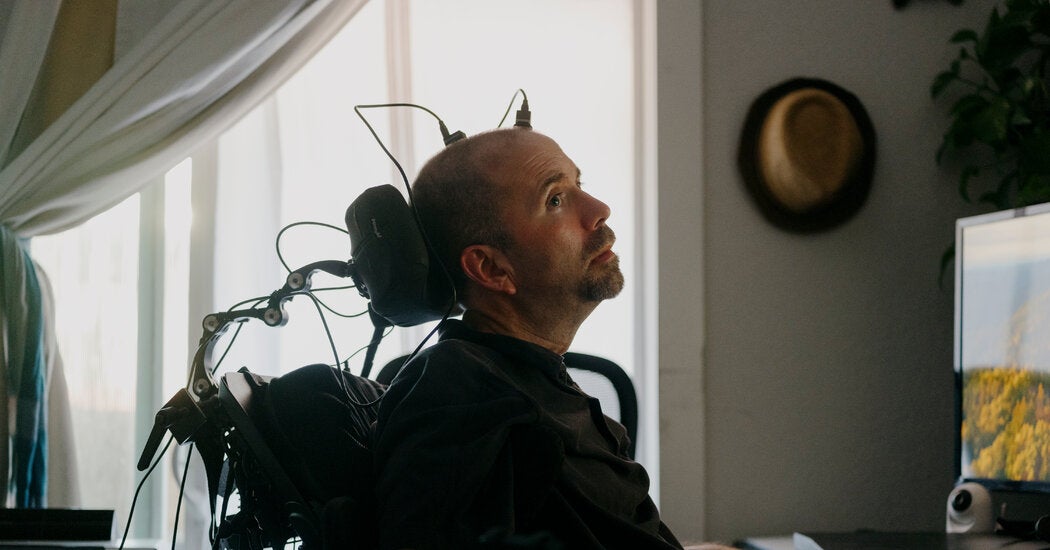
AdvertisementSKIP ADVERTISEMENTIn one demonstration, a former singer sang a musical scale. Afterward she cried tears of joy.VideoA patient given a musical scale prompt on a screen was able to sing the scale using an implanted brain-computer interface device.CreditCredit...Wairagakar et al., 2026Nov. 14, 2026, 12:00 p.m. ETBrain signals from a 46-year-old man who lost his voice to A.L.S. were decoded by experimental brain implants and translated directly into intelligible speech. A 58-year-old woman, a trained singer, whose voice was gradually silenced by the disease, was able to sing a musical scale.The new advances from researchers at the University of California, Davis, to be presented next week at the Society for Neuroscience conference in Washington, demonstrate that research into brain-computer interfaces are crossing from proof-of-concept demonstrations into everyday usefulness.“This system, for the first time, is good enough,” said Cindy Chestek, a biomedical engineer at the University of Michigan who was not involved in the new work. “Good enough for real communication. It’s good enough to sing.”For years, brain implants paired with increasingly powerful A.I. have been shown in remarkable case studies to restore a person’s ability to communicate, ask questions, even make jokes. The sense of connection that the technology provided to patients — who had lost control of the muscles that allowed them to speak, from A.L.S. or a stroke — could be profound, but was also halting, because systems translated signals first to text, then to speech.A person would attempt to speak, and electrodes surgically implanted in the brain would detect electrical signals. Software would decode those signals into phonemes, the sonic building blocks of words. Participants would watch words appear, one by one, on a screen, building a sentence. They would then trigger a cursor click to signal that they were done. Then, a computer-generated version of their voice would speak.Research subjects could convey their thoughts in rich detail, but on a slight delay, which made it hard to truly join conversations. People often communicate with the rhythm, timing and emphasis of their speech, not by composing full responses and mentally hitting “send.”“Imagine you can only speak just by texting for the rest of your life — that’s not sufficient, right?” said Maitreyee Wairagkar, a neuroengineer at the Neuroprosthetics Laboratory at the University of California, Davis, who led the work on the two patients.One of them, Casey Harrell, a climate activist who lost his voice to A.L.S., began participating in the study at U.C. Davis in 2023, when four arrays with 256 electrodes were surgically implanted in his brain. He was 45. He has used the system to generate nearly 2 million words over two years, including conversations with his family, messages to friends and writing emails and browsing the internet on his laptop for work.In 2025, the team published news in Nature of a remarkable feat of real-time expressive speech generation — direct, brain to voice — with just a 10-millisecond delay.ImageCasey Harrell, an activist who lost his voice to A.L.S., in 2024. He has been using the system since 2023, generating nearly 2 million words over two years.Credit...Ian C. Bates for The New York TimesThe feat was impressive, but came with limitations. The people listening could accurately transcribe only a bit more than half of his spoken words.In the new work, described in a preprint, the researchers fine-tuned the algorithms and showed that by reanalyzing the same dataset, they could increase the intelligibility of words by up to 94 percent.“I think this is really clinically meaningful improvement and not just impressive machine learning,” said Christian Herff, who leads the Neural Interfacing Lab at Maastricht University in the Netherlands and was not involved in the study.Mariska Vansteensel, a brain computer interface researcher at University Medical Center Utrecht in the Netherlands, applauded the work, but said that because it was testing the technology on data that had already been collected, it would be important to see how well it worked in real time, and to see how well it works in people with different degrees of speech loss.She added that for such systems to be useful outside of a research context, they will need to be fully implantable, unlike the systems that currently require participants to be tethered to a computer through ports in their skulls. Companies such as Neuralink and Paradromics are developing and testing wireless systems, but it remains to be shown how those technologies work.In a second experiment being presented by the same team, a participant with A.L.S. who could no longer speak intelligibly when she enrolled in the study had 384 electrodes implanted in her brain. This patient, known as T21, attempted to sing and modulate the tone of her voice, controlling the nuances in pitch that can mean the difference between asking a question and saying something happy or angry.As the speech-generating capabilities of these systems have improved, research teams have also begun focusing on other essential facets of human communication, ranging from gestures to tone.“They’re not just for essential communication, they’re expressive too; you can show more of your personality,” Dr. Wairagkar said. That research is ongoing and the finding is preliminary and unpublished.With the advancements, participant T21 was able not only to recreate the musical qualities of conversation, using a questioning or joyful tone — she could also sing a scale. The experience was so profound, Dr. Wairagkar recalled, that afterward, the former singer had cried tears of joy.Carolyn Y. Johnson is a reporter covering science and medicine for The Times.Related ContentAdvertisementSKIP ADVERTISEMENT
Brain Implants Give A.L.S. Patients the Voice to Speak and Sing
Full Article
Original Source
Read the full article at Nytimes →KhanList aggregates and links to publicly available news content. We do not host full articles from third-party sources. Always verify important information with original sources.