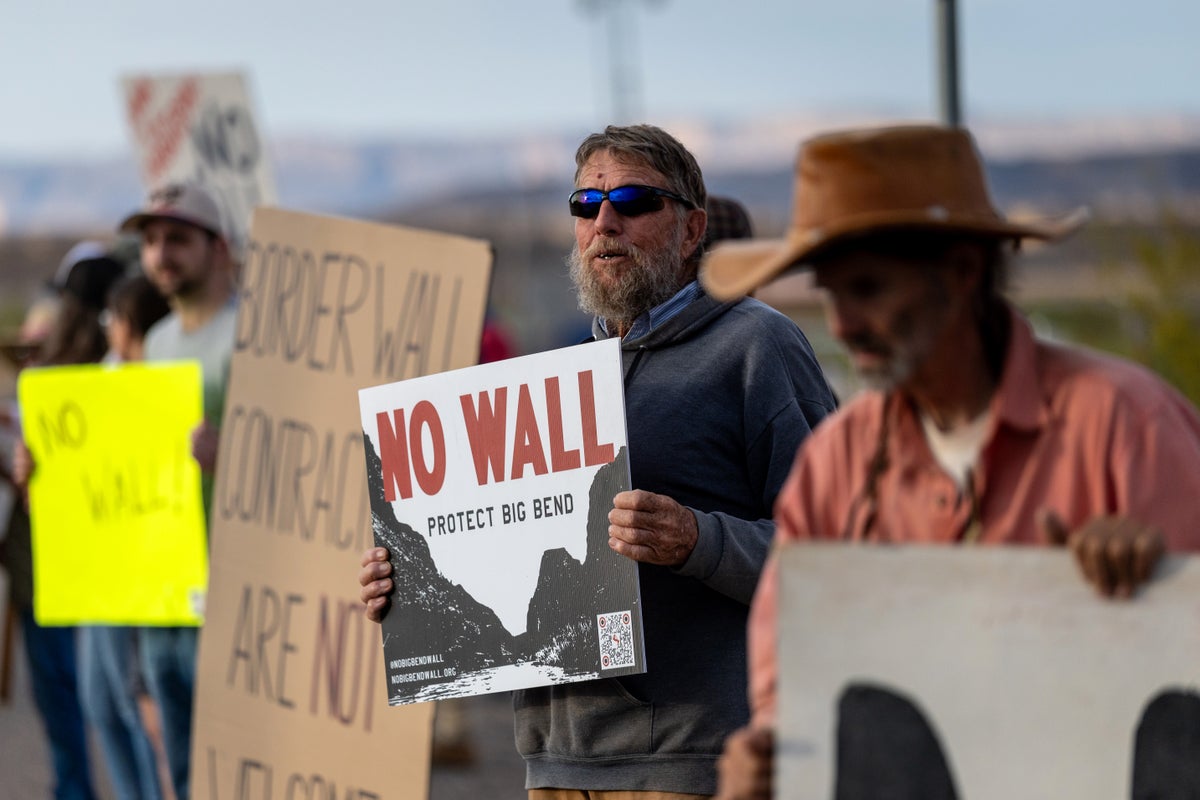
The head of U.S. Customs and Border Protection is defending a $1.7 billion plan to install barriers and other infrastructure in a national park on the Mexican border — despite opponents who say it would needlessly transform the far West Texas landscape.Commissioner Rodney Scott said the barriers were needed to keep Big Bend National Park “safe, secure, and pristine so American families can enjoy the beauty of our country, free from fear of cartel activity, for generations to come.”Scott also reiterated that the project had been scaled back from an earlier plan to erect a controversial border wall, saying, “We are NOT building a 30-foot wall or stadium lighting through Big Bend National Park, Big Bend Ranch State Park, or the Black Gap Wildlife Management Area.”“What people are seeing right now is survey and design work — NOT construction of a wall through the park,” he said in a statement posted on the CBP website. “We are working to preserve the landscape and protect the access visitors and local businesses depend on.”But foes of the project remained fiercely opposed, with Terrell County Sheriff Thaddeus Cleveland — a Republican and former Border Patrol agent — saying on social media that “if the facts on the ground showed a need for a barrier here, I would support it. They don’t.”Locals protest a border security plan for Big Bend National Park on April 11, 2026, in Terlingua, Texas (Getty)“In the Big Bend, decisions about security and infrastructure should be driven by demonstrated need and the realities on the ground, not simply by applying the same solution to every mile of the border,” he wrote. “This is our home. We know the terrain, we know the challenges, and we know what our communities and law enforcement face every day.” Laiken Jordahl of the Center for Biological Diversity, a non-profit advocacy group in Tucson, Arizona, also told The Hill that the CBP chief’s statement “seems to really minimize the fact that their plans call for 17 miles of vehicle barriers and that will block access to the Rio Grande.““If we don’t stop this project, Americans will lose access to a great Western wilderness river,” Jordahl said. “So many people come from across the country to take guided trips down the river. People come here to fish and swim. The river access, I think, is such an affront.” Cary Dupuy, Texas regional director for the Washington, DC-based National Parks Conservation Association, also said a lack of transparency left it unclear whether the barrier project was even an improvement over the abandoned border wall.“There will be lasting impact, and we can’t tell the extent of what that lasting impact is because we don’t know the details of where and exactly what that they’re building,” Dupuy told The Hill. “We’re really asking them to stop construction before they move forward so we can have a conversation with the local communities.”Customs and Border Protection Commissioner Rodney Scott says officials ‘are working to preserve the landscape and protect the access visitors and local businesses depend on’ (AFP/Getty)Activists have been staging weekly protests against the CBP project, and the Houston Chronicle reported Thursday that demonstrators gathered in the park’s Santa Elena Canyon as workers used bulldozers to clear brush Wednesday for construction of a patrol road.Construction vehicles began rolling into the park late last week, but it remains unclear exactly what the Trump administration plans to do there, the Houston Chronicle said.The Department of Homeland Security awarded a $1.7 billion contract to the Southwest Valley Constructors Co. of Albuquerque, New Mexico, in May for what the federal government’s USA Spending website calls a “construction task order for border wall in Big Bend, Texas.”The following month, DHS Secretary Markwayne Mullin told the House Appropriations Committee, “In Big Bend, we only have two miles now that we’re going to put a physical barrier in,” the Houston Chronicle reported at the time.“The rest will be smart fence, so there won't be a constant barrier across there,” he added.But the park covers more than 1,200 square miles, including about 118 miles along the twisting Rio Grande, which gave Big Bend its name and forms a natural border between the U.S. and Mexico.Last year, the Global Investigative Journalism Network reported that at least 1,107 people drowned while crossing the Rio Grande to try to enter the U.S. between 2017 and 2023.
Border chief defends billion-dollar plan to erect barriers in national park to ward off ‘cartel activity’
Full Article
Original Source
Read the full article at Independent →KhanList aggregates and links to publicly available news content. We do not host full articles from third-party sources. Always verify important information with original sources.