
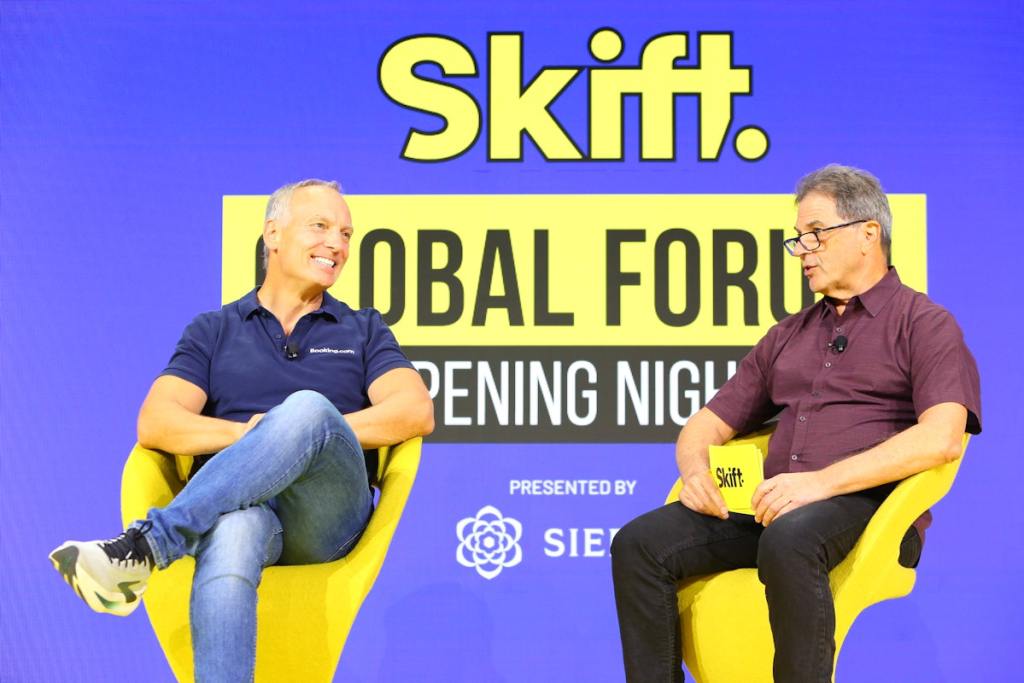
The Decision Brief Glenn Fogel, CEO & President, Booking Holdings Moderated by Dennis Schaal, Skift THE VERDICT Established travel companies have to decide whether their scale and trust can outlast the current technology cycle. Fogel is confident that Booking will. The company is placing five simultaneous AI bets across its brands, which Fogel described as a venture capital approach: “most of them are not going to be great, but just one has to be a big winner.” He said the technology itself is becoming easy to build, so his advantage is what AI alone can’t provide. Incumbent brands have to ask themselves: if the technology gets democratized, what do we have that no one else can replicate? PATHS FORWARD Place multiple AI bets and cut the losers fast. Fogel said Booking Holdings is running five different AI approaches — consumer agents for Priceline, Agoda, and Booking.com, plus two native AI startups. He said scale gives the company the capital and talent to run all five at once. He valued the startups specifically for their speed, calling out the risk that large organizations become “bureaucratic and slow-moving.” Not every company has a balance sheet that supports running parallel experiments, but those without it can make individual bets and commit. Build the product that solves disruption across every booking. When pressed on whether the full connected trip works today, Fogel said, “Not yet.” However, he explained how Priceline’s Penny agent could reconstruct a disruption scenario and propose alternatives with the ability to book. The first company to deliver seamless cross-vertical recovery in real time will have a service advantage no single-product competitor can match. Make your channel good enough that travelers choose it over the agent. Fogel said improving the AI-powered experience will pull even more travelers to come directly. He questioned who a traveler calls when an LLM booking goes wrong — “do you think there’s a number there, a customer service number to call? No.” Any brand that still holds a direct relationship should consider AI investments that strengthen that channel. WHAT TO WATCH AI referral traffic drives fewer than 1% of room nights at Booking.com today. Fogel called that “a fact” that is “neither positive nor negative,” and said he believes commerce through AI agents will grow. He said Booking will be there to handle the transaction with “some sort of economic relationship at that point.” Watch how fast that number moves and whether incumbents or agents capture the margin when it does. Fogel said Airbnb entering hotels was inevitable and suggested it could work in Booking’s favor: home-rental hosts who currently rely on one platform for demand “maybe now … say, ‘Oh, well I should get another source of demand,’ and they’ll come to us.” Whether that actually happens, or whether Airbnb’s hotel push pulls share from Booking’s independent hotel base, will be visible in the next few quarters. Access all the Skift Takeaways from this event, as well as full session videos, presentation documents, and more editorial coverage at our Skift Global Forum attendees hub.
Booking Holdings: Building a Long-Term Competitive Advantage
Full Article
Original Source
Read the full article at Skift →KhanList aggregates and links to publicly available news content. We do not host full articles from third-party sources. Always verify important information with original sources.