
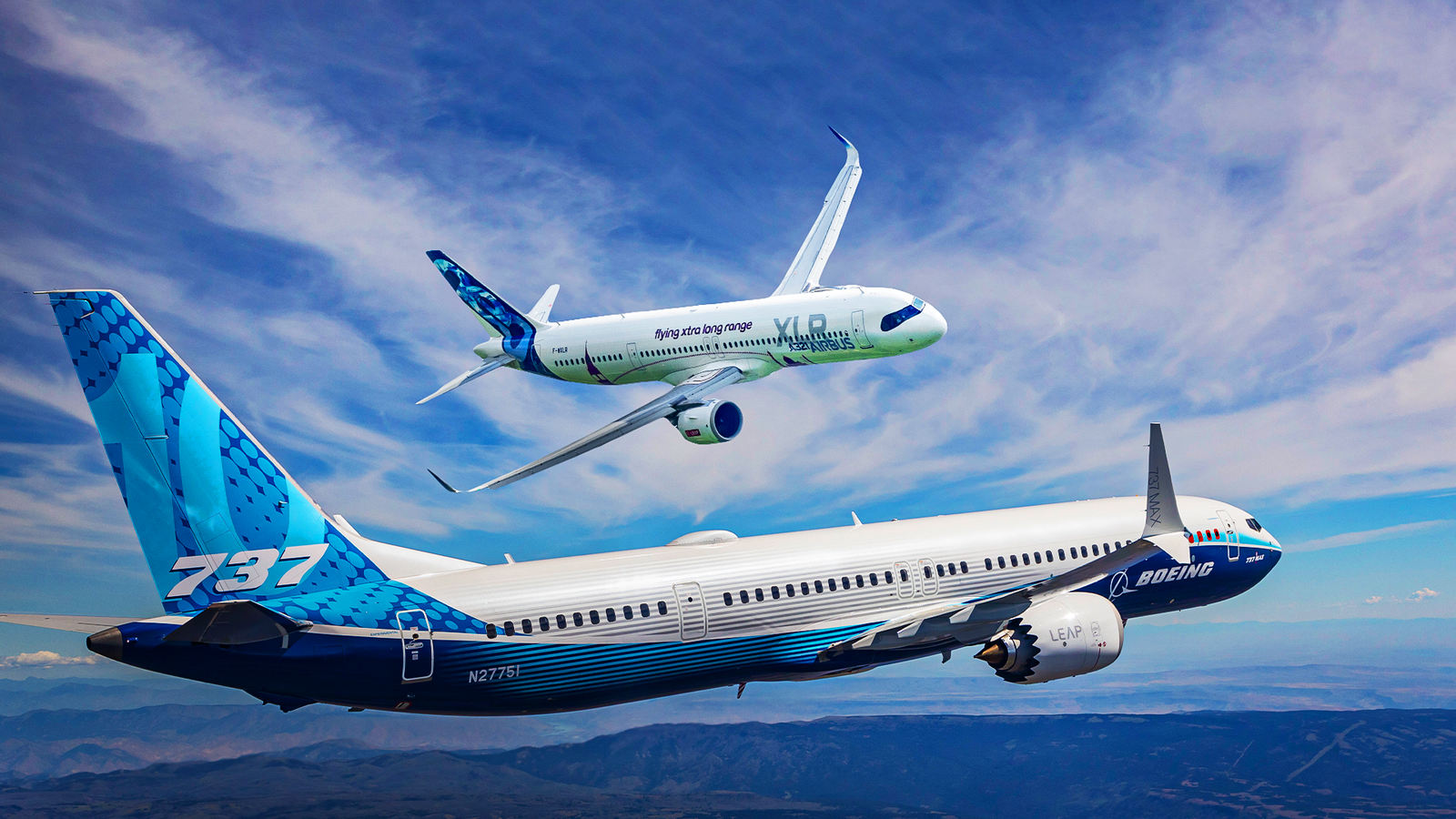
Credit: Boeing, Sergey Kohl | Shutterstock, Simple Flying Published Sep 10, 2026, 1:01 PM EDT Louis is a military historian and the staff writer for History of War magazine, a leading military history monthly. He also has an interest in private and commercial aviation. After 976 test flights, the Boeing 737 MAX 10 finally completed its flight tests this July. Boeing expects Federal Aviation Administration (FAA) approval this September or October, while the FAA has pushed Boeing 777X certification into early 2027 to make way for this work. That means first deliveries will not be until 2027. Flight testing has taken so long because of an engine anti-icing design flaw, as well as the need for enhanced cockpit alerting systems. Meanwhile, the 737 MAX 10's main rival, the Airbus A321XLR, is already bringing in substantial revenue for the airlines flying it. For example, Iberia received an A321XLR in October 2024. It remains to be seen how the 737 MAX 10 performs in commercial operations. However, even if it performs better than the A321XLR, it will still carry the extended delays as a mark against it and against Boeing's reputation. The 737 MAX 10's Final Test Flight Credit: Boeing On July 26, Boeing announced that its 737 MAX 10 had completed its final certification flight. It was the culmination of over 2,000 test flight hours, along with 1,060 ground test hours. Overall testing included demonstrating that the jet meets certification requirements for the main landing gear, maximum-energy emergency stops, brakes in test conditions, the advanced angle-of-attack system, and the engine's anti-ice system. Meanwhile, this specific test flight was an interior's evaluation to ensure the lavatory smoke detector and cabin speaker system can be heard. “Reaching this milestone is a huge testament to the commitment and dedication of the entire team,” said Chris Payne, vice president and general manager of 737 Development Programs. “Thank you to everyone who gave so much of themselves to get us here. This is an important step on our journey, and we’re focused on building on it as we move forward.” Completing this final test flight does not mean Boeing's work was complete. It still had to deal with the outstanding development assurance reviews (DARs) and system safety assessments (SSAs). Finally, Boeing had to submit all deliverables to the FAA for regulatory review. Only once the FAA assesses all these deliverables and test results will the MAX 10 receive the certification needed to enter active service. Why Has 737 MAX 10 Testing Taken So Long? Credit: Boeing Boeinginitially wanted the 737 MAX 10 to enter into service in 2023. The planned actual entry into service in 2027 is a humiliation that has been costly for both the manufacturer and the carriers that bought the jet. For comparison, initial plans for the A321XLR's entry into service were also 2023, with the actual entry into service being late 2024. The delays have been caused by the 737 MAX groundings, the COVID-19 pandemic, and testing issues. The problems began in 2023 when engineers identified a flaw with the engine's anti-ice system. It caused the engine nacelles to overheat during prolonged use. The overheating could cause structural failures or debris to break off and enter the engine. Boeing initially sought a temporary safety waiver but buckled under pressure from regulators and the political system. The manufacturer spent two years on a hardware redesign. Further problems followed the 737 MAX 8 crashes, when the US Congress demanded that new aircraft meet improved crew-alerting standards. Boeing's stress eased slightly with a waiver that avoided a total flight deck redesign. The FAA then took an increasingly hands-on approach in January 2024 after a mid-flight door plug failure aboard a 737 MAX 9. Oversight raises standards but slows progress in aircraft testing and development. How The 737 MAX 10 Order Sheet Shows It Could Still Be A Success Credit: Boeing Despite years of certification delays, indications suggest the 737 MAX 10 will be an incredibly popular aircraft. In February, Simple Flying previously reported that the type has over 1,400 orders. Some carriers have made truly enormous orders. Alaska Airlines has bought 68 examples of the jet, while United Airlines has 165. At the time when Luke was writing, there were still 130 unassigned orders. Operator Boeing 737 MAX 10 Orders Air India Express 50 Akasa Air 99 Alaska Airlines 168 American Airlines 115 Delta Air Lines 100 Donghai Airlines 10 El Al 20 Flybondi 10 GOL 25 Iraqi Airways 10 Lion Air 50 Luxair 2 Malaysia Airlines 12 Okay Airways 3 Pegasus Airlines 100 Ryanair 131 SkyUp Airlines 3 Skymark Airlines 4 SunExpress 30 TUI Airways 27 Unassigned 130 United Airlines 165 Virgin Australia 10 Vueling Airlines 25 WestJet 107 Total 1,406 Part of the reason airlines keep ordering such a problematic aircraft is that the backlog isn't shrinking. Carriers that wait until certification to place orders will find themselves at the back of the queue. They'll then waste money burning huge amounts of fuel with their old, inefficient aircraft while they await the MAX 10. How Carriers Are Using The A321XLR Like the 737 MAX 10, the A321XLR has an enormous order backlog. However, it has started to deliver the jet into service. Airbus describes the A321XLR as "the Xtra long-range route opener." However, carriers have used this aircraft in much more diverse ways. Firstly, LATAM Airlines Group has committed to the jet. This strategy uses a premium-dense two-class configuration. It brings widebody long-haul comfort to the narrowbody market. LATAM's efforts show plans to use the A321XLR on flagship routes, not just the long and niche routes Airbus intended. In North America, carriers such as American Airlines are using the jet to replace high-utilization narrowbody aircraft, such as the 757, which requires deprioritizing lie-flat business class. These airlines have built cabins that increase density without sacrificing the lie-flat business class product. Reduction In Fuel Burn & CO2 Emissions Per Seat 30% Range 4,700 nautical miles (8,700 km) Maximum Takeoff Weight (MTOW) 222,700 lb (101,500 kg) Maximum Capacity 244 Typical Two-Class Seating 180 to 220 Wingspan 117 feet, 5 inches (35.8 meters) In Europe, the A321XLR's launch customer, Iberia, is setting the standard. Iberia has equipped its A321XLRs with VantageSOLO door-protected business class seats. This specialized product will provide a superb option for high-value customers. It shows European airlines' intent to dominate the North Atlantic with the jet. The A321XLR Is Beginning To Hold An Important Position In Airlines' Marketing Another sign that the A321XLR has made an excellent entry into service appears when we look beyond route and aircraft-utilization discussions. Carriers are now starting to use the jet as a marketing flagship, attracting new customers in a way the 737 MAX 10 has yet to achieve. One example is Air Canada's recently launched competition ahead of its summer 2027 network expansion. By looking for clues in its 46-second trailer, customers can guess the routes to be added. Five winners will be selected. Each will receive two round-trip economy class tickets to fly anywhere in the Air Canada network. This prize is worth $8,800. Sadly, this competition has now closed. The A321XLR is not explicitly named in this competition. However, given the aircraft's unique capabilities, the routes will almost certainly involve it. This competition is a clear attempt to get customers and avgeeks thinking deeply about the new capabilities the A321XLR will bring to the Air Canada network. How The A321XLR May Not Be All It's Cracked Up To Be Some issues are already emerging with the A321XLR. For example, the experiment in using the jet to replace widebody aircraft on premium long-haul corridors may be coming to an end. Air Canada has quietly moved its brand-new A321XLR off its Toronto Pearson International Airport (YYZ) to London Heathrow Airport (LHR) route. It has replaced this long-haul narrowbody with the conventional widebody 777 and 787 Dreamliner. The move doesn't show the A321XLR is dead in the water on high-yield, slot-constrained routes, but it does call into question this utilization. The A321XLR is more efficient per seat than a 777 or 787 and 30% more efficient per seat than previous-generation aircraft. However, these savings can be offset by the cost of taking up a slot with a low-capacity jet, which will slash the total route capacity. Air Canada's two-class A321XLR has just 182 seats. Seats alone only tell part of the story. Single-aisle jets also have far less underfloor container volume. The permanently integrated rear center tank (RCT) cuts cargo volume even further by providing the additional fuel needed for extended range. Located directly behind the main landing gear well, the RCT takes up space that conventional narrowbody jets can use for cargo. Carrying large amounts of cargo on passenger flights provides essential income to carriers, particularly when ticket sales are unstable.
Boeing's 737 MAX 10 Finished Flight Testing In July While The Airbus A321XLR Is Already Flying Paying Passengers
Full Article
Original Source
Read the full article at Simpleflying →KhanList aggregates and links to publicly available news content. We do not host full articles from third-party sources. Always verify important information with original sources.