
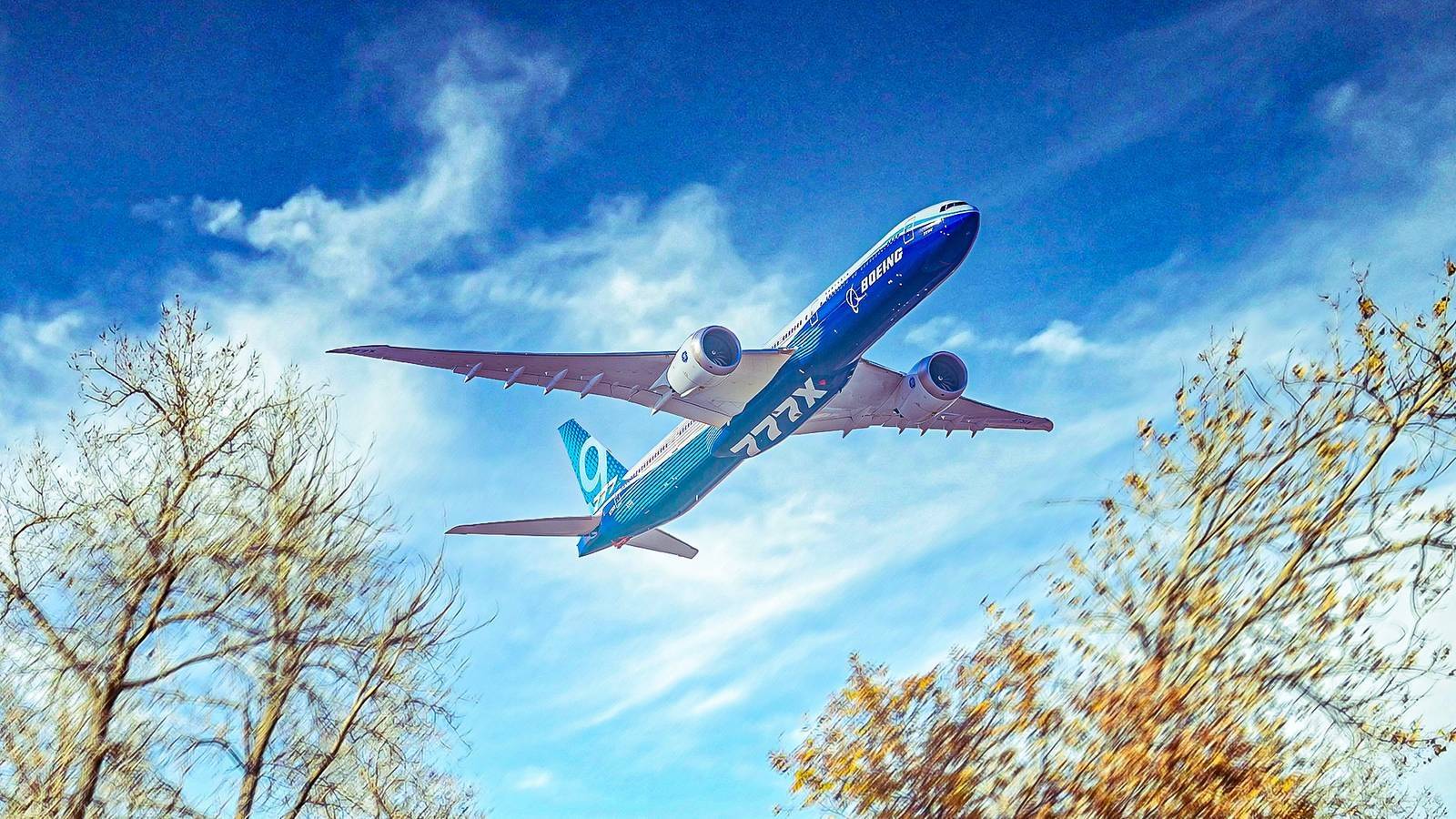
Credit: Shutterstock, Simple Flying Published Aug 28, 2026, 3:00 PM EDT Aaron is an aviation enthusiast and world traveler with a deep interest in aerospace history and technology. He has traveled around the world numerous times, often incorporating visits to aviation museums and historic aircraft collections into his journeys. A native of New Zealand, he is an expert in aviation and maintains a broad interest in a variety of other subjects. Sign in to your Simple Flying account Boeing recently updated the advertised range of its upcoming Boeing 777-9 from 7,285 nautical miles to up to 8,000 nautical miles on its official website without explanation or a redesign of the aircraft's capabilities. The development highlights a cautionary tale when it comes to reading advertized aircraft characteristics and even more caution when comparing the performance of aircraft between companies and countries. While this article will focus on Boeing's 777X aircraft, it has also increased the ranges for its 787 Dreamliner series. At the same time, Airbus has increased its ranges for the A350 series. It says that "the A350-1000 is designed to fly up to 9,100 nautical miles, targeting entry into service in 2030." The original range was advertized from 7,750 nautical miles around a decade ago. Airbus also says the A350-900 entered service with a maximum range of 8,100 nautical miles, "up to 8,600 now in 2026." Boeing's Quiet Increase In 777X Range Credit: Shutterstock Previously, Boeing advertised the stretched Boeing 777-9 range as being 7,285 nautical miles and the shorter Boeing 777-8 as having a range of 8,745 nautical miles. Ironically, with these older numbers, the Boeing 777-9 actually came with a shorter advertised range than the older Boeing 777-300ER it replaces. The -300ER has an advertised range of 7,370 nautical miles, even though the 777-9 is considerably more fuel efficient. In June 2026, Boeing quietly updated the advertized range to up to 8,000 nautical miles for the 777-9 and up to 9,500 nautical miles for the 777-8. This represents an increase of 9.8% for the 777-9 and 8.6% for the 777-8. There was no corresponding public announcement by Boeing explaining what had changed. While Boeing may have become more confident in the performance of the 777X and its GE9X engines, it is also possible this is mostly a marketing move. Aircraft range is highly dependent on the assumptions used to calculate it, including payload, aircraft configuration, cruise speed and altitude, fuel reserves, and other operating assumptions. In real-life operating conditions, other important factors include the direction of the jet stream and weather conditions. Without knowing these parameters, it is not possible to estimate an aircraft range with any precision. It is possible Boeing's older figures assumed unfavorable operating conditions (such as a heavy payload), while the new figures may be more favorable conditions. One of the best examples illustrating how deceiving an advertized range is, is Qantas' route from Perth to London with Boeing 787-9s. Until recently, the advertized range of the Boeing 787-9 was 7,635 nautical miles. However, the straight-line distance from Perth to London is around 7,829 nautical miles, or around 194 nautical miles more than the advertized range. However, even this understates it. In reality, flights don't fly in a perfect straight line, and Qantas' QF9 flights have been recorded at around 7,930 and 8,020 nautical miles. That is around 300 nautical miles more. It is worth noting that these are real commercial flights, and so the aircraft is flying with passengers and baggage, not empty ferry flights. Additionally, the flights are arriving with sufficient reserves, meaning that they could fly further by eating into that safety margin. However, another factor is that this is a north-south route, meaning the aircraft can't take advantage of favorable jet streams that other routes can (in one direction) when flying eastbound. The route highlights that the 7,635 nautical mile range is not a hard physical maximum distance. Boeing Vs. Airbus Advertised Ranges Old range New range Boeing 777-9 7,635 nautical miles Up to 8,000 nautical miles Boeing 777-8 8,745 nautical miles Up to 9,500 nautical miles Airbus A350-900 7,950 nautical miles Up to 8,500–8,600 nautical miles (9,800 nautical miles for -900ULR) Airbus A350-1000 7,750–8,100 nautical miles Up to 9,100 nautical miles (9,700 nautical miles for -1000ULR) Instead, it can be extended by changes to passenger/payload, fuel reserves, cruise profile, and aircraft configuration. However, Boeing has not only adjusted the 777-9 range, but it has also adjusted the 787-9's range to "up to 8,300 nautical miles." This is why it is difficult to cross-compare figures. Are Boeing's new or old figures using the same assumptions as Airbus's advertised figures, or are both companies using assumptions that never fully align? Extreme Example: Russia's Kinzhal Missile Credit: Shutterstock Perhaps one of the most egregious modern sets of range and speed claims is with the Kh-47M2 Kinzhal (NATO AS-24 Killjoy). This is an air-launched ballistic missile that Russia derived from its ground-launched Iskandar missiles. Russia claims the missile to be hypersonic and capable of speeds of Mach 10. What distinguishes many modern weapons marketed specifically as hypersonic is their ability to sustain hypersonic flight and, in particular, maneuver at such speeds within the atmosphere. To be considered hypersonic, a missile needs to travel at a speed of Mach 5+ in the terminal phase. This is when it reenters the atmosphere and is slowed down by dense air. The claim of hypersonic Mach 10 appears to be from the mid-course phase in space. According to a US Army Colonel speaking in 2024, the Kinzhal's terminal speed is Mach 3. Almost all ballistic missiles reach hypersonic speeds in the mid-course. However, perhaps worse is the range claim. According to the think tank CSIS, Russia claims the Kinzhal has a range of up to 1,080 nautical miles or even 1,620 nautical miles, but this includes the range of the motherships (MiG-31K and Tu-22M3, respectively). The missile's post-launch range is commonly cited as around 323 nautical miles. Russia's Kinzhal range claims are somewhat analogous to if the US were to claim its MOB GUB 57 bunker-busting bombs have 'unlimited range,' as they are carried by B-2 Spirits, which can fly virtually anywhere nonstop with in-air refueling. Caution With Aircraft Operating Costs Credit: Airbus In a presentation from 2016, Airbus claims its A350-1000 has a 15% lower trip cost and a 7% lower cost per seat (assuming 366 vs 398 seats) compared with the Boeing 777-9. Meanwhile, Boeing's website claims the 777X has "10% lower operating costs than the competition" and "5% lower specific fuel consumption than the competing engine." The competition is squarely the A350-1000, and the engine is the Rolls-Royce Trent XWB-97. So which is it? Is Airbus overstating the A350-1000's economics, is Boeing overstating the 777-9's, or are both companies simply using different assumptions? A third explanation is entirely plausible: aeither manufacturer is likely comparing the same things. Importantly, there is no fixed criteria by which plane makers are required to measure their aircraft's fuel efficiency. The operating economics depend on factors such as the assumed number of seats, passenger and cargo payload, flight distance, fuel price, aircraft utilization, maintenance costs, crew costs, and the precise definition of 'operating cost'. In essence, both companies are likely cherry-picking the most favorable set of scenarios and saying that "if you load it like this and fly it like this, then it's better than the competition when it is also operating in that particular way." Saab Has Been Called Out On Operating Costs Credit: Department of Defense It needs to be stressed that all airplane manufacturers are incentivized to advertise their aircraft with the lowest possible operating costs, and this incentivizes them to omit expenses when a definition can be stretched to not include them. One particular example called out is Saab vis-à-vis its Gripen fighter jet. Indeed, Sandboxx News noted in 2025 that the Gripen E is often claimed to have an operating cost of just $8,000 to $10,000 per flight hour, only around a third of the F-35's roughly $30,000 per flight hour. However, it has been found that these claims originate from a self-funded study in 2012, which is also often not adjusted for inflation. That estimate included the Gripen's fuel and consumables but not maintenance and other expenses factored into the F-35's $30,000 hourly cost figure. The F-35's cost estimate is comprehensive. In 2023, Aviation Week concluded that the Gripen E's hourly operating costs are closer to $22,175, and noted that there is no universal methodology for calculating through-life costs. Furthermore, the cost elements included can vary considerably between countries, operators, and programs. Its $22,175 estimate includes $9,975 for operations and around $12,200 that Saab's self-funded study excluded. This still makes the Gripen E cheaper to maintain and operate, but then again, it is also a much lighter aircraft. The same caution should be applied across the industry, especially to Russian and Chinese fighter jets. No Big Gap Between Boeing & Airbus Credit: Shutterstock Overall, the per-seat fuel consumption of Boeing and Airbus aircraft is most likely similar, although the precise difference varies considerably by aircraft, configuration and mission. The best evidence for this is the fact that the two companies and their aircraft are very competitive, with neither able to gain a decisive advantage over the other. With that being said, it is also worth noting that fuel consumption is not the only factor these companies compete over. Other factors include lead times, financing, interoperability with existing aircraft (pilots, maintainers, tooling), risk hedging, valuing existing relationships, capital costs, durability, confidence in sustaining the aircraft for decades (ongoing upgrades, spare parts), and sanctions. There are also geopolitical considerations: for example, Chinese Boeing orders became very politicized in 2025. The reason why orders for the Trent 1000-powered Boeing 787-9 aircraft collapsed was engine durability, not engine fuel efficiency. At a macro level, the combined quality of Boeing and Airbus aircraft, together with confidence in those companies, is broadly even. The overall value proposition of their competing aircraft is sufficiently close that neither manufacturer has been able to establish a decisive and enduring advantage. This is not the impression from reading their marketing material. This is a reason not to take advertised figures as unqualified truth, including Russia's claim that its Russified Ilyushin Il-114-300 turboprop is somehow 17% more fuel-efficient than the Dash 8/Q400 and ATR-72-600 aircraft.
Boeing Boosted The 777-9's Range By 715 Nautical Miles - What That Reveals About Aircraft Performance Numbers
Full Article
Original Source
Read the full article at Simpleflying →KhanList aggregates and links to publicly available news content. We do not host full articles from third-party sources. Always verify important information with original sources.