
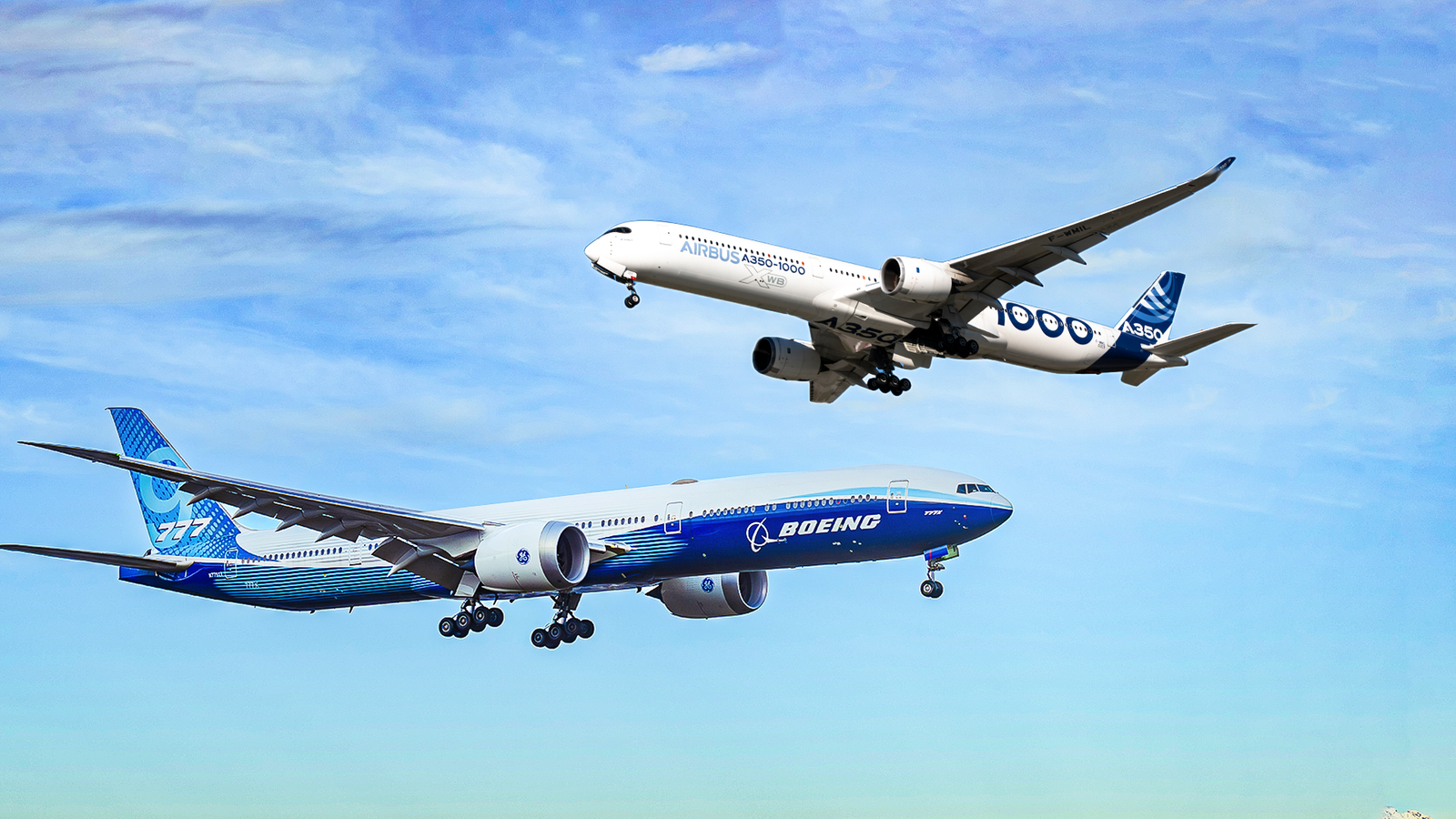
Published Oct 5, 2026, 5:01 PM EDT Airline and Airport Management Graduate, Student Commercial Pilot and Commercial Aviation Writer. Based in London & Nagoya With legendary four-engine flagships like the Boeing 747 and Airbus A380 gradually transitioning out of passenger fleets worldwide, the responsibility of connecting distant global hubs falls onto a new class of massive twin-engine widebodies. At the very top of this segment sit two competing flagships: the 777-9 and the A350-1000. These wide-cabin giants are the pinnacle of modern aerospace engineering, delivering transoceanic reach and burning significantly less fuel per seat than the four-engine vanguards they replace. Both twinjets are designed to fulfill similar ultra-long-haul roles, but their respective design teams at Everett and Toulouse approached the challenge with very different engineering philosophies. From carbon-fiber fuselage structures and massive high-bypass engines to folding wingtips and advanced aerodynamics, each design leads to unique performance tradeoffs. Advanced carbon-fiber materials meet proven metallic fuselage engineering Airbus constructed the A350-1000 around a clean-sheet carbon-fiber composite airframe. Advanced materials make up roughly 70% of the aircraft, featuring 53% carbon-fiber reinforced polymer (CFRP), 14% titanium, and 12% aluminum-lithium alloys. The manufacturer dramatically reduced overall airframe weight while eliminating fatigue and corrosion vulnerabilities inherent to traditional metals through building large composite barrel panels for the cabin fuselage rather than traditional aluminum sheets. The material enables lower cabin-altitude pressure and higher humidity levels on long flights, offering passengers a more comfortable environment while giving airlines lower structural maintenance costs over the aircraft's lifespan. Boeing selected a hybrid approach for the 777-9, combining a proven metallic fuselage hull with an all-new composite wing assembly, according to Simple Flying. The fuselage builds upon the traditional aluminum-alloy construction of the original 777 family alongside a massive fourth-generation carbon-fiber composite wing inspired by the 787 Dreamliner design. This allowed Boeing to retool existing Everett assembly lines and maintain familiar manufacturing processes for the main body section, though it results in a heavier overall airframe structure compared to the clean-sheet composite barrel design of the A350-1000. Qatar Airways introduced the A350-1000 to commercial service in February 2018, giving Airbus eight years of real-world operational data and fleet experience across global routes. In contrast, complex certification hurdles, engine-testing revisions, and regulatory scrutiny have delayed the 777-9's commercial entry to 2027, according to Simple Flying . That revised timeline is a massive seven-year shift from its original 2020 entry target, leaving Airbus as the only manufacturer to deliver ultra-large twin-engine widebodies to market for nearly a decade. 4 Record-Breaking Propulsion And Scale Pushing the boundaries of turbofan scale and thrust capability Credit: Aerospace Trek I Shutterstock Boeing and Airbus' engine selections clearly show the different paths each manufacturer took in designing its newest flagship models. Boeing partnered exclusively with GE Aerospace to develop the GE9X specifically for the 777X family. Featuring a 134 inches (3.4 meters) composite fan diameter housed within a 184 inches (4.7 meters) nacelle, the GE9X is officially the largest commercial jet engine ever produced, with a front fan wider than the entire fuselage cross-section of a 737. Designed to generate 105,000 lbf (467 kN) of rated takeoff thrust, the giant powerplant incorporates 16 fourth-generation carbon-fiber fan blades and 3D-printed ceramic matrix composite materials to achieve a 10:1 bypass ratio and an overall pressure ratio of 60:1. In contrast, Airbus partnered up with Rolls-Royce as the sole power supplier for the A350 program, equipping the largest variant with the Trent XWB-97. According to Aircraft Commerce, it features a 118 inches (3.0 meters) fan diameter, the Trent XWB-97 produces 97,000 lbf (431 kN) of thrust, making it the most powerful turbofan in the Rolls-Royce Trent engine family. Rolls-Royce engineered this high-thrust variant with advanced high-pressure turbine technology, updated core aerodynamics, and 22 titanium hollow-core fan blades designed to manage extreme thermal loads during ultra-long-haul flights. This means the A350-1000 can deliver exceptional cruise efficiency without the immense size of its American competitor. These contrasting propulsion dimensions directly affect ground operations, maintenance procedures, and logistics for airline engineering departments. The GE9X's scale requires special transport tooling and handling equipment, as the complete engine assembly cannot fit inside standard freighter aircraft without removing the fan module. Conversely, the Trent XWB-97 maintains a more compact profile but still delivers excellent dispatch reliability across the global A350 operator network. Both powerplants equally use cutting-edge metallurgy and aerodynamic design to lower fuel burn by double-digit percentages compared to earlier-generation widebodies, but the sheer scale of the GE9X remains one of the defining mechanical distinctions of the 777-9. 3 Cabin Capacity & Passenger Payload Economics Balancing high-density seating against multi-class long-haul comfort Boeing designed the 777-9 to deliver unprecedented capacity for a twin-engine jetliner, featuring a cabin width of 19 feet and 7 inches (5.97 meters). The interior width lets airlines install a ten-abreast economy layout in a 3-4-3 arrangement, with 18 in (45.7 cm) seat widths. Boeing advertises a standard two-class capacity of 426 passengers, though three-class configurations typically accommodate around 388 seats. A cabin volume of this size is perfect for those operators that need a high-density flagship capable of carrying massive passenger loads on heavily traveled trunk routes between major global hubs. Airbus built the A350-1000 with a cabin width of 18 feet 5 inches (5.61 m), narrower than its rival. Standard long-haul configurations feature a nine-abreast economy layout in a 3-3-3 arrangement, though recent cabin modifications enable 10-abreast seating for high-density operators, such as Philippine Airlines. Airbus lists typical three-class seating between 350 and 410 passengers, with a maximum certified exit limit of 480 seats. The slightly narrower cross-section makes the A350-1000 easier to fill profitably across seasonal demand fluctuations or on secondary long-haul routes with lower hub passenger feed. The expanded floor area of the 777-9 gives carriers plenty of room to install luxurious first-class suites and extensive business-class cabins without drastically reducing main-cabin seat count. However, filling over 400 seats consistently demands robust connections at both ends of a route. The A350-1000 trades total payload capacity for lower trip costs, giving airlines the flexibility to operate profitable long-haul flights between primary and secondary hub markets. 2 Operational Range & Ultra-Long-Haul Capability Comparing 8,700 nautical mile endurance with high-volume regional flexibility The A350-1000 holds a decisive advantage in operational reach, boasting an advertised range of 9,100 nautical miles (16,850 km). This endurance comes directly from its lightweight composite airframe and aerodynamic wing design, which reduce fuel burn on 16-to-18-hour sectors. The extended range allows airlines to connect distant city pairs across oceans without payload penalties. Qantas selected a modified variant of the A350-1000 for its ambitious Project Sunrise initiative, designed to operate nonstop commercial flights connecting Sydney directly with London and New York. Boeing quotes an advertised baseline range of 8,000 nautical miles (14,280 km) for the 777-9. On one hand, the range enables non-stop coverage across most transatlantic and transpacific routing networks, but it trades extreme range endurance for sheer passenger and cargo volume capability. The heavier hybrid metallic fuselage and high takeoff weight mean operating the 777-9 near its maximum range boundary will require airlines to carefully balance fuel loads against revenue cargo capacity. Airlines such as Emirates and Qatar Airways plan to deploy the 777-9 mainly on high-density trunk routes connecting Middle Eastern mega-hubs to Europe, Asia, and North America. The range gap establishes contrasting network roles for both widebodies. The A350-1000 is a more flexible point-to-point flagship, capable of pioneering ultra-long-haul routes where point-to-point travel commands premium fares. Conversely, the 777-9 is a high-capacity trunk airliner built to consolidate high passenger volume between major slot-constrained hubs. Ultimately, choosing between the two involves balancing the strategic value of non-stop geographic reach against the raw revenue potential of maximum seat count. How folding wing mechanisms allow massive spans to fit existing airport gates The 777-9 is the longest commercial passenger jet ever built, measuring 251 feet, 9 inches (76.7 meters) from nose to tail. That beats the A350-1000, which measures 242 feet, 1 inches (73.79 meters) from nose to tail, by nearly 10 feet, as per British Airways data. However, the most radical dimensional divergence between these two widebodies is actually their wing design. To maximize aerodynamic efficiency during high-altitude cruise, Boeing engineered a massive carbon-fiber composite wing with an unfolded span of 235 feet, 5 inches (71.8 meters). In comparison, Airbus selected a fixed, ultra-efficient carbon-composite wing for the A350-1000 with a span of 212 feet, 5 inches (64.75 meters). A wingspan exceeding 213 feet (65 meters) automatically places an aircraft into ICAO Code F (or FAA Group VI) gate compatibility categories, the same operational class as double-deck giants like the A380 and 747-8. To avoid making airlines spend millions of dollars modifying airport gate infrastructure or facing taxiway restrictions, Boeing developed commercial aviation's first folding wingtip mechanism. On the ground, electric actuators fold the outer 11 feet, 5 inches (3.5 meters) of each wingtip upward into a vertical position upon landing. This reduces the ground wingspan of the 777-9 to 212 feet, 8 inches (64.8 m), allowing it to fit standard ICAO Code E gates alongside the A350-1000, whose fixed wingspan measures virtually identical at 212 feet, 5 inches (64.75 m). The folding mechanism lets the 777-9 fit into existing airport gates, but it also adds mechanical complexity, maintenance demands, and strict regulatory oversight. Redundant locking pins, automated cockpit warnings, and fail-safe flight controls ensure the wingtips lock securely in place before takeoff. Conversely, the A350-1000's fixed wing profile offers mechanical simplicity, avoiding extra weight from folding actuators and eliminating specific taxi checklists. When parked side by side at an international airport terminal gate, these two flagship twinjets occupy nearly the exact same area, but once airborne, the expanded span of the 777-9 gives it a distinct aerodynamic advantage.
Boeing 777-9 Vs. Airbus A350-1000: 5 Key Differences Between The Big Twins
Full Article
Original Source
Read the full article at Simpleflying →KhanList aggregates and links to publicly available news content. We do not host full articles from third-party sources. Always verify important information with original sources.