
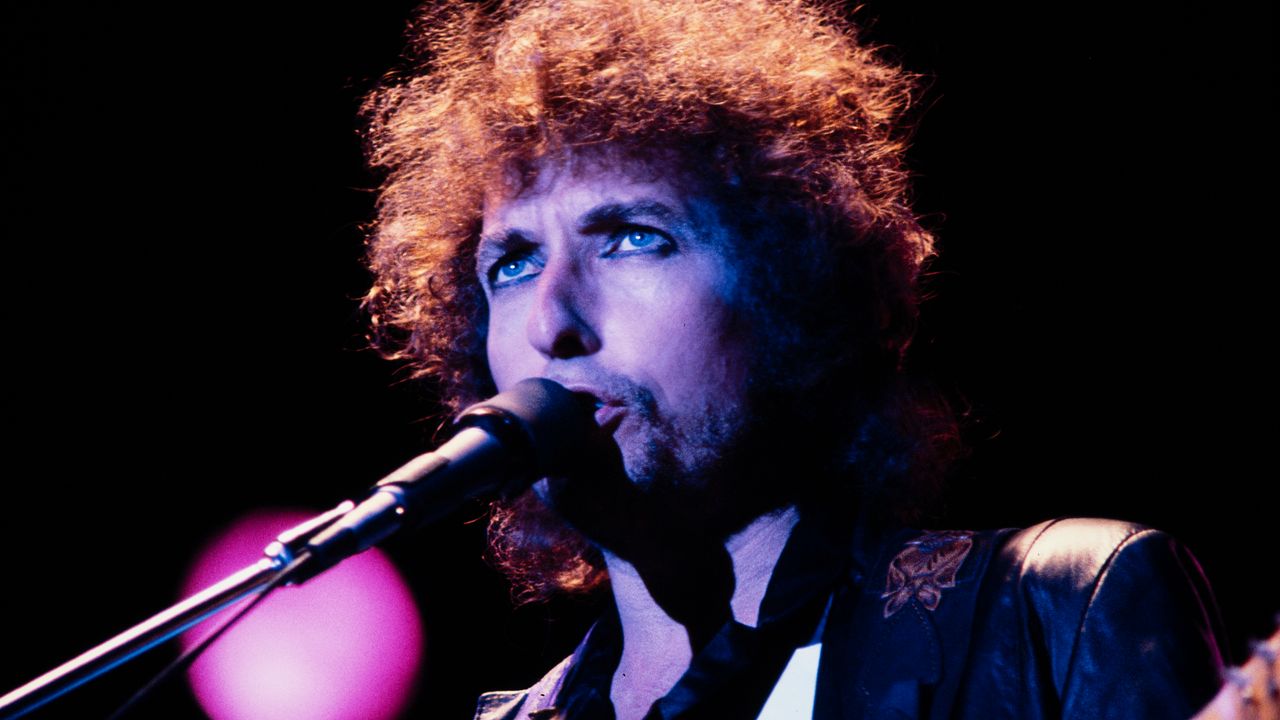
The Rolling Thunder Revue: The 1976 Live Recordings includes 371 previously unreleased tracks. But its real aim is purely legal: the maintenance and extension of copyright.Gijsbert Hanekroot/Getty ImagesIt showed up in my inbox on a Tuesday afternoon without any particular fanfare, just an email from Legacy Recordings with a link to a stream. Artist: Bob Dylan. Title: Rolling Thunder Revue — The 1976 Live Recordings. Total Tracks: 381.The link brought me to a bare-bones Sony Music web page, a couple light grey boxes arranged against a dark grey background. A small window in the middle of the page occupied maybe 10% of the available space. Inside the window were lines of text with lengthy, baroque file names, one on top of another. You could see about five at a time, starting with the first:Bob Dylan_The Rolling Thunder Revue The 1976 Live Recordings_G0100060414779_01_01_Visions of Johanna_USSM12603067_CT122.Then the second: Bob Dylan_The Rolling Thunder Revue The 1976 Live Recordings_G0100060414779_01_02_If You See Her, Say Hello_USSM12603068_CT122.And so on.This, it hardly needs to be said, is not the ideal way to familiarize yourself with the 31 hours and 18 minutes of new music included in the latest box set from Bob Dylan Industries. Like previous installments of the Live Recordings series, 1976 is an exhaustive accounting of (nearly) every second of (nearly) every show and concert given by Bob Dylan on a legendary tour. If a document of a performance from this tour exists, it is here, whether you want it or not.There’s a certain thrill to a release like this, especially for the Dylan mujahideen, those of us willing to engage in the struggle. The 1976 Live Recordings is best thought of as a choose-your-own-adventure set, allowing you the opportunity to ramble along with the Rolling Thunder Revue at whatever pace you find comfortable. You can dip in on St. Petersburg (4/23/76) for the first recorded edition of “Idiot Wind,” then mosey on to Gainesville (4/25/76) for the only-ever performance of “Dink’s Song,” then settle in for a long date with Oklahoma City (5/18/76), one of the strongest complete shows. And if you want to summit the whole mountain—well, hit “play” on Lakeland (4/18/76) and let it rip. Just remember to stay hydrated.Rick Diamond/Getty ImagesRick Diamond/Getty ImagesAs exciting as the sheer volume of new Bob Dylan music is, these ultra-complete tour retrospectives can be an intimidating listening experience. This is especially true in the case of The 1976 Live Recordings, which captures not the crackerjack bonhomie of the inaugural Rolling Thunder Revue, but the second, flabbier incarnation—halitosis and head scarves rather than whiteface and roses.Dylan caught lightning in a bottle with the first Rolling Thunder, trucking around northeastern college towns with his ramshackle rock carnival while simultaneously 1) shooting an autofictional art film, and 2) trying to piece his broken marriage back together (partially by forcing his wife to act in said art film). The looks were immaculate, the vibes heady, the performances electric. Just peep a few minutes of a 1975 “Isis”—talk about the ghost of electricity howling in the bones of a face. The music press tailed the show from town to town throughout, breathlessly reporting on the latest feats of derring-do from Bob and co-conspirators. Rolling Thunder became a viral sensation, a meme, an object of FOMO decades before the term was invented.For Dylan, it was the culmination of a thrilling 24-month period in which he’d returned to touring, recorded three brilliant albums, and reclaimed his reputation as the most vital force in rock songs. Taken together, Planet Waves, Blood On The Tracks, and Desire, along with the Before The Flood tour in ‘74 and Rolling Thunder in ‘75, seemed a clear statement of intent. You can’t repeat the past? Whaddya mean you can’t, of course you can.Riding high on good will and good press, Bob got the band back together the following year. It was only natural. The first Rolling Thunder had been an experiment of sorts, a burst of creativity fueled in large part by spontaneity and esprit de corps. There was a real “let’s put on a show!” energy to the proceedings. Tour dates were announced only a few days in advance, the itinerary unfolding according to the whims of the man in the wide-brimmed hat, and concerts were given not in theaters, but in New England’s stuffiest gymnasia and rotary halls.The mercurial, DIY approach was a big part of the magic, but it also limited the tour’s reach. The sequel would be a professional operation: fully produced, well-rehearsed, hosted in cavernous coliseums across the American South. Better, boozier, browner.Those latter two descriptors certainly applied to Rolling Thunder ‘76. As for the former, it depends on who you ask. The energy of the ‘75 shows was dialed back considerably, the wiry charge dissipating somewhere between the action on stage and the tens of thousands in the stands. It would have been impossible to reproduce the energy of a room like Plymouth’s War Memorial Auditorium (capacity 1,500) in a place like Fort Collins’ Hughes Stadium (capacity 30,000), and Bob didn’t even try. Instead, he and the band dialed up the cream quotient, turning the sound into something thicker, a little less wild. If Rolling Thunder ‘75 was a bantamweight, dodging and dancing around the ring, ‘76 was a heavyweight—slower, steadier, with a brutal left hook.Some of the best Desire cuts (“Hurricane,” “Sara”) were stripped from the ‘76 setlists, replaced with Blood On The Tracks material that neatly mapped the emotional geography of Dylan’s crumbling marriage. Most shows included some, if not all, of the following: “Tangled Up In Blue,” a tale of missed connections and cruel fate; “You’re A Big Girl Now,” a bitter, disillusioned sequel to “Positively 4th Street;” “Idiot Wind,” the breakup song to end all breakup songs, a kiss-off to both a former lover and a former self; and “You’re Gonna Make Me Lonesome When You Go,” a sweet little number written, not coincidentally, about the young A&R rep Bob had been seeing on the side. To the surprise of no one, Sara Dylan would file for divorce early the following year.Jeffrey Mayer/Getty ImagesListening now, it’s clear that the live Blood material is the lifeblood of Rolling Thunder ‘76. Bob is invested in these songs like they’re written in his soul: performances of “Idiot Wind” and “Shelter From The Storm” highlight every show in which they appear, and “Tangled” is always interesting, even if it’s occasionally more tuneless than it ought to be. The other stuff is more hit-and-miss.Take the 4/22/76 taping for the Midnight Special television program, which notably lacks any Tracks tracks. Instead, Bob and company meander through an abbreviated selection of greatest hits in a vain attempt at pleasing the crowd (and, presumably, network execs hoping to sell ad spots against the programming). It’s the Dylan pupu platter: a few “protest” songs, a few mid-Sixties rockers, and a couple contemporary cuts as a sop to the actual fans present. Several Rolling Thunder cast members make appearances—Joan Baez, Bobby Neuwirth, Roger McGuinn—but no one’s heart seems to be in it. Dylan was dissatisfied with the results at the time, and he refused to allow the performance to air. Now here it is a half-century later, available for all of us to judge ourselves. Turns out Bob made the right call.I can’t help but compare The 1976 Live Recordings to last year’s salvo from BD Industries, Through The Open Window: The Bootleg Series Vol. 18 1956-1963. That volume covered plenty of well-trod ground, tracing Bob’s earliest days in the Greenwich Village folk scene. Still, producers Sean Wilentz and Steve Berkowitz managed to string the collection’s hundred-odd tracks into something coherent and compelling. The result is a release that is intentional, engaging, and, despite its marathon length, essential.The same cannot be said about this latest set. On a personal level, I find 1976 Bob much more compelling than I do 1962 Bob—I like my Dylan aged, like a fine Cabernet. But the experience of listening to The 1976 Live Recordings is somewhat less satisfying than that of Through The Open Window. Any time I return to Sony Music’s cursed promo portal, I feel like I’m pulling the lever of a slot machine. Sometimes I hit a jackpot like “Going Going Gone,” with its revised lyrics about “diamonds and rust,” a nod—or a shot?—at Baez. Other times I get bupkis—yet another by-the-numbers edition of “Oh Sister.”It’s worth noting that The 1976 Live Recordings, like previous releases of the 1966, 1974, and 1975 tours, isn’t being marketed as part of the Bootleg Series. The first Bootleg volume—released all the way back in 1991, now closer to the beginning of Bob’s career than it is to the present—set a high standard for classic rock box sets. Deep, voluminous, and impeccably sequenced, the inaugural release presented an extraordinary alternate history of The Great American Artist, one nearly as strong as the actual history. Even if selections were weighted toward Dylan’s first decade, a number of brilliant recordings from Bob’s wilderness years were also included. See “Lord Protect My Child,” a powerfully vulnerable ballad from the Infidels sessions. See also the alternate take of “When The Night Comes Falling From The Sky,” featuring the hot-rod stylings of Roy Bittan and Little Steven Van Zandt. “Blind Willie McTell,” “Foot of Pride,” “Series of Dreams”—the list goes on and on. My favorite Bob record shifts with the seasons; there are simply too many colors in the man’s mind to settle on one. Sometimes, however, the answer to that question is the last disc of the first volume of the Bootleg Series. It is that good.Whatever its merits, I won’t ever say the same about The 1976 Live Recordings. Rather than present a considered set of highlights from the ‘76 run, Bob Dylan Industries has simply thrown open the gates of the vault. The words of William Mulholland upon the opening of the Los Angeles Aqueduct come to mind: “There it is, take it.” Those of us familiar with the Expecting Rain message boards have had it for years—most of it, anyway. I had my fingers crossed that someone would have rustled up a tape of Salt Lake City (5/25/76), which featured the only-ever performance of “Lily, Rosemary, and the Jack of Hearts,” but no such luck. If a tape of that show does exist, it’s still sitting in a tomb somewhere, waiting for someone to ride through the devilish cold and find it.That, more than anything, is the central disappointment of The 1976 Live Recordings: there’s very little here that hasn’t already been in circulation for some time. Of course, bringing new and heretofore unknown delights to light was never the primary purpose. Neither was telling a story in the manner of Open Window. A release like this will surely boost the cultural footprint of Rolling Thunder ‘76, particularly amongst lower echelons of Dylan fans—those who do most of their listening through YouTube and have no idea what a FLAC is—but that’s more a happy byproduct than a raison d’etre.The real aim here is purely legal: the maintenance and extension of copyright. EU law dictates that recordings published within 50 years of their creation are protected for 70 years following their publication. Miss that deadline and the recording enters public domain, allowing any interested parties to do with it what they will. This simple fact explains the last decade-plus of releases from Bob’s archives: The 1966 Live Recordings in 2016, The 1974 Live Recordings in 2024, and now The 1976 Live Recordings in 2026. There’s a lot of juice left to squeeze in these lemons, and Sony Music is intent on squeezing them.Graham Wiltshire/Getty ImagesThe general attitude of Bob Dylan Industries seems to be that any scrap of music ever made by Dylan is worth preserving and exercising ownership over. There is a cold, calculating logic behind these box sets, one which prioritizes financial motives over the music itself. The 1976 material would benefit greatly from the deft hand of a curator, someone who had dedicated the time to separate the wheat from the chaff (releasing the complete Fort Worth show on streaming services is a poor substitute). This careful editorial approach is what makes the inaugural Bootleg Series release or Through The Open Window such powerful collections. In this case, however, it would yield an incomplete copyright arrangement. So here we are instead.Fine by me. Even if The 1976 Live Recordings ends up being too much of a good thing—seriously, if I ever hear another “Vincent Van Gogh,” it’ll be too soon—I can’t say I’m dissatisfied with the finished product. If anything, it makes me excited for the years to come, as later Dylan tours approach their semicentennial.I’ve long been obsessed with the 1978 shows, for instance. That year’s incarnation of Dylan featured radically glitzy rearrangements, powerhouse Street-Legal cuts, and a plethora of ruffled shirts. The At Budokan live album documented a specimen from the early days of the tour, but the best performances came at the end, as Bob refined the schmaltzy big band sound into something soulful and desperate. I’ll be first in line for a hypothetical 50-disc The 1978 Live Recordings set. Then there’s the gospel tours of ‘79 and ‘80, and the “Bob Is Back” run from ‘81, and the butt rock and eyeliner era from ‘84… It goes on and on.The important thing is that this music was made, and now it is being made available. Copyright holders and Dylan obsessives can agree on that much, even if we’re getting different things out of a release like The 1976 Live Recordings. We always did feel the same, we just saw it from a different point of view.Sign up for Manual to receive useful advice on style, health, and more, six days a week.Ian Grant is a writer from San Francisco and the cohost, with Evan Laffer, of Jokermen, a podcast about good music. ... Read More
Bob Dylan Just Dropped a 39-Disc Box Set. I Listened to Every Single One
Full Article
Original Source
Read the full article at Gq →KhanList aggregates and links to publicly available news content. We do not host full articles from third-party sources. Always verify important information with original sources.