
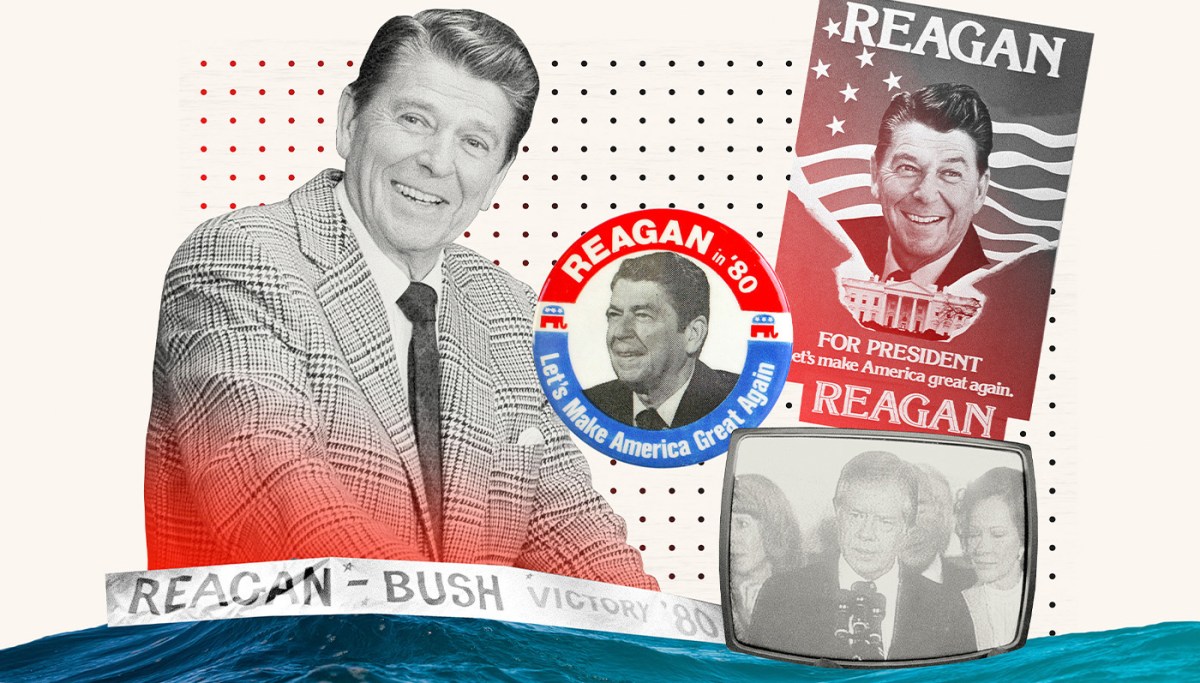
The 2026 blue tsunami upended American politics, with Democrats winning full control of Congress. The party also romped in the states, and by late January 2027, when all newly elected governors will have been sworn in, Democrats will hold 30 of 50 governorships — including nine of the 10 most populous states.Red-to-blue changes in statehouse power are part of a broader shift that will allow Democrats to put President Donald Trump on the defensive during the waning two years of his second, nonconsecutive term. Persistently high inflation and the unresolved Iran war, among other issues, helped fuel their huge wins.But the out-of-power party typically does well in midterm elections. Such was the case 60 years ago when rookie political candidate Ronald Reagan secured California’s Republican gubernatorial nomination. And then, in a political earthquake, he thumped Democratic Gov. Pat Brown to win the 1966 California governor’s race. That election had lasting political effects, setting the stage for Richard Nixon’s 1968 White House win, and culminating in Reagan’s own presidential victory in 1980. (Washington Examiner illustration; AP photos) Like the Democrats in the 2026 midterm elections, Reagan’s win over Brown, then seeking a third term, was part of a Republican wave nationally. With President Lyndon Johnson’s administration mired in Vietnam, antiwar sentiment growing, and race riots exploding in cities across the country, Republicans won 47 seats in the House and three in the Senate, although both chambers remained firmly in Democrats’ grasp.Notably, Republicans also netted eight governorships in the 1966 midterm elections. That transformed Democrats’ statehouse 33-17 edge to a 25-25 split.Reagan’s impeccable timing The California gubernatorial victory by the “ruggedly handsome” Reagan, as the New York Times described him, helped initiate a rightward push in the country. California might not have been as blue a state as it is today, but Democrats still outnumbered Republicans 3-2 at the time. Heavy turnout marked the election, just as it did in the Nov. 3 midterm elections.Reagan, who won nearly 58% of the vote, took advantage of voters’ disillusionment with growing disorder, such as the 1965 Watts riots in Los Angeles, and antiwar protests at the University of California, Berkeley. Reagan also benefited from the perception that Brown had been too tentative in response. The governor had been on vacation in Greece when the Watts riots erupted. When Brown finally returned, 34 people were dead, a swath of Southern California was in ruins, and residents throughout the state were jittery.It marked a quick political downturn for Brown, a San Francisco native who had been district attorney of the combined city and county, and then California attorney general, before winning the open 1958 governor’s race.Once ensconced in Sacramento as California’s chief executive, Brown presided over massive infrastructure growth to meet the needs of a rapidly growing Golden State, which in 1962 surpassed New York as the nation’s most populous state. That year Brown also earned the reputation of something of a political giant-slayer, with an easy reelection win against Nixon, the former vice president who had made an ill-advised bid for California governor.But Brown, who was 61 in 1966, found that change can happen quickly. It’s a lesson that Republicans are now relearning after voters in 2024 returned Trump to the White House and supported unified GOP control of Congress.Reagan, then 55, a former Hollywood actor and charismatic self-described “citizen-politician,” had impressed conservative Republicans with his fundraising and speaking chops as co-chairman of 1964 Republican presidential nominee Barry Goldwater’s unsuccessful 1964 California race. When Reagan won the California governorship two years later, his supporters were already dreaming of life beyond Sacramento, unfurling a giant “Reagan for President” banner at his victory party.When asked about the significance of his victory, Reagan made it clear he understood it was more than just a California political movement.“It seems to be all over the country,” he said. “The people seem to have shown that maybe we have moved too fast and want to pause and reconsider the course we’ve been following.”With Republicans’ big House wins, “It will be a whole new ball game,” predicted House GOP leader (and future president) Gerald Ford of Michigan. The House Republican class of 1966 included another future president, then-Rep. George H.W. Bush of Texas (though nobody used those middle initials until decades later, when his future presidential son George W. Bush got into politics).The Republican Party’s success in big governors’ races loomed particularly large in the GOP electoral triumph — none more significant than Reagan’s.“The Republicans won virtually all the nationally publicized races, held the governorships of four of the largest states, New York, Pennsylvania, Michigan and Ohio, and added to them the governorship of the biggest state of all, California,” Tom Wicker wrote in the New York Times, adding that white backlash helped fuel GOP gains.Reagan said he planned to serve out his full four-year term but left the door open to a presidential run in 1968. Other Republican candidates mentioned included Michigan Gov. George Romney (father of 2012 Republican presidential nominee Mitt Romney) and Oregon Gov. Mark O. Hatfield, who had just won a Senate seat. Both were centrists.In the Washington Post, David Broder wrote that Reagan “is regarded by many as the logical heir to Barry Goldwater’s conservative support, and therefore a rival to Romney and a threat to Nixon’s right flank.” (Reagan did wind up mounting a brief, unsuccessful bid for the Republican presidential nomination in 1968 just before the party’s national convention convened in Miami Beach, where delegates gave Nixon the nod amid South Florida’s hot, humid summer nights.)As governor, Reagan took some surprisingly liberal positions, such as signing a permissive abortion law. He also presided over a huge growth in California’s budget and big growth in state employees.Reagan won reelection in 1970. After eight years in office, he was succeeded by Brown’s son, Jerry Brown, in 1975.When Reagan ran for president in 1980, Brown’s executive aide, Hale Champion, wrote a Washington Post op-ed headlined, “Look Out, Democrats.”Champion, at the time the executive dean of the John F. Kennedy School of Government at Harvard University, admitted that, back in 1966, Brown and his staff were happy that Reagan was their opponent and even took steps to hurt his GOP primary opponent.“You know the line: Reagan is shallow, doesn’t know anything about government,” Champion wrote. “He’s so tied to the right wing as a former Goldwater and General Electric spokesman that he will be seen as demagogic and threatening by most Americans.”But in the piece, published in August 1980, Champion explained that Reagan’s political rivals had underestimated the Republican candidate’s political prowess.“How did this fellow do it? First, by not being stupid, by being what my mother used to call kitchen smart about what matters to voters and what doesn’t — and by doing the homework that counts, as against trying to memorize the political and government encyclopedias,” he wrote.“In 1966, he had Watts and Berkeley to run against in California, but he did it in a remarkably understated way,” Champion added. “He got every single white vote there was to be had from the searing racial tensions that surrounded the Watts riot, before and after. He also got all the benefit of the social unrest about what was happening on the campuses, particularly at Berkeley.”And he presciently warned that Reagan could use the same disarming style to take down President Jimmy Carter.“What Reagan did against a weakened foe in a restless, disillusioned time in California 14 years ago, I fear he can do nationally this year,” Champion wrote. “He either knows instinctively or has learned that you can get away with being a thundering conservative if you don’t thunder … The evidence both of the present and of 14 years ago is that Reagan isn’t going to make it easy for us as Democrats.”The Washington Post reprinted the piece two days after Reagan’s landslide victory over Carter, with an editor’s note: “It is even better the second time around.” That election ushered in what was known as the Reagan Revolution, a decidedly conservative shift in governing philosophy away from the New Deal and the Great Society.GUY BENSON: AN EARLY RUBIO POLL BOUNCESixty years after that first Reagan victory, political echoes reverberate after the big Nov. 3 election wins. On MS Now’s Morning Joe last month, host Joe Scarborough noted that Republicans this year had underestimated Democrat James Talarico, who broke a GOP stranglehold on Texas by winning his Senate race over Republican Ken Paxton.“It kind of reminds me of how Democrats were mocking and ridiculing Ronald Reagan up until 8, 8:30 Election Night in 1980,” said Scarborough, a former Republican congressman from Florida who has since left the party. “They just couldn’t believe that Reagan could ever be president.”Frederic J. Frommer (@ffrommer) is a sports and politics historian who has written for the Washington Post, the New York Times, the Atlantic, and other national publications, and is working on a book on ’70s baseball.
Blue wave had GOP precedent in Reagan’s first win
Full Article
Original Source
Read the full article at Washingtonexaminer →KhanList aggregates and links to publicly available news content. We do not host full articles from third-party sources. Always verify important information with original sources.