
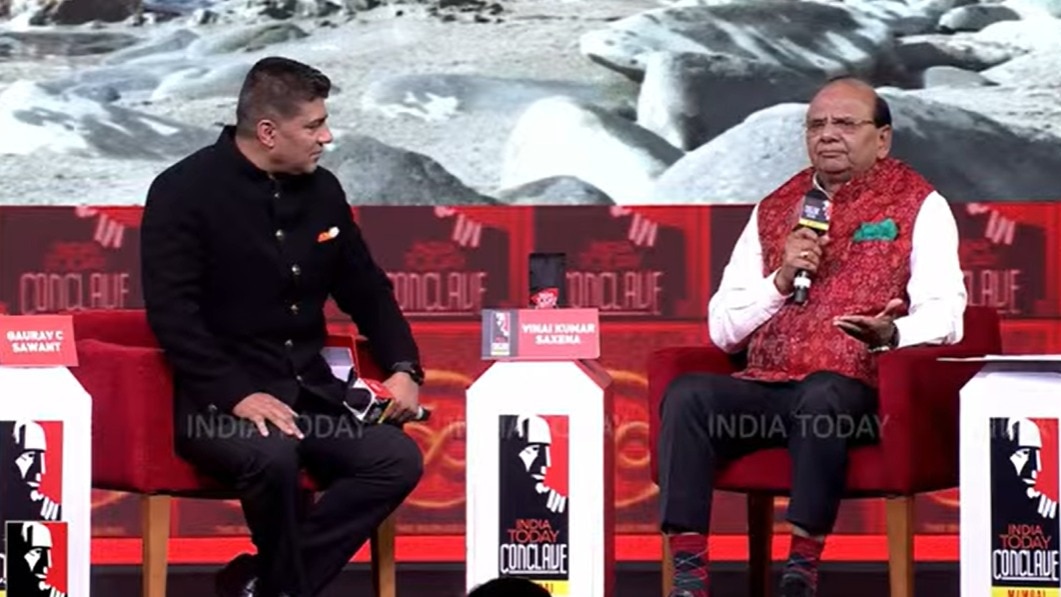
Ladakh Lieutenant Governor VK Saxena promised to resolve the region’s water crisis within a year, linking its conservation programme to Prime Minister Narendra Modi’s assertion that Indian water should serve Indian farmers.Speaking at the India Today Conclave Mumbai 2026, Saxena said he was acting on PM Modi’s message by prioritising water supply to Ladakh’s farmers through check dams, ponds and canals.In his Independence Day address on August 15, 2025, PM Modi said “blood and water will not flow together” and argued that Indian water should benefit the country’s farmers rather than irrigate enemy territory. The remarks followed India’s decision to hold the Indus Waters Treaty in abeyance after the Pahalgam terror attack.Saxena said water scarcity was identified as Ladakh’s biggest problem at his first meeting after taking charge in March 2026. Since then, the administration has diverted 5,000 million litres of water over six months, raising utilisation from 1.85% to 2.35%, he said. The target is to increase it to 10% within two years.ROCK CHECK DAMS FOR IRRIGATIONTo improve irrigation, Saxena said the administration has built five rock check dams using riverbed stones, without concrete or steel. Each stores around 20–25 million litres, he said, outlining plans for 50 such structures. The first was inaugurated at Upshi on the Indus in May under the Sindhu Jal Samriddhi Abhiyan. These barriers create pools upstream, making it easier to lift water to fields.The administration has also diverted glacier water from Stok Nallah into the Igoo-Phey and Chushot village canals.Alongside these projects, Saxena said 60 village ponds have been created and glacier water diverted to develop ponds in 50 villages. Another 100 villages are to be covered.The work aims to support farming communities, including around 50 villages where acute water shortages prevent farmers from cultivating apricots, he said.WATER USE AND THE TREATYSaxena also questioned treaty-related objections to water projects, arguing that local communities’ needs must take priority.The 1960 Indus Waters Treaty allocated the eastern rivers to India and the western rivers, including the Indus, primarily to Pakistan. It nevertheless permits specified Indian domestic, agricultural and hydropower uses on the western rivers, subject to conditions.Beyond irrigation, Saxena outlined plans to expand hydropower and solar energy to reduce Ladakh’s dependence on diesel generators. He also said he wants electricity to reach Siachen soon.The broader goal is to raise water utilisation to 10% within two years. For communities facing shortages, however, Saxena set a nearer deadline: resolving Ladakh’s water crisis within a year.- Ends
Blood, water won't flow together: Ladakh L-G cites PM, vows to end water crisis
Full Article
Original Source
Read the full article at Indiatoday →KhanList aggregates and links to publicly available news content. We do not host full articles from third-party sources. Always verify important information with original sources.