
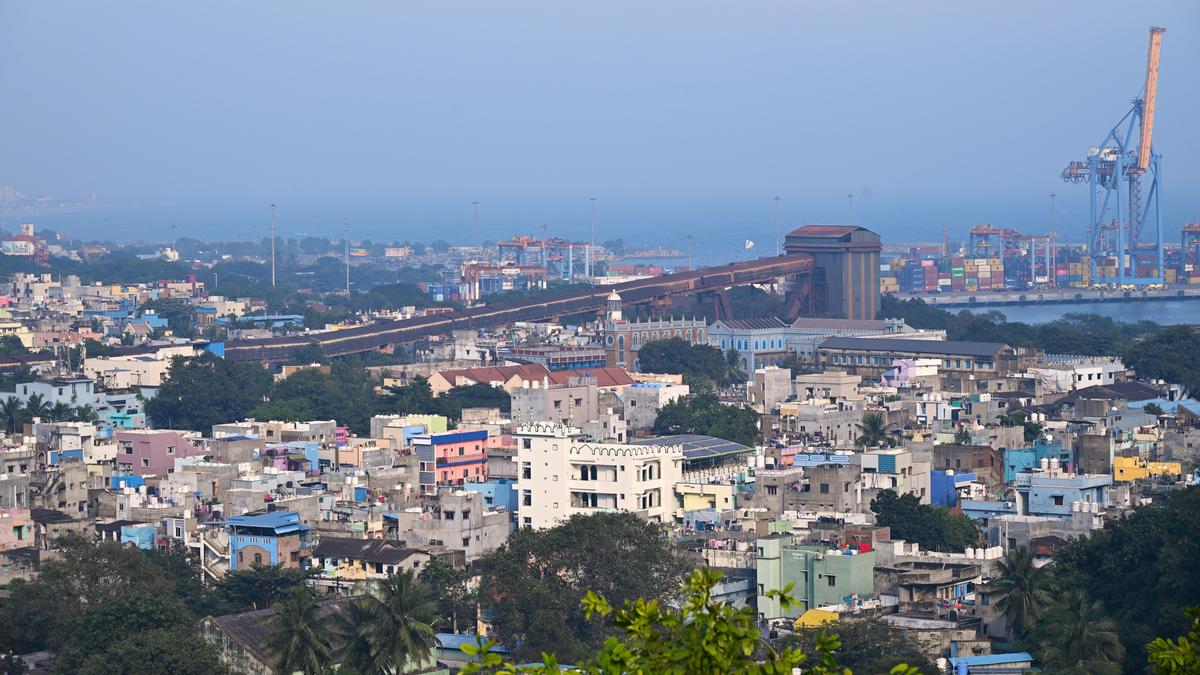
Ravi, 24, a resident of Chengalraopeta in One Town area, wakes up as early as 5.30 a.m. and switches on an air purifier placed beside the bed on which his 48-year-old mother is sleeping. Ravi’s mother has been experiencing respiratory problems, which the family believes have been aggravated due to the worsening air pollution in the area.The family has been living in the area for decades, and since the elderly and children began to suffer from respiratory issues, the family members have started taking precautions. They maintain door meshes and have installed air purifiers to prevent the pollution from entering the house and worsening their health conditions.For residents of the South Assembly constituency in Visakhapatnam, especially around Old Post Office, Kurupam Market, and Chengalraopeta, it is an uncomfortable description of their everyday reality.Although the city – home to beaches, hills, lush valleys, and colonial-era architecture – boasts an image of a happening city, a walk through the narrow lanes of the South Assembly constituency offers a different picture as residents often complain about the air feeling heavy, making breathing uncomfortable. The pollution is not merely about visible dust settling on roads, vehicles and buildings. Residents say it has become an invisible presence inside their homes and a constant source of anxiety over its possible impact on their health.“Besides respiratory issues, other problems such as eye strain, respiratory ailments, cough and cold are consistently reported in the locality. We believe they are due to dust pollution, particularly coal and iron ore,” Ravi explains. A woman shows the black dust accumulated on the wall of her house, allegedly due to dust pollution, in the Old Post Office area of Visakhapatnam. | Photo Credit: V. RAJU The impact is visible across several neighbourhoods. Walls and building exteriors lose their colour quickly, while blackish dust deposits can be seen on houses, roadside structures and vehicles. “Every morning, we are greeted by a thick layer of black dust on the windows and the walls and terraces of our house. How many times can a person clean a house, once or twice a day? But we have to clean our house at least five to six times a day to keep it clean,” Ravi says.A senior private doctor from the One Town area, speaking on condition of anonymity, says that prolonged exposure to dust pollution is increasingly affecting the health of residents, particularly the elderly and children. “Many elderly people are suffering from respiratory problems due to dust pollution, while children are frequently coming to us with complaints of persistent cough and other respiratory symptoms,” said the city-based doctor.Legislator’s dig“A person wearing a white shirt while travelling through Visakhapatnam’s One Town area in the morning could find it turning black due to the dust and pollution,” Bheemili legislator and former Minister Ganta Srinivasa Rao said during a recent Assembly session, taking a dig at the worsening air pollution in the Port City. His remark might have evoked a chuckle among the Cabinet Ministers and legislators in the House. However, the data has shown a deteriorating trend of air quality in the city.According to a May 2026 report based on the analysis done by the Pune-based climate-tech startup Respirer Living Science, air quality in Andhra Pradesh has deteriorated over the last three years, while particulate matter (PM2.5 and PM10) and pollution from nitrogen dioxide have worsened during the same period, with Visakhapatnam emerging as a major pollution hotspot.The analysis, carried out for the duration of three years between January 2024 and April 2026, states that PM10, which are coarse dust particles small enough to enter the nose and throat, has exceeded the national limit, while PM2.5, which are ultra-fine particles that can penetrate the lungs and bloodstream, has surged by 33% and crossed the national threshold. Nitrogen dioxide, a combustion gas from vehicles and industry that irritates the airways, has increased by about 44%, the report reveals. A girl shows black dust accumulated on her fingers, allegedly from coal dust settling on her terrace, at Old Post Office area in Visakhapatnam. | Photo Credit: V. RAJU The city’s air quality has also periodically deteriorated. During December 2025 and January 2026, Visakhapatnam recorded air quality levels ranging from ‘Moderate’ to ‘Poor’. The Winter months – November, December, and January – drive pollution to its highest levels across PM10 and PM2.5, and nitrogen dioxide, a pattern attributable to reduced wind speeds, temperature inversions, and lower atmospheric mixing that trap pollutants close to ground level.Heritage overshadowed by pollutionOne Town occupies a unique place in Visakhapatnam’s history. Long before the city expanded into a sprawling urban centre, the area formed the heart of the city of destiny. From Kurupam Market and Queen Mary High School to the Sri Kanaka Mahalakshmi Temple at Burujupeta and Poorna Market and to the 175-year-old St. Aloysius Anglo-Indian High School, its narrow lanes and old buildings continue to reflect the city’s heritage.But residents fear that the identity of the Old City is increasingly being overshadowed by its pollution burden.The problem, they say, is not restricted to one street. Residents of Boggu Road, Velampeta, Burujupeta, Relli Veedhi, Rangireejuveedhi, AVN College Road, St. Aloysius School Road, Barracks Road, Kota Veedhi, Lakshmi Talkies Road, Kobbarithota, Prasad Gardens, Ambedkar Nagar, Bhupesh Nagar, Lakshmidevipeta, Gnanapuram and Allipuram, Jalaripeta and many other lanes have repeatedly raised concerns over dust and air pollution.In recent months, complaints over pollution have also emerged from Beach Road and several other parts of the city.The pollution problem is not confined to the Old City. Several areas of the city and Gajuwaka are also facing concerns linked to industrial activity and port operations. Old Gajuwaka Junction, Y-Junction, Jaggu Junction and Pedagantyada have been witnessing complaints over pollution attributed to activities at Gangavaram Port. Residents have organised protests demanding measures to curb the problem.Former corporator and CPI(M) leader B. Ganga Rao stated that pollution from the Visakhapatnam Port and Gangavaram Port was posing a serious threat to residents. “The pollution caused by the Visakhapatnam Port and Gangavaram Port is severely affecting the health of residents. The impact may be long-term and may not be immediately visible. This is a serious matter of concern,” he said, calling for immediate action against cargo lorries transporting bulk materials through city roads. “These lorries are wreaking havoc, damaging roads and also leading to fatal accidents. Stringent action must be taken,” he said.Legislator flags concernsVisakhapatnam South MLA Ch. Vamsikrishna Srinivas, whose constituency includes One Town, II Town and many of the areas facing pollution concerns, said thick layers of pollutants were visibly present in the air during morning hours.The MLA alleged that some berths operated by private agencies at the port were not taking adequate measures to control dust pollution and were violating prescribed norms. He said the loading and unloading of iron ore and coal needed to be handled more carefully and alleged that vehicles transporting such material were often not properly covered with tarpaulins.Srinivas called for strengthening green belts around port and industrial areas. He also suggested examining the feasibility of underground storage systems for bulk materials and increasing the number of closed godowns to prevent dust from dispersing into residential areas.He said measures such as sprinkling water on roads could provide only temporary relief. “Water is being sprinkled on roads to control dust, but the dust then settles on vehicle tyres and is carried on to other roads, further spreading pollution,” he says.Vehicular emissions add to burdenThe Bheemili MLA says port operations were only one of several sources contributing to Visakhapatnam’s air pollution. Industrial units, pharmaceutical companies and vehicular emissions were also adding to the city’s pollution burden, he said.According to Visakhapatnam City Traffic Police statistics, the city had around 11 lakh vehicles in 2020. The vehicle population has been increasing by at least 50,000 every year, according to officials. The increase in traffic and congestion at major intersections has also contributed to vehicular emissions.“Definitely, the increase in vehicular emissions is also one of the reasons for the increase in pollution. There were proposals for road widening, flyovers and free-left arrangements to ease traffic. But these have not materialised so far, while the city continues to wait for the Metro proposals,” a senior traffic police official said on condition of anonymity.He said that during a meeting held in December last year, when pollution levels suddenly increased, officials had considered awareness campaigns urging motorists to switch off their engines while waiting at traffic signals. However, the initiative did not receive the expected public response.Orange dust cloud sparks concernThe long-standing pollution issue came into sharp focus again recently, following an incident in July in the Old Post Office area, where a sudden release of thick orange-coloured dust from a conveyor belt covered trees, motorcycles and nearby surfaces.The unusual dust triggered panic among residents, who alerted the Andhra Pradesh Pollution Control Board (APPCB). The incident also prompted the YSR Congress Party (YSRCP) to stage protests, alleging that the government had failed to take adequate measures to control pollution. A subsequent investigation reportedly found gaps in the conveyor belt system to be the cause of the dust release.The pollution control authorities initiated action against those allegedly responsible for negligence.Industries asked for time-bound actionFollowing the incident and growing concerns over air pollution, the APPCB held a high-level review meeting chaired by its chairman P. Krishnaiah. Representatives of around 18 industries, along with MP M. Sribharat and MLAs, participated in the meeting.During the meeting, Sribharat directed industries identified as major contributors to pollution to submit time-bound action plans within 60 days. The plans would have to detail the measures proposed to reduce emissions and pollution.He warned that stringent action would be taken against industries that failed to comply with environmental norms. The industries were also asked to submit monthly progress reports so that implementation could be continuously monitored.Sribharat said dust pollution was largely associated with smaller cargo-handling operators that were yet to adopt mechanised systems. The Visakhapatnam Port Authority had directed such operators to complete mechanisation within six months, he said.The MP said, in addition to the existing Continuous Ambient Air Quality Monitoring Station, three more advanced continuous monitoring stations and six additional ambient air-quality monitoring stations would be established across Visakhapatnam. The data generated through these stations would be made available to the public, he said.Meanwhile, Andhra Pradesh TDP president and Gajuwaka MLA Palla Srinivasa Rao advocated permanent structural measures to control pollution. He called for the construction of boundary walls of at least 20 feet around industrial premises to minimise the spread of coal dust and other airborne particulate matter into residential areas.
Black dust chokes lives in Visakhapatnam
Full Article
Original Source
Read the full article at Thehindu →KhanList aggregates and links to publicly available news content. We do not host full articles from third-party sources. Always verify important information with original sources.