
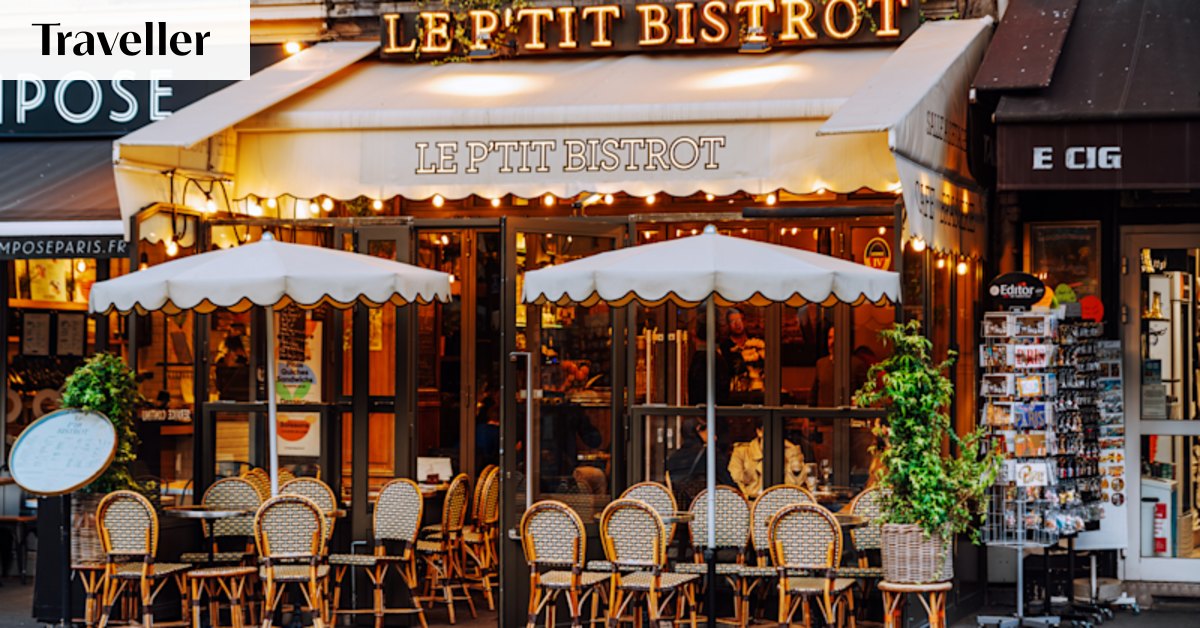
Anthony PeregrineSeptember 16, 2026 — 5:00amFrench cuisine is the best in the world. Or it isn’t. The discussion goes around and around, leads to explosions in the comments section, and gets us nowhere.What this doesn’t do is tell us much about the sorts of places in which the French eat, their differences and, in general, what to expect in the various establishments. Though the edges may have become more blurred over the years, French catering spots may still be filed under five main categories.Traditional cafes in France are ideal for people-watching.iStockThey are as follows (we’re ignoring fast food, in the hope that you will, too):CafesTraditional cafes are the extension of the street by other means (pubs being refuges from the street). In their basic form, they may be recognised by the scrape of metal chairs on tiled floors, scuffed trophies from the village’s great soccer days of the 1970s and old blokes studying the racing pages and drinking rouge from 10am, with maybe 17 teeth between them.Sign up for the Traveller newsletterThe latest travel news, tips and inspiration delivered to your inbox. Sign up now.If you are not from the village, the cafe owners will be surprised to see you. They will probably serve one dish of the day – generally veal blanquette. Otherwise they’ll rustle up a ham sandwich, pâté or a croque-monsieur (cheese-and-ham toastie; croque-madame adds an egg on top).There is no scope for whims, nuances or for exploring different vintages. This is gastronomy as sustenance at its most democratic. Such cafes don’t bend to the tourist trade – they barely recognise it – so they are ideal spots for tourists, notably if you need to know what’s wrong with every French politician, why France didn’t win the World Cup or what time is the next bus to Thionville.BarsBars in France offer the all-important aperitif hour.AlamyIn towns and city centres, bars more sophisticated than the basic cafe (“less sophisticated” would be a stretch…) serve a plethora of beers and wines you might order by region and name, as well as cocktails for those who like leaves and primary colours in their drinks.Key to note here is the aperitif hour. Aperitifs transform “drinks before the meal” into an institution. As a minimum accompaniment, you should order plates of cheese and charcuterie. Thus is joy unconfined.The best of these bars also lay on weekend brunch, with a French accent. And among the very best is Monsieur Moutarde in Dijon. Through a warren of rooms in a 13th-century townhouse, the bar offers a brunch featuring almost every foodstuff, hot and cold, known to man. Should you be in Dijon, and you should, you’d be silly to miss it.Bistro(t)sBistros and bistrots are perfect for eating like a local.iStockSmall, usually independent and often family-run, serving simple fare prepared from scratch – the sort of spot I look for in Britain and don’t find too often – these are the backbone of French catering.You will be packedinlikethis around tables that historically should bear red-checked tablecloths but usually don’t these days. Ideally, you’ll be eating whatever’s local – though, in Provence, I’d steer clear of pieds-et-paquets (the dish of simmered lambs’ feet and stomach is the region’s main weapon in keeping international tourism at bay). You may pay less than €25 (about $40) for a three-course lunch.Unless, that is, you’re in “bistronomic” territory. The concept emerged late last century as a halfway point between simple and complicated. Bistronomic spots aren’t going the full Monty for Michelin status, but nor do they want us to think they’re some eggs mayonnaise outfit. They’ve ideas above their station, and frequently good ones.BrasseriesA classic French brasserie puts on quite a show.AlamyOr, in other words, the full floor show of French cuisine: soaring ceilings, chandeliers, mirrors-a-go-go, banquettes, white tablecloths, bustle, Art Deco and more flamboyance than is usual in daily life. If you enter and don’t feel mildly uplifted, you’re probably in the wrong place.Sharp uniformed waiting staff – aprons, waistcoats, bowties, that kind of thing – surge about toting platters of seafood they can barely see over, or a full choucroute (French sauerkraut) with its cardiac arrest array of sausages and pork cuts.Go for the early morning through to late-night opening hours, country pâté through to lobster dishes, and artist through to aristo and stock exchange style – and you’re being as French as you can possibly be.Such brasseries are all over the place – Brasserie Georges in Lyon, Brasserie Le Français in Bourg-en-Bresse, an abundance in Paris (not least the Terminus Nord by the Gare du Nord) and, perhaps best of all, La Cigale in Nantes. Essentially, the owners have gathered all the Art-Deco stuff they could find and bunged it in. It should be set to music by Offenbach. The food and service are exemplary, too.RestaurantsExpect verbose menus and considered wine choices when dining at a French restaurant.iStockThis category takes in everyone else, from the young-couple operation with innovative ideas concerning low-temperature cooking (see Les t’OCqués, Montpellier) through some startlingly good Italian, Vietnamese and Maghrebian establishments (see Vietnam Délices in Toulouse or Le Palmier in Marseille) on to those places aiming for Michelin stars. Here, as you enter, you must suspend disbelief. The curtain goes up, metaphorically. Usual values don’t apply.The chef will have a philosophy spread over quite a number of lines on the menu. However extreme the verbosity, all it means is that he or she is cooking fresh produce as well as possible. Which is what you’d expect anyway. Much hangs on your choice of bread. Will the 2010 or 2016 Châteauneuf du Pape go best with the flurry of starter dishes? Who would have thought that raspberries, a dab of fennel coulis and a beetroot crisp went so well with monkfish?High-skill, top-end cooking is extraordinarily difficult. It pulls all French catering upwards, and I really like a crack at such cuisine a couple of times a year, just to remind myself what it’s all about. Also to empty my wallet. But it can be an endurance test; proper appreciation of great subtlety becomes hard work after the first 60 minutes.You might go once during your stay. Do arrive on time, wear something other than shorts and your sports team’s jersey and react with decorum when treated as a potentate. I’ll be in the brasserie down the road, being noisy and paying a fifth the price.The Telegraph, LondonFrom our partners
Bistro or brasserie? What you need to know about dining in France
Full Article
Original Source
Read the full article at Smh →KhanList aggregates and links to publicly available news content. We do not host full articles from third-party sources. Always verify important information with original sources.