
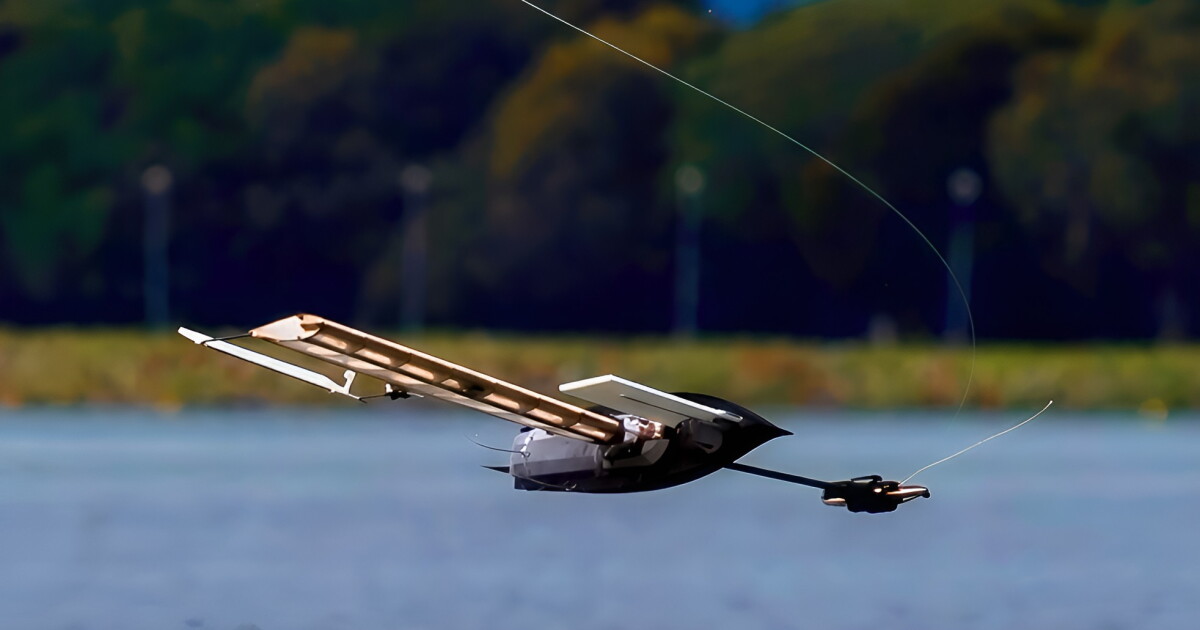
“Fall like a maple seed, sail like a boat” sounds like advice from legendary heavyweight boxer Muhammad Ali. In reality, it describes a new robotic platform scientists have created for fast, long-term deployment to monitor remote waters.Researchers at the Singapore University of Technology and Design (SUTD) have developed what they call ALBATROSS, short for Airborne Lander with Buoyant AuToROtating Sailing Sensor; a nature-inspired, concept robotic platform that can be deployed from an aircraft over remote waters, land in water, straighten itself, and then sail autonomously using wind energy. The researchers say future deployments of the current prototype would be able to remain at sea for weeks at a time, monitoring environmental conditions.Monitoring remote locations in the wide open sea presents a unique problem. Boats and other watercraft can traverse a desired area for extended periods, gathering the required data. However, they may take a long time to travel from the deployment point to the desired destination. Aircraft, on the other hand, can reach a destination relatively quickly but cannot stay on station nearly as long as their sea-borne counterparts. The researchers' proposed solution combines the best of both worlds. A depiction of an ALBATROSS deployment scenarioSUTD “Surface systems are useful because they can remain at sea, but they are constrained by how long it takes to get to the target location,” says Prof. Foong Shaohui, Associate Head of the Engineering Product Development Pillar at SUTD. “With ALBATROSS, we wanted to use the best of both worlds: the speed of aerial deployment to reach remote waters quickly, and the endurance of sailing to remain there for long-duration monitoring.”In a practical scenario, an aircraft carries the ALBATROSS platform across open waters and deploys it over a designated area. The platform features two rigid wingsails that slow its fall through the air and also power it across the water, removing the need for a separate parachute or landing mechanism. As it descends, the wings passively autorotate like a maple seed, slowing and stabilizing the platform as it approaches the water. Once it lands in the water, the platform rights itself and the wings act as sails, harnessing the wind to move around. The robot also features a fish-tail-inspired rudder for steering.“We designed ALBATROSS to use the environment rather than fight it. It falls through the air using passive autorotation, rights itself on water through its weight distribution, and then uses wind to move,” says Dr. Shane Kyi Hla Win, lead author of a paper published in Science Robotics. “That simplicity could enable lower-cost and more scalable platforms for sensing in places that are difficult to reach.” The robot sails across a reservoir as part of the studySUTD Once fully deployed in the water, ALBATROSS navigates autonomously between set waypoints using just three actuators and three navigation sensors. To test the concept, the researchers released a prototype from an altitude of 150 meters (492 ft). It stabilized during descent, landing on the water with low impact. It then autonomously righted itself and sailed off into the sunset. OK, not into the sunset, but around the test environment. The researchers estimate that a similar platform, without the autorotation system, would experience about 18.5 times more impact energy upon hitting the water.During reservoir trials in Singapore, a larger ALBATROSS prototype reached a peak sailing speed of about 1 km/h (0.62 mph) and operated for about three hours, gathering data on humidity, heat levels, and wind direction using onboard sensors. The researchers see potential applications in environmental monitoring, climate change research, search and rescue, and maritime security. The platform’s wind-powered locomotion could allow missions to continue for long periods using relatively little energy.So far, ALBATROSS has lived a sheltered existence in controlled test environments and has yet to prove itself in the grueling real-world conditions of open waters. The researchers describe getting the platform ready for real-world testing as the upcoming stage of the project. “The next step is to take the design principles we have demonstrated in sheltered waters and scale them towards open-sea operation,” says Prof. Foong. “That means making the platform more rugged, more durable and ready for harsher maritime environments.” Future versions would also feature a broader array of sensors such as underwater sensors and sonar, as well as larger energy-storage systems.Source: Singapore University of Technology and Design via EurekAlert
Bioinspired robot airdrops into remote waters via morphing wing-sail
Full Article
Original Source
Read the full article at Newatlas →KhanList aggregates and links to publicly available news content. We do not host full articles from third-party sources. Always verify important information with original sources.