
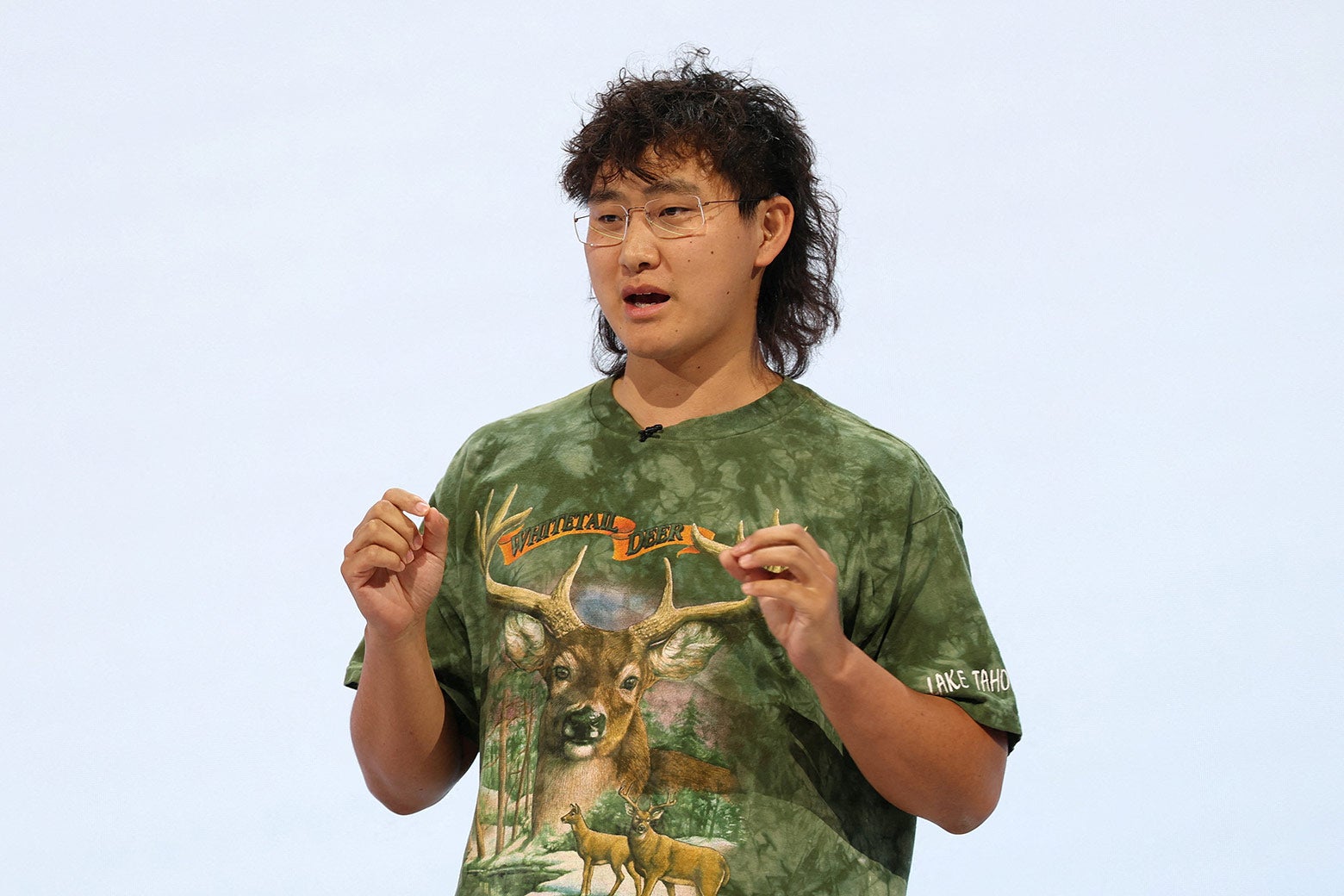
The Industry The Billionaire in Crocs Would Like You to Trust Him Silicon Valley’s most powerful men have discovered the appeal of looking harmless. Alexandr Wang at Meta Connect. Carlos Barria/Reuters Sign up for the Slatest to get the most insightful analysis, criticism, and advice out there, delivered to your inbox daily. Five years ago, then 24-year-old Alexandr Wang’s startup, Scale AI, hit a $7.3 billion valuation, temporarily making him the youngest billionaire in the world. He graced magazine covers and appeared above the fold on newspapers, sporting the look that he would become known for: an unbuttoned popped collar and a sassy little crew cut, looking incredibly young and innocent for a man who created a company being investigated for hiring overworked and underpaid contract workers in Africa to build out gigantic sets of labeled data and large-language-model evaluation services for other A.I. companies. That was five years ago. Now 29 and an A.I. executive at Meta, Wang’s got a new look. He stood onstage at Meta Connect last week in an outfit that immediately launched a swarm of online discourse: a camo graphic T-shirt that read “Lake Tahoe,” black joggers, matching Crocs, and a shaggy, loosely styled mullet. In Reneé Rapp–esque wire-framed glasses, he no longer looked like the youngest billionaire in recent history but rather a precariously employed part-time DJ with a menthol-cigarette problem. It makes no sense! How could it be that the elf in a button-down shirt now looked like someone’s cool bisexual cousin! Some were insistent that the outfit must be head-to-toe designer, with a few Twitter users speculating that the Crocs must be Balenciaga ones and the pants must be Prada, estimating the total outfit cost at $3,500, until Wang hopped on X with an annotated graphic revealing the prices. In a post, he said he actually thrifted the shirt for $30 and, for whatever reason, also drew an arrow to his crotch and said that his underwear were $5 from Calvin Klein. “Excuse me I must correct the record on this slander,” he wrote in the caption. Tech executives are no stranger to a Princess Diaries–style makeover. Mark Zuckerberg was superglued into those Brunello Cucinelli gray T-shirts until he started wearing oversize Amiri tees in an effort to seem cooler. Jensen Huang started Nvidia wearing garden-variety polo shirts but is now probably legally required to buy every single black leather jacket he comes across for the rest of his life. Jeff Bezos appears to now be wearing all the Amazon returns from every single sorority’s themed rush parties from across the nation. Still, this is probably the strangest rebrand we’ve seen so far, partly because there was no public impetus for such a visible change. Sure, we can write some of this off as the natural evolution of personal style changing with time, but the playbook of large A.I. companies right now is to make their tech seem as cool as possible, particularly in an era when most people are already suspicious of its adverse impacts on their lives. That factor is impossible to ignore. Attempts at garnering swag points have arrived at pointed moments in recent tech history: Zuckerberg’s style evolution first appeared when he announced key updates to Meta AI; Palantir announced it was adding a trendy chore coat to its merch line (yes, its merch line) in April days after it was reported that Immigration and Customs Enforcement was paying them $30 million to build an “ImmigrationOS” surveillance platform, and the company had published a controversial mini manifesto that basically explained why it simply had to create technology to bomb countries overseas. We cannot write treat these moments as a write-off, because they’re not. Palmer Luckey, 34-year-old co-founder of Anduril, is building the world’s next frontier of warfare for the Pentagon but wears a uniform of exclusively Hawaiian shirts and cargo shorts. It’s countersignalling—how could the guy with a soul patch be building A.I.-powered drones that are scanning battlefields to kill with more accuracy? He’s got palm trees on his shirt! That’s fun! Visual choices matter, and this is a venture with high stakes. Meta sunk $14.3 billion into Scale AI, in order to buy Wang into its ecosystem and spearhead its artificial intelligence lab. It’s the tech that’s powering its creepy glasses, its open-source coding model, and now its bid into the battle of personal agents that will basically turn the experience of scrolling online into a water slide. At Meta Connect, underneath his mullet, Wang presented the updates to Meta Muse, including new security measures, a Mac app, and rollouts to more countries. “This is how you make personal agents for everyone,” he said. The consistent theme was that there was a reason for all of us to be using the personal A.I. agent. He then told a pretty weird anecdote about how he could track different users’ searches on Muse, offering specific examples like one person who broke their mother-in-law’s “favorite china set” and another who was planning a vacation with his wife. Again, visual choices matter. Even if the choice of this outfit is that Wang is soft-launching his stick-and-poke tattooing side hustle, it’s still a conscious choice. This doesn’t just exist in the corporeal world, either—Meta and OpenAI are currently locked in a battle of personal A.I. agent tools, and both of them come in the shape of weird, glossy, cartoon assistants (here is a post that Wang reposted on X of the Meta Muse mascot, named Jolly, eating the OpenAI Dots for breakfast). Why did they both choose kid-friendly cartoons to act as assistants, and not a busty Jessica Rabbit or the likeness of an accountant in Reno? I mean, both options are technologically possible. Wang wants us to believe that he’s just like us, that his product is right for all of our lives. So it’s important that he look and feel like us. He isn’t wearing Balenciaga Crocs, but the Realtree hunting collaboration ones that cost $60. It’s slander to allege that he’s above us, just because he’s been one of the richest people on the face of the planet. He would never buy Gucci glasses (“lol no” he wrote in his correction diagram)—why would he? Where would he even get the money? We’re in an era of mask-off technocratic rule; we know that tech industries hold a huge amount of influence over our lives, that they are amassing a level of power and wealth never seen before in history. But they still want us to keep using their products, even if we are more uneasy about their safety. Perhaps it’s easier to believe that these products are less harmful from a guy who’s dressed like your high school weed dealer who ended up studying theater at Oberlin. Zuckerberg spoke alongside Wang at the same keynote address, wearing his new Hillsong pastor drip, the T-shirt this time emblazoned with the slogan “Building is my love language.” I’m not too convinced about the love language part. I don’t think they’re building for love anymore. Artificial Intelligence Facebook Fashion Mark Zuckerberg Silicon Valley
Billionaires Are Suddenly Dressing Like They Deal Weed. I Have a Theory Why.
Full Article
Original Source
Read the full article at Slate →KhanList aggregates and links to publicly available news content. We do not host full articles from third-party sources. Always verify important information with original sources.