
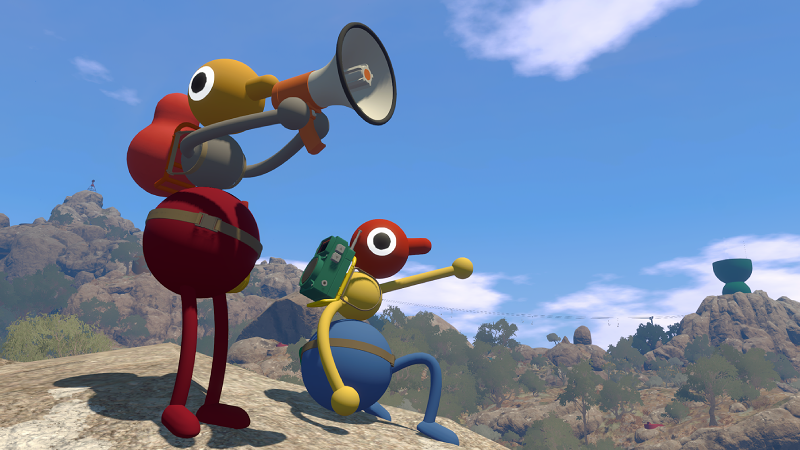
Published Nov 14, 2026, 9:30 AM EST House House's Jake Strasser unpacks one of 2026's most celebrated multiplayer experiences What really went into making Big Walk House House's Jake Strasser unpacks one of 2026's most celebrated multiplayer experiences Image: House House Big Walk started as a respite from the reality of lockdown. The team at House House (Untitled Goose Game) needed to get out of their house houses at a time when they couldn’t. So they built a new way to chat. That became a new way to play. That became an island to call their own. That became a playground on which they could fundamentally rethink and challenge the multiplayer co-op experience. Big Walk started small, then grew and grew and grew. Earlier this month, the team at House House found itself at the middle of a minor scandal: As it noted in a statement, added to Big Walk’s FAQ, there was a point where a lighting physics issue in Unity, the engine with which they built the game, seemingly had no answers (or as a Unity engineer told them: “what we wanted wasn’t possible.”) The team resorted to using an LLM chatbot to crack the literal code and allow for their vision to take shape. On Nov. 19, a group of influential members of the Indie Game Festival's jury released a statement saying they wouldn't vote for any game that used gen-AI tools (which includes Big Walk) for this year's awards. This immediately resulted in a storm of debate around the art of code, the degree to which LLM usage demands AI disclosure, how ethically minded players should interpret “AI usage,” and the emerging minefield that technology has created for developers who aim to make a truly great game. After a week of chewing on it, all I know for sure is: Big Walk is a truly great game and an incredible amount of artistry went into making it. In a conversation I conducted a few weeks prior to the blow-up, Jake Strasser, co-founder of House House and a lead designer on Big Walk, discussed how proximity chat shaped the game, why collaboration sometimes needs friction, and what his team learned from players forging genuine connections. If a number-crunching chatbot took Big Walk over the finish line, I'd say the five-person team at House House clearly broke a sweat running all the way up to the edge. Polygon: What makes a great multiplayer game? How did that perspective shape Big Walk? Jake Strasser: I think the thing that we were looking for when we were starting Big Walk was a multiplayer game that was a truly shared experience. We found that a lot of games get you in and get you together, but you're kind of playing in parallel. Everyone's maybe on their own track or doing their own thing, and being together isn't necessarily that important to the gameplay. For Big Walk, we wanted everything to be shared. How did Big Walk evolve into a game House House was ready to pursue and gamble on? I felt similar to how we've made our other games — it all felt like tumbling into something. When we started making Big Walk, we thought we were making something much smaller than it ended up being, almost like a small game that would test some technical aspects of a bigger project that we thought we were going to make after that. We wanted to learn networking. We wanted to figure out the basic building blocks of a multiplayer game. But we found that the starting point of proximity voice chat and the feelings that you got out of really feeling like you were sharing a space together, that feeling was so special that we just wanted to keep exploring that. We started making the game during COVID lockdown, and so we needed and wanted a place to get together when we were all in our own homes and couldn't do it physically. By necessity, we started creating this space to hang out in and felt this real magic. And then we took Kalonica [Quigley] in, who's now the fifth member of House House, and gave her a tour of this island. It was much smaller than the final thing, but it was really just an island with a bunch of trees and a few rocks, and maybe the red lookout tower was there, or an earlier version of it. There was a giant floating sphere and maybe just some really primitive shapes. But we took her around and had this really amazing experience just exploring together. It felt social and fun, like hanging out with your friends. Then we tried to do it again with two [people] from the studio that we share our office with, and the magic wasn't there. We realized that we needed design. We needed to make a video game in order to bring that magic out. We felt like we were retracing our steps with what we did with Kalonica, and it wasn't the same. We needed more structure around the experience, and that's where the challenges started coming in. We started growing out this thing so that the game itself would point you towards what we felt was special and give you these opportunities to play with it. Early on, what challenge made the game click for you? For me, one of the first things that really sang was a constructed experience in the game that was very early on: we put in a huge cinema screen that you could play music through. The feeling of sharing media together in the game and having it sound like an enormous festival sound system, with the day-night cycle and the feeling of being in nature, and recognizing these feelings from being out at festivals and things from our lives, that was one of the first real sparks of magic. In terms of the actual challenge and puzzle design, it did take a while for us to figure out what a “challenge” was in Big Walk. The first one was what we called a gauntlet, and it was just a bunch of doors that one person had to walk through and other people had to press buttons to open the doors. You're in a tube just yelling out and waiting for someone to press the next correct button so that you could keep walking through and get the thing at the end. That was the opposite of when we realized what the magic was, but I think we were pushing toward it. Image: House House/Panic via Polygon What did you learn wasn’t fun while experimenting on the island? There were some challenges that people could do alone, which I think they probably still technically are, but we would find that certain players might go off by themselves. In a very early playtest, when that gauntlet was still in, a friend named Tom just disappeared from the group and went off and was doing stuff by himself. There was the fielding challenge, which shoots a Pomodoro timer out of a cannon, and you have to go get it. He just did that by himself, secretly got the prize and brought it back. Didn't tell anyone about it. At the time when we were playtesting, we were all in the game as ghosts who had noclip, and we were just literal flies on the wall spying on people. We were flying around watching Tom go off and do this and come back. He was having a kind of fun, but from a group perspective, we considered that not fun. Even the fact that he could stash the prize object into the monument without needing someone else. Part of the design in Big Walk, you need two people to even put those things away. You need someone to press the button to open the lid and someone else to place it in. So to us, enforcing a kind of fun, a kind of togetherness, a kind of collaboration was more fun in our minds. How did you balance realistic physics and light with the cartoony look of the world? How did Big Walk need to feel? I think something that we maybe learned, or interpreted in hindsight, with making Goose Game was that giving players a lot of things they recognize, and having your game exist in a world that is recognizable to regular people, lets it come with a bunch of rules built in that everyone understands intuitively. So in Goose Game, that was all just everyday objects. You understand the context and nature and importance of different things and the relationship they might have to the people who own them. And in Big Walk, we're not dealing with society particularly, but we are dealing with socializing in that sense, like a society that you build as players in the game. I think having everything feel very grounded means things you take for granted normally in games, things like eye contact and touch, and down to the physics, that stuff should just act like it ought to and that we expect it to. It makes it so much easier for players to jump in and have a fun time and understand the rules of the world you're in because it matches real life. Image: House House/Panic via Polygon Big Walk isn't necessarily a narrative-driven game, but do you look at it now and think: this is about something? We talked a bit about the instinct toward creating lore for a game as designers. What is the nature of this place? Who made it? We have our own sense of what those answers are, and… they're not important. I don't really want to say them. As we went along, it became clear to us, or it was almost a running joke, that the story of Big Walk is that House House made a big island for people to go and play on. It is literally itself. There's no added text in our minds. So the game is a space for people to get together and have this experience. The story that happens is the playthrough that players have. What stories has Big Walk created for its players? What have you heard from people? We have been sent countless emails from people telling us their stories. It's been astounding what kind of impact the game has had on people. We've had cousins who've never met in their lives reconnect by playing a game of Big Walk together. Someone reached out and they ended up spending 10 hours playing together in the game and truly meeting each other for the first time. Siblings saying that they helped repair their relationships. I'm a dad, I've got a two-and-a-half-year-old, so the dad and son stories always get me. Parents who feel like they're connecting with their kid in a way they haven't been able to before in this game. People finish the game and say goodbye at the end and feel like they've had this really special time together. They come away feeling almost a sense of loss that they're not going to be in this space anymore together, which is wild. This sounds a lot like “the last day of camp” — despite being temporary, players have an intense and profound experience. Yeah, totally. You go back to normal life. I would hope, as a person, that you bring the things you learned at camp back with you and you come back changed. That does seem to be the case with some people, like couples who say that the game helped them understand and get better at communication in general. It's really beautiful. It's amazing. It's hard to express the magnitude of the feeling, because it's coming in through emails. We're just getting a sliver of it. People are trying really, really hard to express what the game's done for them. Even feeling compelled just to reach out at all, you can tell it's having a big effect on people. Spoilers for Big Walk's ending follow Is there a challenge or moment in the game where all the elements of Big Walk come together? That feels emblematic of the thing your nascent idea grew into? Big Walk is a game about being together with your friends, and it's a game that forces you to do things together, to the point of maybe causing almost friction. There are things that players might feel they should be able to do more easily, or that in other games you would be able to do more easily. Like take something out of your backpack: You need someone else to put on your backpack and put the object in the backpack, and then take it out of the backpack if you want it. You need other people. It's a game that's all about sharing that communication and being together. And part of that is it's a game that splits you up and makes you feel like you have to be alone sometimes, and that will hopefully just make it feel even more special to be back with your friends. You feel the togetherness more sharply because you've been alone. Through the time that you spend playing it, you develop the skills to play the game, but you're also developing your own group communication. You're developing a shared language to play, and your own understanding of each other and just the things that you do when you spend time with people. So you play through the bulk of Big Walk and then you get to the ending, which is a black orb where we take everyone's voices away and anonymize you. We suddenly make you use all the skills that you've learned in a new situation that you weren't necessarily prepared for. But people work it out. Part of our vision is giving players a lot of space to develop all these things for themselves. I think of it now almost as parenting. You need to give players a clear framework of how to do things and build up their skills and also give them the confidence. There's a point where you need to push them out in the world and have them figure it out themselves. I feel like the ending is a real big push where you're suddenly, as a group, cast off and need to figure it out on your own without the tools that you normally had. And people invariably rise to the occasion. A lot of that is Nico [Disseldorp] and Stuart [Gillespie-Cook’s] great design of those challenges and how they’re formed around the players. That took a lot of iteration and a lot of work to get it feeling the right kind of magic, and having it feel like players were cast adrift just enough, but also like they could come through and figure it out together. When that sequence is over and everyone can speak again, and they've spent so long speechless, anonymized, and suddenly have the chance to talk again, I think that puts the whole game in a microcosm a little bit. Do you think Big Walk can be underestimated as a work of art because it doesn't look like a giant competitive multiplayer game or a typical friend-slop game or a solo-developer creation? The scale is elusive. I think Big Walk can be underestimated in some sense. People who haven't played it might not know what they would be getting into. But I think everyone who has, and who has spent the time and meets it halfway or any part of the way, seems to have an amazing experience. We love it and we love playing it. We haven't played it since we content-locked, so maybe a month or two before launch. It's been a little while. But we all played it through as a group, the five of us, and 100-percented it. It was such a beautiful experience and such a nice way to send the game off, and feel like it was finished emotionally. I think people who play it seem to really love it in the same kind of way. And that's just the best feeling as a creator, that you make a thing and you hope that people get it. It seems, as far as I can tell, that heaps of people really get Big Walk in exactly the way that we hoped. And the thing they're getting from it may be benefiting their lives in a deep way. That's crazy to say, and really humbling and beautiful. Free sign-up Get Polygon’s Wishlister newsletter A weekly cheat sheet to what you’ll eventually love to play. No buying, no commitment — just saving for later. Sign up free Free. Unsubscribe anytime.
Big Walk's AI Controversy Overshadows a Remarkable Creative Achievement
Full Article
Original Source
Read the full article at Polygon →KhanList aggregates and links to publicly available news content. We do not host full articles from third-party sources. Always verify important information with original sources.