
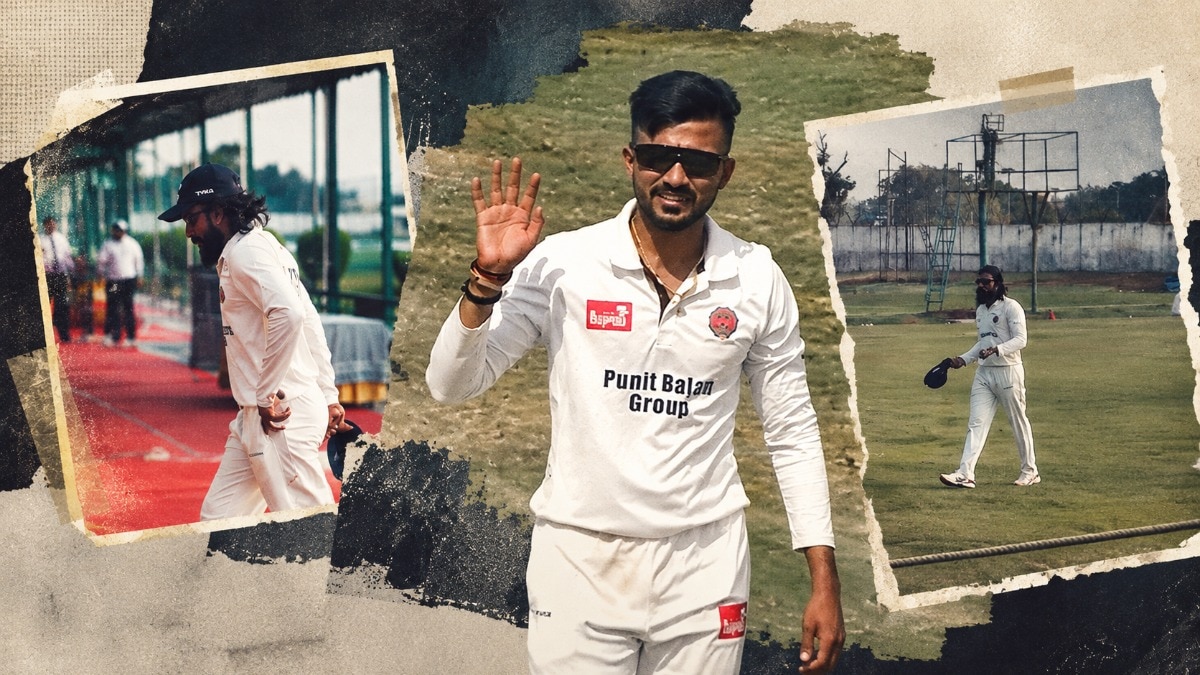
Hitesh Walunj was padded up and taking throwdowns near the sight screen at the Air Force Complex Ground in Palam, Delhi, as the day’s play wound down on Tuesday. Out in the middle, Maharashtra were having a tricky final session against Services, losing five wickets for 66 runs in their second innings.The 33-year-old left-arm spinner had already done his bit with the ball, five wickets that had given Maharashtra a 106-run first-innings lead in their Ranji Trophy Elite opener. But the pitch was getting trickier with every session, and a 10 or 20 from him on the final day could matter. He was not going to wait for the game to come to him.RANJI TROPHY, OCTOBER 13: WRAP Hitesh Walunj opened his Ranji Trophy season with a five-wicket haul, turning years of persistence into a timely statement. The instinct to keep working comes naturally to Walunj. He knows a five-wicket haul in the opening match of a season is a good start, not a guarantee. He has been here before, on the fringes of a Maharashtra side that has never been short of competition for places, with seasons in which wickets came in a rush and were followed by another long wait. At 33, he is still working towards the next opportunity. His is the story of a man who chose cricket over the security of a regular job, and kept making that choice when nothing suggested the game would reward him.A DREAM DEFERREDWalunj started playing cricket at 14, but the road to the Ranji Trophy was anything but straight. He did not come through Maharashtra’s age-group system. His state debut came directly in the Syed Mushtaq Ali Trophy, the domestic T20 competition, in 2018-19, when he was 26. The Ranji Trophy cap, the one that mattered most to him, took another five years. “I had to wait 16 years just to play Ranji Trophy cricket, which is a dream for everyone,” Walunj tells IndiaToday.in in Palam.“I haven’t played just one specific age group; I directly made my Syed Mushtaq Ali debut at the age of 26 in the 2018-19 season. After that, I had a three-year break, and then I made my Ranji Trophy debut at 30.”CHOOSING THE UNCERTAINThe wait was not only about selection. It raised a bigger question: what would he do with his life if cricket did not work out? Walunj had completed his B.Com, and his parents, like many in a middle-class household, wanted him to find a secure job, settle down and build a future. His mother stitched tiffin bags; his father worked as a servant. Their worry was understandable. Cricket, particularly the kind of career Walunj was pursuing, offered no monthly salary and no assurance that the next opportunity would come. With his family hoping for a secure future, Hitesh Walunj chose the uncertain road of cricket and kept going. (Photo: Instagram) Walunj, however, knew what he wanted. He had already given a large part of his life to the game, and he was unwilling to walk away without giving himself one more chance.“If I wanted a regular job, I could have done it at 19 or 20 right after graduating. Why would I waste the next five or six years?” he says.“My mindset was clear that I had given 10 to 12 years to cricket, so I could give another two years 100%. That was my mindset.”He does not blame his parents for wanting something safer for him.“Every mom and dad has expectations that their son should get married, settle down, and secure a job. As a middle-class family, their mindset was completely fair, and I don’t blame them,” he says.But he had to make them understand that the decision was his to take.He told them: “You don’t need to worry about me. I will never do anything that ruins our family name or brings disrepute, so don’t worry. Whatever I do, I will do it myself. Just be happy and mentally support me.”FINDING A WAYThere was no easy way to pay for that decision. With no regular job and no monthly income, Walunj began travelling across India to play cash-prize tournaments, taking whatever came his way. He went to Goa, Kashmir and smaller towns across Maharashtra, playing T20 cricket to cover his expenses and gain match experience. The journeys were often by bus, depending on what the organisers could manage. It was a way to keep playing while paying his own way, rather than sitting at home waiting for a call that might never come.For a cricketer in that position, the mental strain can be as demanding as the physical work. He had to keep believing that the wickets he took and the matches he played would eventually count for something.“It is a very difficult phase when you keep performing and don’t get picked,” he says.“As a cricketer and a sportsman, my mindset is: ‘Fine, today I took 20 wickets, tomorrow if I don’t get selected, no problem, I’ll take 30 or 40 wickets.’” Sixteen years chasing a Ranji Trophy dream, with every wicket bringing him one step closer to what he still wants most. (Photo: Instagram) The pressure at home, he found, could be harder to handle than the uncertainty on the field.“The family pressure and their expectations of you settling down with a job are much more dangerous for an athlete,” he says.“During those times, you need immense mental stability to explain things to your family.”Friends helped him through those periods, reminding him he was on the right path and urging him to be patient. He kept going.LEARNING AND WAITINGA big push towards first-class cricket began in 2022, when Walunj was brought in as a net bowler for Chennai Super Kings. He had briefly entered Maharashtra’s Ranji set-up during the truncated, Covid-affected season, only to be pushed back as the tournament was disrupted and younger players, including members of India’s Under-19 World Cup-winning side, were prioritised. It was a hard setback to take, but an opening appeared elsewhere.Walunj credits Ruturaj Gaikwad for the CSK opportunity. Gaikwad knew he was performing well and urged him to bowl in the nets and use the experience to improve.“He told me, ‘Come here, bowl in the nets, and gain experience; it will help your overall cricketing growth,’” Walunj recalls.It was a chance to work alongside players he had watched from a distance, and to see what preparation looked like at the top of the domestic and franchise game.Among them was Ravindra Jadeja. Walunj spent time talking to the India all-rounder about bowling and the mental demands of cricket, and the conversations stayed with him.“I had extensive conversations with Jadeja about bowling and mindset,” he says.“I believe that at a certain level, whether playing Ranji Trophy or international cricket, skills don’t matter as much as mindset. Mindset is what helps you tackle difficult situations.”When his chance finally came, he took it emphatically. In his first season, he took 14 wickets in a single match against Saurashtra, six in the first innings and eight in the second, and dismissed Cheteshwar Pujara twice. That could have told him he belonged at this level. That season brought 41 wickets in seven matches, among the most in the competition, and the one after that, another 29. Still, he has been in and out of the side. Last season, Maharashtra’s options changed with the arrival of veteran all-rounder Jalaj Saxena from Kerala, and Walunj made way. He played just one match and took four wickets. After two productive seasons, he was back to waiting.Through all of it, Kedar Jadhav has been there. The former India cricketer, who comes from Pune and knows Maharashtra’s domestic system intimately, has been a mentor to Walunj, helping him through difficult periods and backing him when he needed cricket equipment.“Kedar Jadhav has helped me immensely, both mentally and in breaking through in cricket. He is like a mentor to me,” Walunj says.“In every aspect, whether it is mental support or getting cricket goods, he has always backed me. In cricket, you always need a mentor, and he is mine.”But Walunj is careful not to suggest that any single intervention built his career. The CSK nets gave him experience, Jadhav’s mentorship gave him support, and the Ranji Trophy eventually gave him a stage. None of them removed the uncertainty.STILL CHASING MOREThat uncertainty is still there, even after his latest five-wicket haul. His first-innings effort against Services came through 29 overs, eight of them maidens, on a surface he described as a grinding wicket rather than one offering extravagant turn. For a spinner, he felt, the first 20 overs could give you something to work with, but the job was to keep bowling and make the batter earn every run.The preparation for the new season had been extensive. Maharashtra played a number of matches in the off-season, held a fitness camp, took part in a Karnataka State Cricket Association (KSCA) tournament and then hosted Goa for further practice games. Walunj believes that volume of match practice made it easier to execute plans from the first game.“When your preparations go well and you start executing them right from the first match, it sets a wonderful tone,” he says.“Starting this well makes the rest of the season much more enjoyable.”He is working on his batting too, conscious that a player who is not guaranteed a place cannot afford to neglect any part of his game. The throwdowns at the sight screen were a small illustration of that thinking. He had taken five wickets, but the match was not over and there was more work to do.At 33, Walunj has not let go of the ambition that has carried him through the long wait. Asked whether he still dreams of playing for India, he does not hesitate.“100 percent! At 33, if someone like Saransh Jain can make his debut for India, why can’t I? Every cricketer’s ultimate ambition is to play for India, so 100 percent, I want to play for India in the coming year.”It is a bold ambition in a system where competition is relentless and the pathway narrows with every passing season. But Walunj has spent much of his cricketing life in the space between what is possible and what is promised. He knows good performances do not always bring selection, that a breakthrough can be followed by another wait, and that persistence guarantees nothing.For now, he has done what he has always done. He has prepared, taken his opportunity and looked for another way to help his team.It took Walunj 16 years to earn a Ranji Trophy cap. He is taking throwdowns so he never has to wait that long again.- Ends
Beyond Indian cricket's glamour: Hitesh Walunj and the grind nobody sees
Full Article
Original Source
Read the full article at Indiatoday →KhanList aggregates and links to publicly available news content. We do not host full articles from third-party sources. Always verify important information with original sources.