
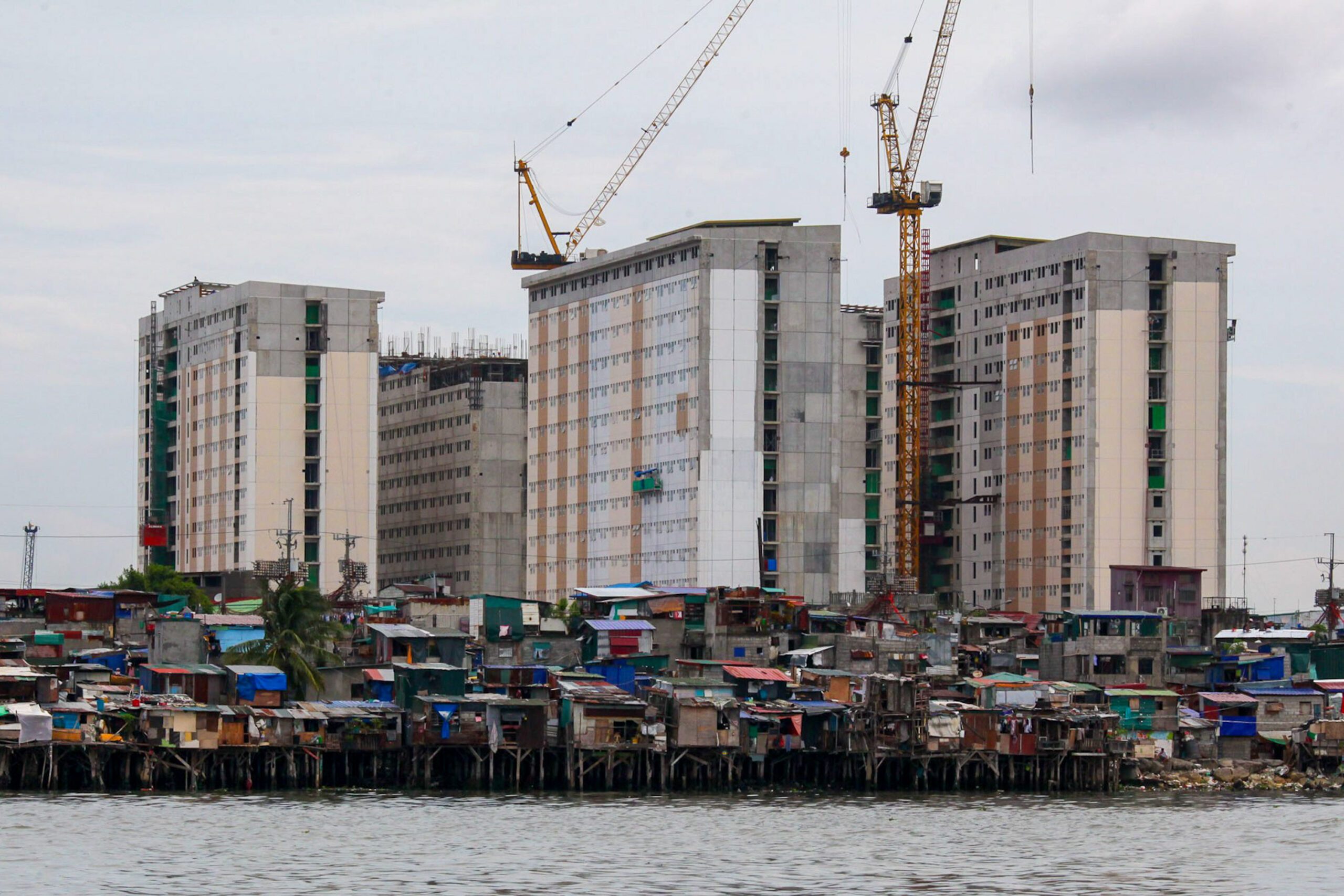
DIVIDE. Informal settlements stand in contrast to Manila's modern high-rise buildings on July 9, 2026. While the Philippines has attained upper-middle-income status according to the World Bank, many Filipinos continue to face poverty and the rising cost of living. Rappler The new measure adds another wrinkle to the poverty debate by measuring deprivation not just through income, but also across education, health, housing and basic services, and employment In 2024, 12.8% of Filipinos were classified as multidimensionally poor, according to the new Multidimensional Poverty Index (MPI) by the Philippine Statistics Authority, which considers various factors beyond income. The MPI reveals that education is the largest contributor to multidimensional poverty, followed by housing, water, sanitation, health, and employment, highlighting the limitations of income-based poverty measures. Despite a reported income poverty rate of 9.7% for 2025, many Filipinos still perceive themselves as poor, with 49% self-reporting poverty, indicating a disconnect between statistical measures and personal assessments of living conditions. This is AI-generated. Read the article for full context. Report any errors. MANILA, Philippines – The Philippines may have finally reached single-digit poverty by the government’s traditional income measure, but a new and broader official way of measuring poverty shows that 12.8% of Filipinos were considered multidimensionally poor in 2024. The Philippine Statistics Authority’s (PSA) first official Multidimensional Poverty Index (MPI) looks beyond how much a family earns and asks whether Filipinos are poor or deprived across education, health and nutrition, housing and basic services, and employment. Based on preliminary results of the 2024 Community-Based Monitoring System (CBMS), 12.4% of households were classified as multidimensionally poor. At the individual level, the rate was slightly higher at 12.8%, or roughly one in eight Filipinos. That is higher than the 9.7% official income poverty rate for 2025, the record-low figure announced by the PSA in August that meant around 11 million Filipinos were living below the national poverty threshold. MULTIDIMENSIONAL. These are the 17 dimensions that the PSA now uses to measure multidimensional poverty. Image from PSA. Note though that the figures measure different aspects of poverty and cover different years. The 9.7% poverty incidence for 2025 is based on whether Filipinos fall below the official income poverty threshold, while the new MPI uses 2024 data to measure deprivation across 17 different indicators. This new multidimensional measure of poverty should be seen as a complement to, rather than a substitute for, the country’s income-based poverty estimates, according to the PSA and Department of Economy, Planning, and Development (DEPDev). Still, the MPI gives the government another official measure showing why crossing the income poverty line doesn’t necessarily capture the full extent of hardship. What does being ‘multidimensionally poor’ mean? The MPI gives equal weight to four broad dimensions: education; health and nutrition; housing, water, and sanitation; and employment. Among the indicators are whether children attend school, whether an adult in the household finished high school, whether family members experience food insecurity, whether someone who needed medical care failed to get it, and whether the household has adequate water, sanitation, electricity, internet, housing, transport access, and employment. A household is considered multidimensionally poor when its weighted deprivation score exceeds 25% DEPRIVED. The dark bars show the share of all Filipinos deprived in each indicator, while the green bars show the share who are both deprived in that indicator and classified as multidimensionally poor. Image from PSA. Education was the biggest contributor to multidimensional poverty, followed by housing, water, and sanitation. Health and nutrition as well as employment were also challenges identified. Across the population, 38.7% of Filipinos lived in households deprived in housing materials, while 26.4% belonged to households without internet access. Another 24.1% lived in households deprived in sanitation or toilet facilities, 21.8% in household assets, and 20.2% in educational attainment. Why many Filipinos still feel poor The broader measure also provides context for the skepticism that followed the announcement that Philippine income poverty had fallen to 9.7%. Under the official 2025 poverty threshold, a family of five needed around P14,634 a month to meet basic food and non-food needs. Earning even slightly more is enough to be classified as non-poor. Filipinos’ own perceptions remain markedly different. In a Social Weather Stations survey conducted in June, 49% of Filipino families described themselves as poor. Self-rated poverty is subjective and cannot be directly compared with PSA statistics, but the gap illustrates the difference between statistical poverty and a household’s own assessment of their living conditions. At the Development Budget Coordination Committee hearing on Thursday, August 27, Balisacan said reaching upper-middle-income status was “not the end in itself,” adding that the greater challenge was translating economic progress into “better jobs, higher incomes, and improved living standards for Filipinos.” He also warned that recent poverty gains remain vulnerable as prices stay elevated. “If inflation remains elevated, it could slow or even reverse our recent advances in poverty reduction,” Balisacan said. DEPDev said the MPI should allow government to better target programs such as adult literacy, affordable housing, healthcare, food security, and improvements in basic services. – Rappler.com How does this make you feel? Loading
Beyond income, 12.8% of Filipinos are poor across multiple dimensions in 2024
Full Article
Original Source
Read the full article at Rappler →KhanList aggregates and links to publicly available news content. We do not host full articles from third-party sources. Always verify important information with original sources.