
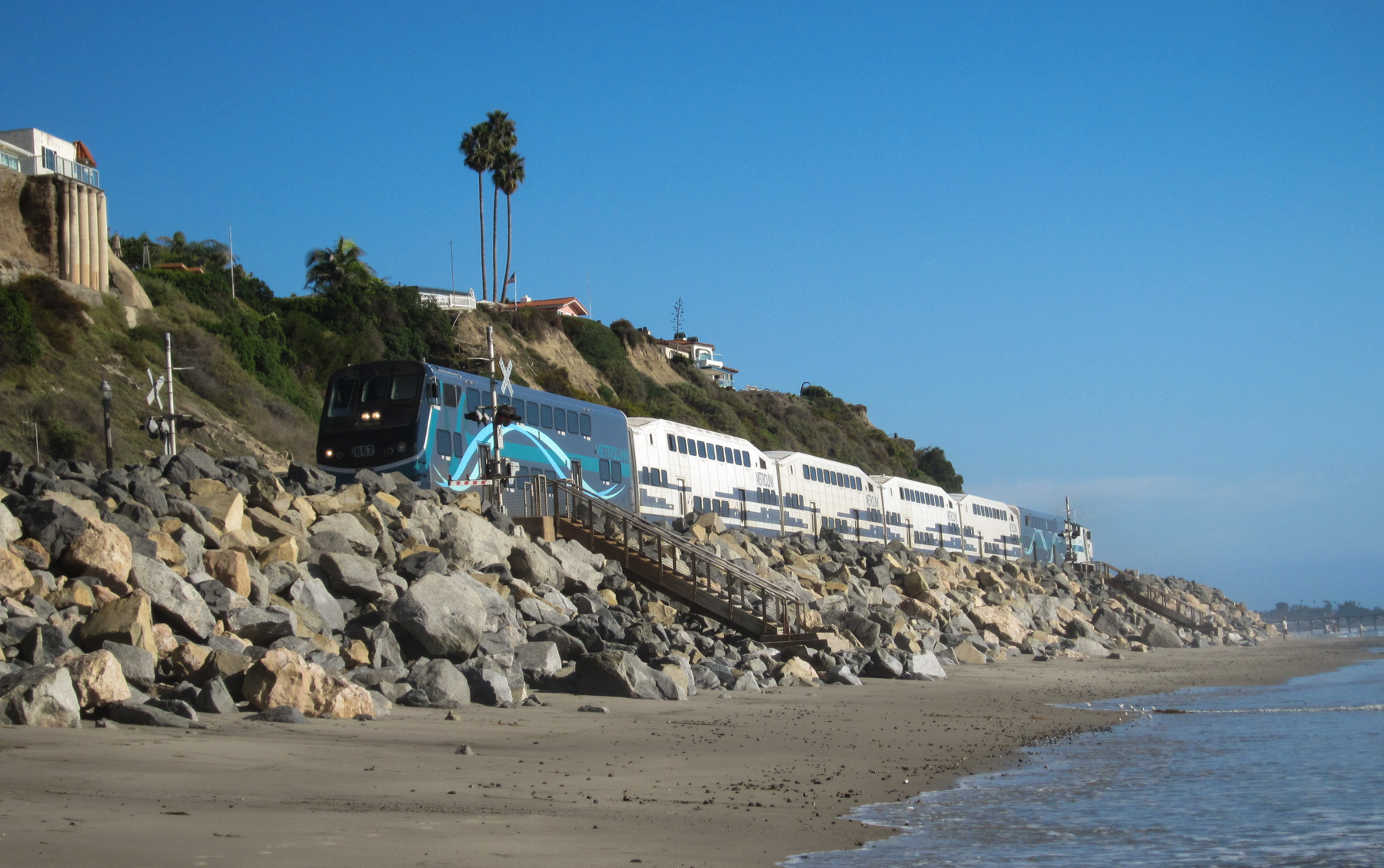
The California Coastal Commission unanimously approved a massive beach armoring project to protect a vital rail corridor, despite years of criticism that the rocks and seawalls are eroding San Clemente’s public beaches.(CN) — The California Coastal Commission voted unanimously on Thursday to approve a massive beach armoring project in San Clemente, California, in an effort to protect a valuable railroad line that runs along the coast that critics say comes at the expense of public beach access.The permit allows the Orange County Transportation Authority, or OCTA, to retain and place about 50,000 tons of riprap, or large rocks, along the coast over the next 10-15 years to prevent the rail line from slipping into the ocean. It also includes the placement of 690,000 cubic yards of much-needed sand for beach nourishment and the construction of a seawall against part of the railroad.The rail line in San Clemente has been increasingly threatened after recent storms in Southern California and the onset of Super El Nino.Proponents of the project say it is necessary to protect the only railroad that links Los Angeles to San Diego, known as the LOSSAN Rail Corridor, that they say is vital to the region’s economy and national security.But critics of the permit describe the plan as the largest loss of public beach in the commission’s history. They say that OCTA’s strategy of placing riprap along the beach has been irresponsible, shortsighted and ultimately a net negative for the rail corridor and the public.Parts of San Clemente’s beaches have seen their width greatly reduced in the past decade, in some cases going from 200 feet in shore width to just 80, the commission staff said in its report on the permit.Since 2021, the rail line has become increasingly vulnerable to coastal hazards, in part related to sea level rise and climate change, the commission’s staff wrote. It has issued 15 similar track stabilization permits to OCTA and the Southern California Regional Rail Authority since then.A few dozen residents and beach advocates expressed their disappointment during the meeting, held in San Francisco, that the continued approval of these permits has not helped anyone.“This is not a rail corridor,” Sarah Spinuzzi, legal director of the Orange County Coastkeeper, told commissioners. “It is a community that has shaped California’s surf culture, home to the most prominent surfboard shapers around the world and the site of the 2028 Olympic surf venue.”Spinuzzi was joined by a coalition that demanded guarantees from OCTA that it will maintain public beach access with a proactive approach and not just continue to armor the remaining beach.Many public commenters asked for an amendment to OCTA’s permit to include a minimum of 50 feet of sandy beaches in front of the rocky revetments. Other groups, such as Save Our Beaches San Clemente, want to see an 80-foot minimum width of sandy beaches.“OCTA has already destroyed Cypress Shore Beach and created impassable boulder piles where pristine beach once stood,” Lisa Gant, of Save Our Beaches San Clemente, told the commissioners. “Please minimize the armoring footprint that OCTA is allowed to place on our beaches. Require OCTA to maintain a minimum sandy beach in front of their armoring. … Require that they replenish that sand in a standardized schedule of monitoring and maintenance.”Ocean waves scour the beach sand after the rocks are dumped, leaving less beach each year, said Save Our Beaches San Clemente President Suzie Whitelaw, who has a degree in marine sedimentology.“This process is inexorable,” she told the commission. “We’re gonna be back here talking to you again and again and again for the next 10 years, and you’re gonna be seeing more and more rock and seawall added to our beaches, unless you do one simple thing, which is require them to maintain a wide, sandy beach in front of any armoring that they put in.”Some commissioners found it difficult to approve a plan that had a long track record of failure.“Although minimized, the impacts on public access and recreation are significant and unavoidable at this stage,” the commission’s staff report said of the project.Commissioner Susan Lowenberg, of San Francisco, described the transportation authority’s plan as the definition of insanity. Other commissioners also expressed skepticism about OCTA’s proposal, given the history of beach armoring in San Clemente.However, commissioners, officials and members of the public agreed that the sand nourishment proposal was much needed. Whether the proposed amount of sand was enough is not clear, commissioners and staff said.The entire project might fall through if it wasn’t approved today, Coastal Commission Executive Director Kate Huckelbridge said.OCTA’s proposal is also contingent on $305 million in state and federal grant funding.“I think doing nothing is never a good option, particularly in this case,” Commissioner Raymond Jackson, of Hermosa Beach, said. “There’s no perfect solution. There is not even a good solution.”Commissioners ultimately agreed to amend the permit to include a beach width assessment within five years of the project. The permit was approved, 11-0.A spokesperson for OCTA did not respond to requests for comment.Subscribe to our free newslettersOur weekly newsletter Closing Arguments offers the latest about ongoing trials, major litigation and rulings in courthouses around the U.S. and the world, while the monthly Under the Lights dishes the legal dirt from Hollywood, sports, Big Tech and the arts.Additional Reads
Between a rock and a sandy place: Coastal Commission approves beach armoring in San Clemente
Full Article
Original Source
Read the full article at Courthousenews →KhanList aggregates and links to publicly available news content. We do not host full articles from third-party sources. Always verify important information with original sources.