
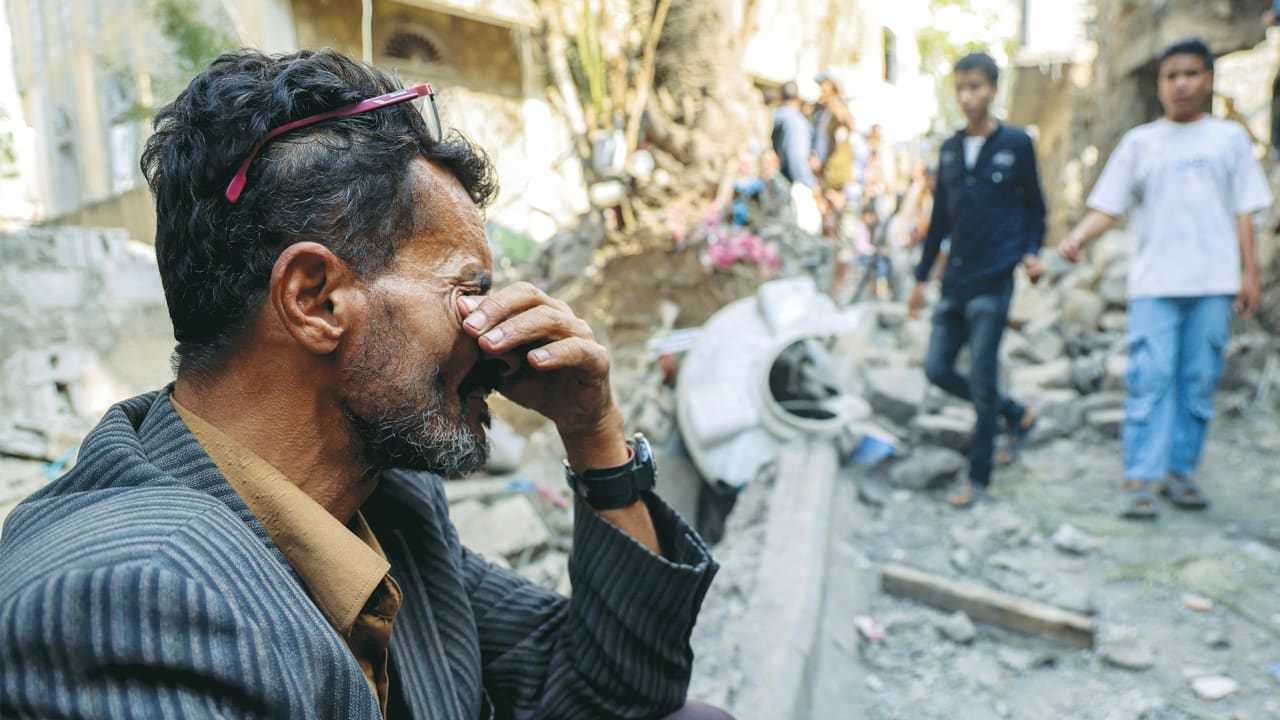
OCTOBER 31, 2026 11:21The city of Taiz in southwestern Yemen is located roughly 250 km south of Houthi-controlled Sana’a, the Yemeni capital, and 200 km north of Aden, the seat of Yemen’s official, Saudi-supported government. Taiz is Yemen’s third-largest city, with a pre-war population of around 1.2 million. There are around 800,000 people there now. The war between the Houthis and the official government erupted again in full intensity in July, with the collapse of the UN-brokered 2022 truce.In the renewed fighting, the Houthis launched a lightning offensive southward. Taiz and the surrounding highlands matter because holding them would enable the Houthis to consolidate their gains in the areas further west near the Red Sea coast and the Bab el-Mandeb Strait. Cutting off the strategic Hejat al-Abd road from Taiz would also serve to isolate pro-government forces from their main center and source of supply in Aden.As a result, the Houthis sought in their renewed offensive to cut Taiz off. They have largely succeeded in this objective. The Iran-supported Shi’ite Islamists have now cut off every primary route out of Taiz City.People inspect damage at a house reportedly hit by a Houthi missile in the southwestern city of Taiz, Yemen October 21, 2026. (credit: REUTERS/Ebrahim al-Suhaibi)After capturing the al-Safiya area, the Houthis severed the main road to Aden. They have destroyed parts of the Hejat al-Abd road across the mountains. An additional unpaved route exists, but is unusable for heavy vehicles that can bring supplies.The predictable result is that Taiz city is now teetering on the edge of humanitarian catastrophe.Yemen is a place of extreme poverty and deprivation. While reporting in the country last year, traveling through the remote Abyan province on the way up to Shabwa and the Saudi border, it occurred to me that in 25 years of working across the region, I had never witnessed impoverishment of a similar depth and scale.The scenes remain vivid. African migrant families, trying to make their way to Saudi Arabia, walking along the highways through the desert in the shimmering summer heat, staying at night in tiny improvised shacks by the roadside.The Houthis, who have reintroduced slavery to Yemen, prey on these migrants if they venture into their areas of control. But the migrants, hailing mainly from Ethiopia and Somalia, are not the only people affected. There is widespread and documented childhood malnutrition in Abyan province (15,300 recorded cases, according to a recent study). The signs of extreme poverty and underdevelopment – uncollected refuse, lack of clean sanitation and water supply, extreme overcrowding in housing – are all apparent.According to the World Food Program (WFP), “Across Yemen, more than 18 million people face acute food insecurity. Some 2.2 million children under the age of five are acutely malnourished, including 500,000 suffering from severe acute malnutrition, the most life-threatening form of malnutrition.”This underlines that the situation in Yemen is precarious also in “normal” periods, as a result of the ongoing conflict, the collapse of infrastructure, and the presence of large nomadic and refugee populations.In Taiz, this preexisting reality is now exacerbated by the complete inaccessibility to access routes for wheat flour, water, and fuel stocks.In a press release issued on October 14, the World Food Program stated that “WFP and its partners cannot access more than 600,000 people in Taiz who depend on humanitarian assistance, including more than 200,000 women and children. Combined with communities affected by access losses on the west coast of Yemen in early September, a total of 800,000 people are now beyond WFP’s reach.”El-Khidir Daloum, WFP’s country director in Yemen, said: “We are critically concerned about the escalating conflict, but even more so about the growing number of people we can no longer reach because of it…“Many of the families affected have been displaced multiple times, and were already struggling to afford even basic food items. This is the kind of situation that can rapidly spiral into a humanitarian catastrophe if assistance cannot move safely and reach those who need it most.”As of now, 12 hospitals in Taiz are hours away from running out of fuel. Should this happen, the lives of thousands of hospital patients dependent on the maintenance of the electricity supply will be under threat. Food stocks are nearly exhausted. The fuel crisis is also leading to the closure of desalination plants in and around the city, with the resultant dwindling of supplies of fresh water.How to prevent disasterWhat needs to happen to prevent the looming disaster in Taiz is easy to state, but difficult to achieve. A humanitarian corridor, or corridors, should be established into the city, and fuel needs to be transported to the city center to keep hospitals and water facilities functioning.For this to happen, however, pressure needs to be placed on the besieging forces. Here lies the problem. As of now, the UN Security Council appears to have no interest in prioritizing the issue.The supposed allies of Saudi Arabia and the official government, namely the countries of the newly minted “Mecca Pact” – Pakistan and Turkey – have made it clear that they have no intention of committing forces.The US, too, has conveyed to the Saudis that when it comes to the fight against the Iran-backed forces in Yemen, they will receive only indirect assistance.Iran and the Houthis themselves, of course, follow a way of war that involves deliberate and targeted strikes on civilian populations in enemy areas, and therefore can be relied upon to greet any international entreaties with indifference unless they are backed up by force, or the threat of force.It goes without saying that the global “civil society,” and the furious Islamic and leftist crowds that gathered in European and American cities over the last three years to condemn Israel’s war effort in Gaza, will be absent from the streets when it comes to the 800,000 people now facing extreme hunger in Taiz.Many among that gathering, indeed, will be openly supportive of the Houthis, precisely because of their stated desire for the destruction of Israel and hatred of Jews.The upshot is that 800,000 people in southwest Yemen are currently staring down the wrong end of possible starvation, with no force waiting in the wings to remedy the situation, and the more or less complete indifference of the media outside of the Arabic-speaking world.The war in Yemen has, in purely numerical terms, accounted for the great majority of war-related deaths in the Middle East over the last decade. More than 378,000 people have lost their lives in this conflict since 2015.This has been met, for the most part, with indifference on the part of what used to be known as the “international community.” The next tragic chapter in this process is currently being written.Follow us on Google
Besieged by the Houthis, Yemen’s Taiz is teetering on the edge of humanitarian catastrophe
Full Article
Original Source
Read the full article at Jpost →KhanList aggregates and links to publicly available news content. We do not host full articles from third-party sources. Always verify important information with original sources.