
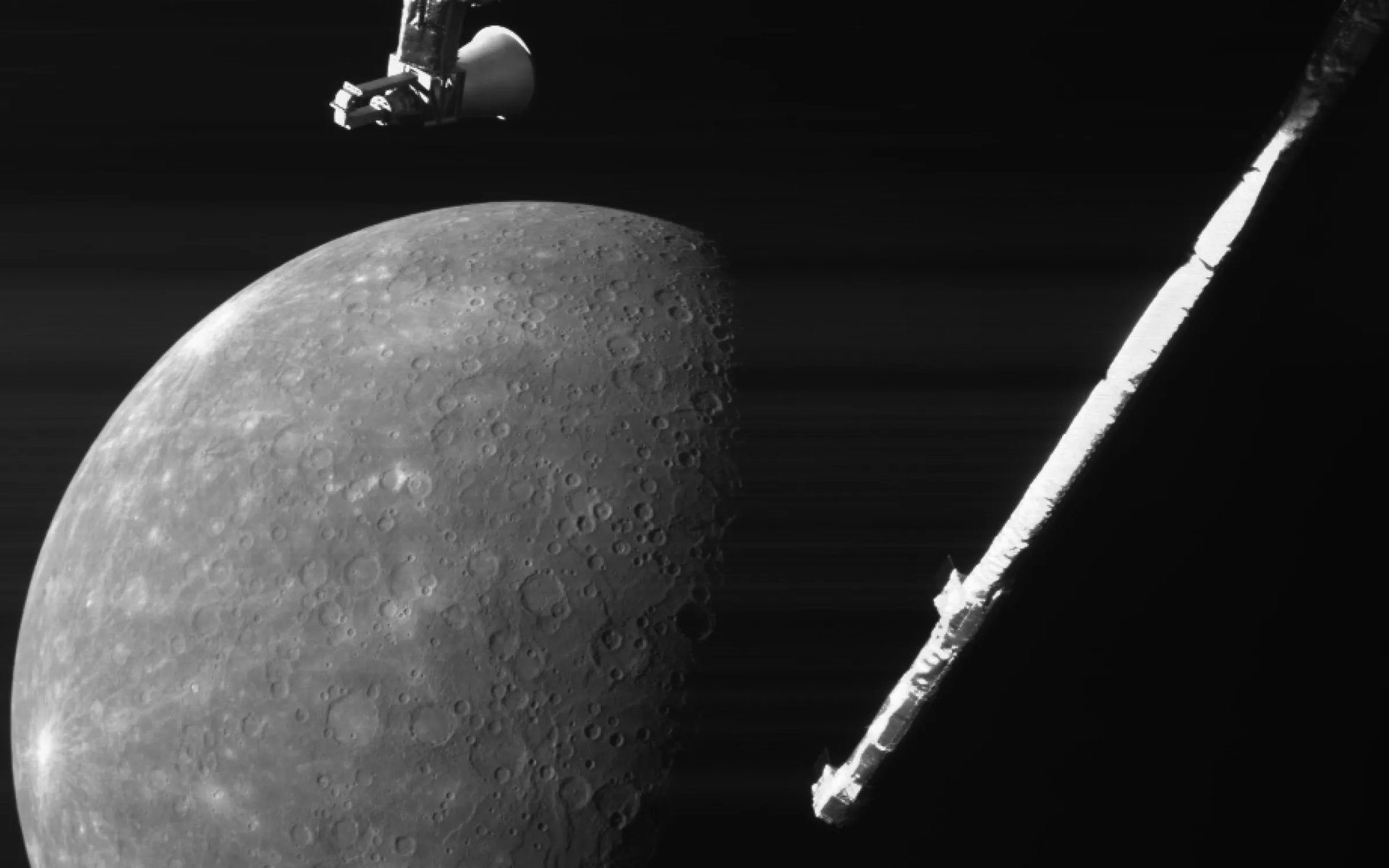
During the eight years since it was launched, the ESA/JAXA BepiColombo mission has made six close flybys of Mercury. During each pass, the twin orbiters collected vital information on one of the least explored planets in the Solar System, helping address its many fundamental mysteries. These include, but are not limited to, the existence of icy craters around the poles, the planet's magnetic field, and its "hollows" and other mysterious surface features. Another major investigation, carried out by the Solar Intensity X-ray and Particles Spectrometer (SIXS), is how solar charged particles and space storms impact Mercury. During the mission's fourth flyby in September 2024, this instrument detected how particles from a solar eruption penetrated Mercury's magnetic field and impacted the surface. In a new study published in Nature Astronomy, a team led by researchers from the University of Helsinki showed how these results could inform predictions of space weather. The SIXS instrument was developed by engineers and technicians at the University of Helsinki. Emilia K. J. Kilpua, a professor of space physics at Helsinki and the study's lead author, is also the Principal Investigator (PI) for the instrument. As she and her colleagues noted, BepiColombo's fourth pass of the planet - on September 4th 2024 - brought the mission within just 165 km (102.5 mi) of the planet’s surface. This coincided with elevated fluxes of high-energy charged solar particles, giving astronomers the opportunity to study how planets close to their stars shield themselves. The SIXS instrument revealed that during the eruption, a large amount of high-energy particles reached Mercury's surface over a wide area. These particles interact with atoms and molecules on the surface, generating X-rays in the process. "The fourth flyby was truly unique," said Kilpua in a University of Helsinki press statement. "The spacecraft came much closer to the surface than it will be on its final orbit, and we were lucky that a major particle eruption occurred on the Sun at exactly that moment." These conditions resemble what would occur on Earth when a powerful solar storm compresses our planet's magnetosphere. The results could therefore help inform predictions of space weather and its potential impact on Earth. This is important since major solar events are known to cause damage to satellites, electrical grids, and other space- and ground-based infrastructure. Said co-author Rami Vainio, the co-Principal Investigator of SIXS and a professor of space physics at the University of Turku: Mercury's magnetic field is weaker than Earth's, and its magnetosphere is much smaller than Earth's. SIXS's observations help us assess how destructive particle radiation would penetrate Earth's near-space environment and atmosphere during the most powerful space storms. The SIXS observations will also be used in the Center of Excellence in Space Resilience, a program dedicated to ensuring that commercial and scientific operations in Low Earth Orbit (LEO) remain safe under the most extreme space weather conditions. Earlier this month, the Mercury Planetary Orbiter (MPO) and Mercury Magnetospheric Orbiter (Mio) separated from the transfer module. In November, the two orbiters will enter Mercury's orbit and separate from each other by December. Further Reading: University of Helsinki
BepiColombo Makes Up-Close Measurement of Mercury's Solar Bombardment
Full Article
Original Source
Read the full article at Universetoday →KhanList aggregates and links to publicly available news content. We do not host full articles from third-party sources. Always verify important information with original sources.