
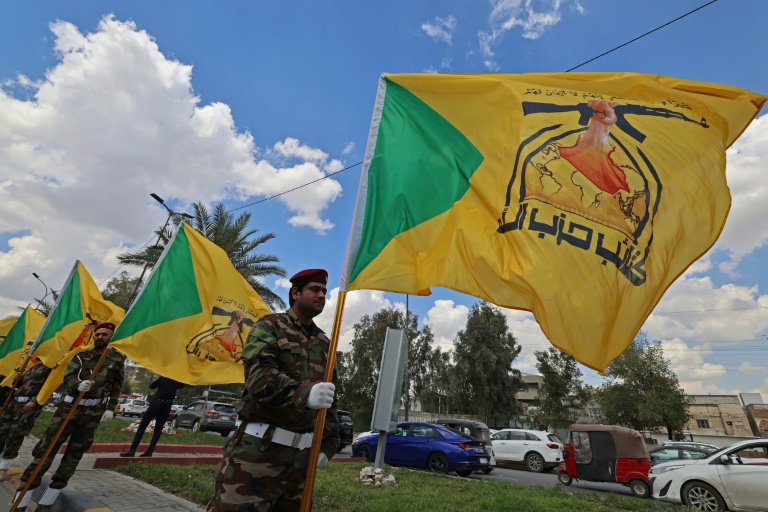
Baghdad (IraqiNews.com) – Two days after federal security forces entered Jurf al-Sakhar (Jurf al-Nasr) in what Baghdad hailed as its first assertion of state authority over the closed northern Babylon subdistrict in 12 years, local sources and insiders close to Iraqi armed factions have disclosed details contradicting the official narrative, according to a report by Al-Mada newspaper. While Prime Minister Ali Faleh Al-Zaidi addressed troops from the newly established joint control headquarters on Friday, November 20, declaring that “there are no weapons outside state authority,” sources on the ground indicate that the federal deployment has not displaced Kata’ib Hezbollah. Instead, incoming Federal Police units were positioned near the town of Musayyib—where most displaced Jurf al-Sakhar residents have lived since 2014—well outside Kata’ib Hezbollah’s core security perimeter, while additional Popular Mobilization Forces (PMF/Hashd al-Shaabi) formations entering the area are described by locals as sympathetic to the faction. A senior Shia political leader close to the factions told Al-Mada that the recent movements amount to reinforcing Kata’ib Hezbollah’s existing PMF brigades (the 45th, 46th, and 47th Brigades), rotating Federal Police detachments, and deploying Energy Police along pipeline corridors rather than dismantling the group’s military infrastructure. Even if Kata’ib Hezbollah formally commits to vacating the district, the source estimated that dismantling bases and relocating heavy weaponry would require at least a full year—a timeline extending well beyond Baghdad’s June 30, 2027 deadline for bringing all weapons under state control. Coordination Framework insiders linked this extended reprieve—and Kata’ib Hezbollah’s abrupt de-escalation after threatening to carry the confrontation into Baghdad’s Green Zone—directly to an eleventh-hour intervention by Islamic Revolutionary Guard Corps (IRGC) Quds Force Commander Esmail Qaani. Prior to Friday’s deadline, Qaani met in Baghdad with Kata’ib Hezbollah Secretary-General Abu Hussein Al-Hamidawi, Badr Organization leader Hadi Al-Amiri, and PMF Chairman Falih Al-Fayyadh, prompting Al-Hamidawi to instruct fighters to stand down from high alert and resolve disputes with the government through private channels. Despite brokering the ceasefire, Iranian officials reportedly expressed sharp dissatisfaction with Kata’ib Hezbollah’s brinkmanship, urging the faction to follow the path of other armed groups that have pivoted toward political integration and state posts. According to coalition sources, Tehran has spent recent months cultivating more disciplined, tightly controlled armed formations with stronger direct ties to Iran rather than domestic Iraqi politics—a shift coinciding with the sudden emergence of a previously unknown group calling itself “Asa’ib al-Jihad.” Appearing in a video statement under the banner of the “Islamic Resistance Front in Iraq,” Asa’ib al-Jihad displayed an explosive-laden drone and threatened Shia political parties and factions it accused of abandoning armed resistance in exchange for government positions and financial gain. Political observers suspect the group represents a hardline splinter faction broken away from Asa’ib Ahl al-Haq following the latter’s decision to comply with weapons-handover initiatives. As Baghdad sought to project calm in northern Babylon, Al-Zaidi’s government was hit by a major energy security incident in southern Iraq on Saturday, November 21, when an explosion along the gas pipeline feeding the Al-Hartha thermal power station in Basra sparked a deadly blaze that killed and injured dozens and damaged nearby homes. While the government launched an urgent technical probe, political and security circles raised suspicions of a potential drone strike echoing prior attacks on energy infrastructure. Analyzing the broader political stalemate, academic and political researcher Ghalib Al-Daami argued that the Jurf al-Sakhar compromise underscores the structural constraints placed on Al-Zaidi by the very ruling coalition that brought him to power. Within Iraq’s consensus system, Al-Daami noted, strengthening sovereign state institutions directly erodes the entrenched economic and security interests of ruling factions—leading influential Coordination Framework actors to impose clear boundaries on how far the Prime Minister can push state consolidation without destabilizing the coalition.
Behind the Jurf al-Sakhar truce: Kata’ib Hezbollah remains in place as Qaani brokers year-long timeline
Full Article
Original Source
Read the full article at Iraqinews →KhanList aggregates and links to publicly available news content. We do not host full articles from third-party sources. Always verify important information with original sources.