
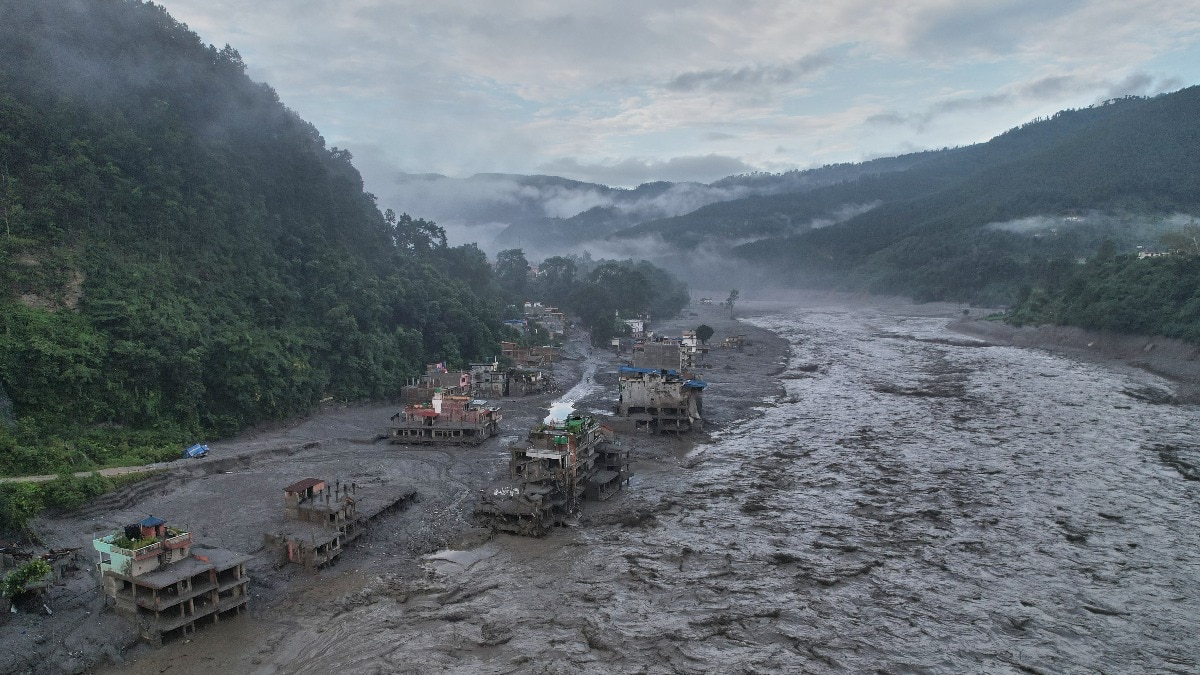
Months before a wall of water, ice, rock and debris tore through Nepal, killing hundreds, scientists were already documenting the changes unfolding high in the Himalayas.These very changes were foretelling what was to come.On August 26, a sudden torrent of water, ice, rock and debris came crashing down near the Nepal-Tibet border.The disaster has since claimed at least 903 lives, while more than 2,500 people remain missing. Relatives console a woman who lost her son in Nepal flash floods. (Photo: AP) Entire settlements and vital infrastructure were swept away as the surge travelled through the Bhotekoshi and Trishuli river systems.What also made the tragedy particularly overwhelming was the timing. Two major reports from the International Centre for Integrated Mountain Development (ICIMOD), released months before the disaster, had already laid out the scale of the changes taking place across the region.But the significance of the finds followed only after lives were lost. A drone view shows a major section of Pasang Lhamu highway washed away. (Photo: AP) WHAT HAPPENED IN NEPAL?The disaster in Nepal was not simply another rain-fed flash flood.Initial assessments by Nepali authorities, the US Geological Survey (USGS) and ICIMOD point to an ice-rock avalanche following a glacial collapse near the Nepal-Tibet border.The collapse sent a huge mass of ice, rock and debris into the river system, generating a sudden surge that raced downstream into Nepal. Rescue works continue at Trishuli Center in Nepal's Nuwakot district. (Photo: AFP) The event, it turns out, was linked to a glacial collapse and debris flow, rather than an earthquake as had initially been suspected.While people point fingers, rescue operations continue, and the glaciers continue to retreat, climate change has garnered a level of attention that it has struggled with in recent years.In the wake of a disaster that claimed lives, the picture has become sharper, and has offered a glimpse of what a warming world has in store for us. Volunteers and rescuers carry the body of a flash flood victim. (Photo: AP) The event in Nepal has shown how a warming Himalaya is changing glaciers, snow, permafrost and mountain slopes, creating conditions in which dangerous cascading events can become only more likely.A WARNING HIDDEN IN NUMBERSICIMOD's report, titled "Changing Dynamics of Glaciers in the Hindu Kush Himalayan Region from 1990 to 2020", found that glaciers across the region lost 12% of their total area and 9% of their estimated ice reserves between 1990 and 2020.The pace of glacier loss accelerated after 2010. A drone view of the aftermath of flash flooding along the Trishuli river. (Photo: AP) At the same time, the HKH Glacier Outlook 2026 looked at five decades of measurements and found that 89% of recorded glacier-wide mass-balance years were negative.Average annual glacier mass loss nearly doubled after 2000 compared with the preceding period.As glaciers retreat, meltwater can also contribute to the growth of glacial lakes, raising the potential for glacial lake outburst floods.At the same time, destabilised mountain terrain can increase the danger from landslides and debris flows.In other words, a disaster has been brewing for decades. Relatives comfort a woman whose husband in missing after the Nepal flash floods. (Photo: AP) AN UNEQUAL CRISISThere is also a cruel imbalance at the heart of the Himalayan crisis, or the climate crisis as a whole.The communities living closest to rapidly changing glaciers and unstable mountain slopes are often the ones facing the most immediate danger, even though the warming driving these changes is a global problem.Just like the problem of a warming world has been made worse by only a handful of developed global powers, a list of places that doesn't include Nepal, but disaster arrived nonetheless. And the consequences do not stop at a single flood. A satellite image shows Shyaphrubesi and the Bhote Koshi River after a massive flood in Rasuwa district of Nepal. (Photo: AFP) The same glaciers are crucial water reserves for the Ganga, Brahmaputra and Indus River systems, supporting agriculture, hydropower and livelihoods for billions of people.That is what makes Nepal's tragedy bigger than one devastating day. And for the people living on the front lines, climate change is no longer a mere prediction for a future far, far away. It is clearly playing out in real time, increasingly arriving as a sudden wall of water, ice and rock.- EndsPublished On: Aug 31, 2026 14:07 IST
Before Nepal's tragedy, the Hindu Kush Himalaya was already sending warning signs
Full Article
Original Source
Read the full article at Indiatoday →KhanList aggregates and links to publicly available news content. We do not host full articles from third-party sources. Always verify important information with original sources.