
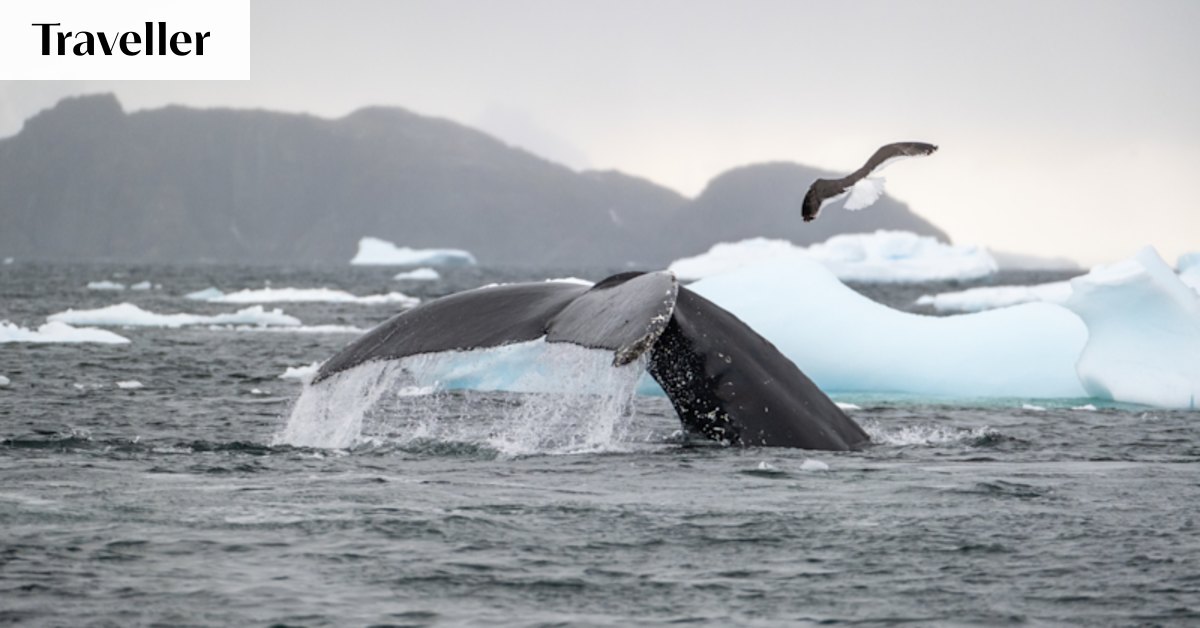
November 29, 2026 — 5:00amI’m perched on the inside edge of the Zodiac, my body angled sideways as the rigid inflatable rises and falls with the gentle swell. Around us, frozen shards tinkle like broken crystal; in the distance, a parade of icebergs encircles the bay, their soft blue hues lighting up the surrounding water.Our entry into Charlotte Bay is heralded by dozens of humpback whales. Some slap their huge tail flukes, others arch their backs before taking deep dives. We stare like stunned icefish as the flash mob unfolds.A humpback whale frolics amid icebergs.It’s early March in Antarctica, a time when humpbacks gather in feeding grounds to fill their bellies in preparation for their long migration north.“It’s not that there’s more wildlife about,” says Silversea’s onboard zoologist, Malcolm Turner. “But it’s what the wildlife is doing that makes a late-season expedition so remarkable.”On cue, the water erupts in a spiral of bubbles, as if a charge has detonated below. Then humpback whales suddenly rise as one through the churning depths, their pleated mouths stretched like accordions, sucking up krill with a liquid roar.Sign up for the Traveller Deals newsletterGet exclusive travel deals delivered straight to your inbox. Sign up now.Being at water level with whales is a treat enough, but to see a collective hunt, known as bubble-net feeding, is the privilege of a lifetime. I draw a deep breath, letting the moment settle in.Silversea’s Silver Wind in Antarctica.Since we boarded Silver Wind in Puerto Williams, Chile, every day has brought pinch-me moments. The Drake Passage served up black-browed albatross and storm petrels (and, thanks to modern stabilisers, a not-too-shaky crossing) before the South Shetlands revealed their wild beauty – chinstrap penguins, collapsed volcanic cones and Antarctic terns diving like silver arrows.We are halfway through our 10-day cruise when we reach Charlotte Bay on the Antarctic Peninsula, and despite having visited the continent before, my brain scrambles to make sense of it. Not just the beauty of this fragile continent, but the responsibility that comes with visiting.In truth, only a small percentage of people set foot in Antarctica. According to the International Association of Antarctic Tour Operators (IAATO), 112,412 people visited during the 2025-2026 season, with just over 85,195 making actual landings. “To put it in perspective, that’s about the capacity of a large football stadium,” says expedition leader Claudia “Clouds” Holgate, when I catch up with her in the Observation Library. “However, there’s no denying every visit leaves an impact.”As a climatologist, senior polar guide, and veteran of 92 voyages to Antarctica, Clouds is one of the most knowledgeable expedition leaders in the industry. “Educating our guests is a key part of a Silversea expedition,” she says. “It’s only when people see and experience Antarctica first-hand that they fully understand what is at stake.”The black-browed albatross is a large seabird with a wingspan of up to 2.4 metres.iStockIts commitment to conservation and education runs deep, with a 28-member expedition team of marine biologists, ecologists, geologists and historians travelling onboard Silver Wind. This brains trust also includes a crevasse rescue specialist, three expedition kayak guides and an Australian ornithologist who knows more about birds than anyone should.As visitor numbers rise, IAATO, of which Silversea is a member, continues to enforce strict protocols for the numbers of passengers allowed ashore, approved landing sites and biosecurity.Where visitors once sat on the ice, waiting for curious penguins to peck at their sleeves, the ever-present threat of avian flu now means nothing touches the ground except boots and the tips of walking poles. It also means a meticulous boot wash and disinfection each time we return to the ship.Silver Wind was built in 1995 and can carry 274 guests. It was transformed into a polar expedition ship in 2021, complete with a strengthened ice-class hull, mudroom and fleet of 24 Zodiacs.Chinstrap penguins on Penguin Island in the South Shetland Islands.iStockIf it’s all expedition-ready below, the ship is pure luxury above. There is a tuxedo-clad butler for every suite, exceptional dining across multiple restaurants and bars, and spacious leisure areas including a pool deck, beauty salon and fitness centre.Without exception, the staff deliver understated yet intuitive service. When my butler Moses discovers my sweet tooth, plates of my favourite cookies appear after each excursion.Our twice-daily Zodiac excursions turn us all into amateur biologists, as we observe a rogue’s gallery of characters – from leopard seals and whales to kelp gulls and Antarctic skuas. One guest tallies the number of onboard lectures and declares we’ve studied the equivalent of a semester at university. Fieldwork entails uploading our photos and sightings to citizen science databases such as happywhale.com, ebird.org and leopardseals.org.Meanwhile, a steep, icy trek at Portal Point leaves us feeling like polar explorers, our cheeks red and wind-scoured as snow tears across the ridge.Watch the scenery go by in the ship’s lounge.Distinct sunrises and sunsets are an unexpected gift for the late-season traveller, a shift from the midnight sun of the austral summer. Anchored off the Melchior Islands, I watch as sunrise burns through a polar palette rarely seen – warm, smoky saffron deepening to scorched crimson, set against a backdrop of neon icebergs.In true expedition style, our plans evolve as we go. When high winds cancel our landing at Cierva Island, Captain Sasha Kolosov finds a safe passage to Cuverville Island. “There are less ships down here at this time of the year,” says Clouds. “Which frees up more [approved] sites should we need to adjust plans due to weather.”News has travelled across the ice because when we land on Cuverville Island, thousands of gentoo penguins line the shore, less a welcoming committee than a grievance council.While some slump in disapproval, others march about honking in penguin protest. All are draped in mottled feathers that look like mouldy blankets. Known as a catastrophic moult, this is one of Antarctica’s greatest wildlife spectacles (OK, comedy shows) and the fortunate few who visit late in the season get front-row seats.An icy, on-shore excursion.Clouds explains that the moult is an annual event where penguins lose all feathers simultaneously. “They must starve on land until their new waterproof feathers grow back,” she says. “It takes a few weeks, and as you can see, they are not happy about it.”Yet, I can’t stop laughing – at the juvenile chicks with their fluffy hairdos, teetering nervously at the shoreline, daring each other to jump in; at the frazzled gentoo adults, running in circles away from their “hangry” offspring; and at the goofy faces of my fellow passengers, who stand frozen in place by the sheer wonder of it all.Later, I’m on deck with the naturalists – glaciers press in close, their hems falling in stiffened pleats. Snow petrels paint the sky like brushstrokes, while humpbacks surface and dive around us. I’m talking to Clouds when, mid-sentence, my voice catches. Tears well and I turn away.It’s the “Antarctic effect” and it can strike at any moment. This time, it’s the overwhelming protectiveness I feel for these gentle giants, who must soon embark on a 10,000-kilometre round trip to tropical waters to mate and give birth.Penguins welcome a Silversea expedition vessel.Leaning over my balcony the next morning, tears blur my vision again as a humpback surfaces just metres below, its dark eyes locking on to mine. It’s tempting to call it a connection but for me, it’s a summons.Given Antarctica has no Indigenous population to advocate for it, every visitor has a role to play. Firstly, as extra eyes in a place where illegal fishing boats are known to prey, but also as ambassadors, demanding change and holding policymakers to account.As the whale sinks into the deep, I whisper: “Safe travels, my lovely.”DETAILS Suites on Silversea’s 10-day Antarctic cruise to and from Puerto Williams start from $23,000 a person. Prices include a pre-cruise hotel stay in Santiago, round-trip charter flights to Puerto Williams, and all-inclusive food, beverages and activities while on the ship. Longer itineraries are available. From October 2026, Antarctica Fly Cruise guests will begin and end their journey at The Cormorant at 55 South, Silversea’s new 150-room hotel in Puerto Williams. See silversea.comThe writer was a guest of Silversea.Kerry van der Jagt is a Sydney-based freelance writer with expertise in Australia's Indigenous cultures, sustainable travel and wildlife conservation, and a descendant of the Awabakal people of the mid-north coast of NSW.From our partners
Be fashionably late for the best wildlife show in Antarctica
Full Article
Original Source
Read the full article at Smh →KhanList aggregates and links to publicly available news content. We do not host full articles from third-party sources. Always verify important information with original sources.