
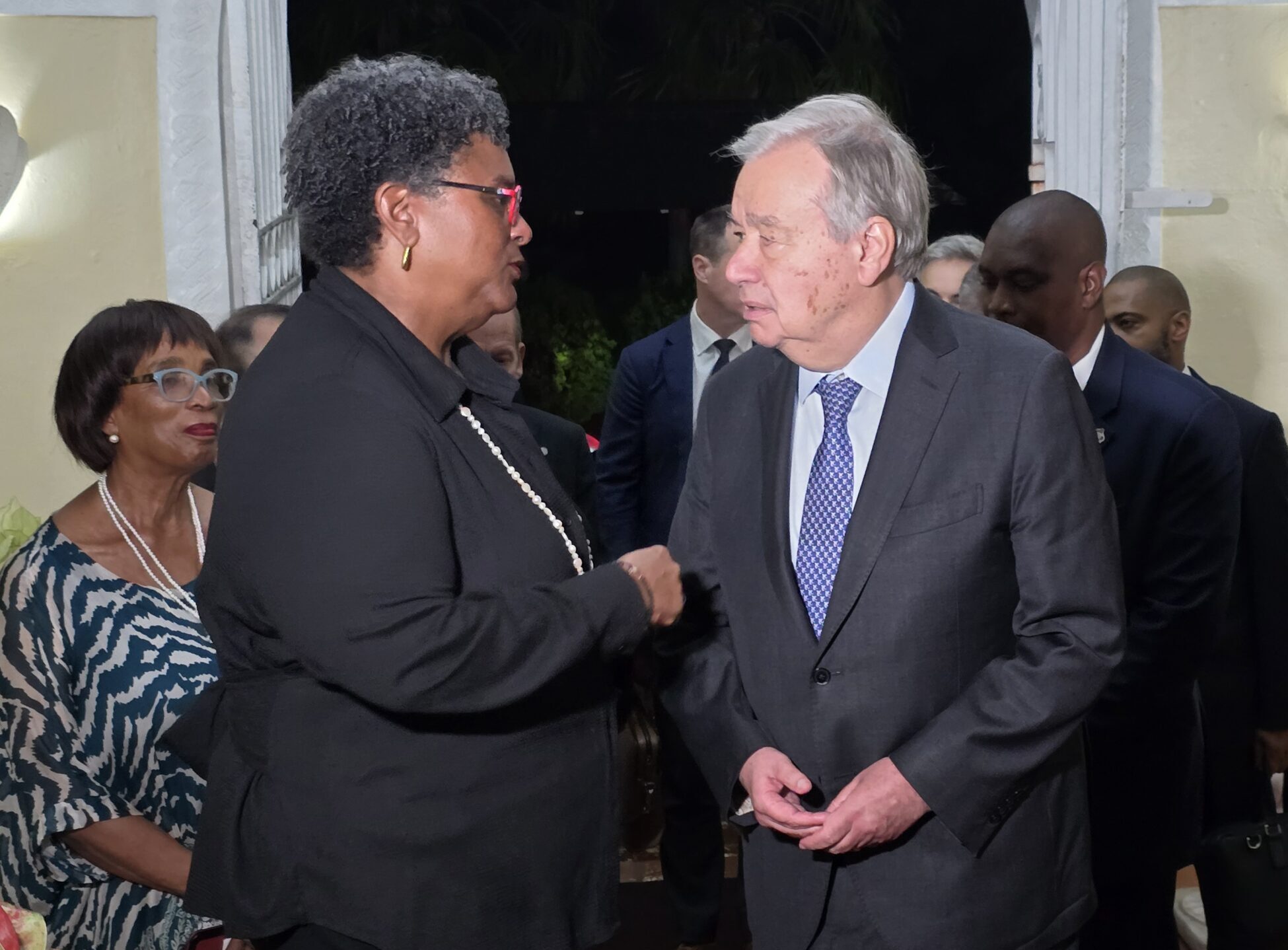
Prime Minister Mia Mottley welcomed UN Secretary General Antonio Guterres to Illaro Court on Sunday evening (Photo by: Lourianne Graham) Barbados has signed a new five-year cooperation framework with the United Nations and a 25-year lease for UN House, securing continued development support and the organisation’s presence on the island for another quarter-century. The agreements were signed at Ilaro Court on Sunday during the visit of United Nations Secretary-General António Guterres, who appeared in a joint press briefing with Prime Minister Mia Mottley. UN House in Marine Gardens, Christ Church, the headquarters of the UN Multi-Country Office for Barbados and the Eastern Caribbean, which comprises 18 agencies serving seven independent countries and three British Overseas Territories. The new five-year framework would help promote inclusive, resilient and sustainable development in Barbados and across the region, Guterres said. The new lease, he said, sent a clear message about the UN’s commitment to the Caribbean: “The United Nations is here for the long haul. That commitment matters more than ever.” The UN’s Multi-Country Sustainable Development Cooperation Framework for 2027-2031 is its principal strategic agreement with governments across 22 countries and territories in the English- and Dutch-speaking Caribbean, including Barbados. You Might Be Interested In It outlines how the UN will work with governments over the next five years, bringing together the expertise of its agencies to address shared development priorities while providing support tailored to individual countries. The new framework places greater emphasis on structural transformation and long-term solutions, moving beyond the resilience and recovery focus of the 2022-2026 agreement, which was developed during the COVID-19 pandemic. UN Resident Coordinator, Simon Springett and Acting Minister of Foreign Affairs Sandra Husbands after signing the agreement for a new five-year cooperation framework (Photo by: Lourianne Graham) It recognises that challenges such as economic concentration, climate vulnerability, inequality, demographic change, crime and violence are interconnected and require coordinated responses. For Barbados, the framework identifies four priority areas: building a more diversified and inclusive economy; strengthening resilience to climate change and other shocks; improving social services, particularly for vulnerable groups; and creating safer, more inclusive communities. Digitalisation, improved data, stronger institutions and innovative financing are also expected to support work across those areas. The framework is aligned with the Antigua and Barbuda Agenda for Small Island Developing States, with a Country Implementation Plan for Barbados to follow. The second agreement secures the United Nations’ base in Barbados for another 25 years. Guterres praised Barbados for its contribution to international affairs, saying the country was “punching above its weight” and bringing new ideas to global debates while helping shape the international agenda. He also described Barbados as a champion of multilateralism and said the country had consistently reminded the international community that “size does not determine significance”. “The world needs that leadership and moral voice now more than ever,” he said. Guterres said the partnership was particularly important as Barbados and other Caribbean countries faced several challenges at once, including climate change, geopolitical tensions, rising debt and living costs, and security threats. “Barbados, like countries across the Caribbean, is being hit by shock after shock.” He pointed to the impact of conflicts in the Middle East on fuel and energy costs and trade routes, as well as the effects of organised crime, violence and the trafficking of weapons and drugs. The secretary-general also commended Mottley’s calls for solutions based on justice, inclusion and solidarity, and said he would continue to support Barbados and the region. “I’ll always stand with the people of Barbados and the Caribbean in the pursuit of justice, peace, and a future in which every country has a real say in shaping our common destiny.” Mottley used her remarks to highlight three existential challenges facing small states: climate change and biodiversity loss, artificial intelligence, and the protection of their sovereignty. She warned that small states could struggle to maintain their independence if the international rules-based order was allowed to collapse. “Without an international rules-based order, small states cannot survive,” she said. The prime minister said Barbados had maintained its longstanding foreign policy position, first articulated by its first Prime Minister Errol Barrow when Barbados joined the UN one week after attaining independence in 1966. UNDP Resident Representative for Barbados and the Eastern Caribbean, Nicholas Booth and Minister of Minister of Housing, Lands and Maintenance Chris Gibbs after signing the 25-year lease for UN House ((Photo by: Lourianne Graham) “We should always be friends of all and satellites of none,” she said, adding that the country had a cross-party foreign policy stance. The world continued to face many of the same challenges it had a century ago, but countries now had a greater understanding of what needed to be done, she said. “The difference is we know better and can do better. The question is who will do better.” She also thanked the outgoing secretary-general for his leadership, saying countries must keep working together despite their differences and remain focused on a shared goal. The former Portuguese foreign minister’s 10-year term at the helm of the global body ends on December 31. Mottley cited the COVID-19 pandemic as having demonstrated how the actions of even the smallest nations and individuals could affect the wider world. “We learned in COVID that really and truly the smallest nation or the smallest person on earth can put at risk the well-being of us all and that we ignore those who are small at our peril.” Officially opened by then UN Secretary-General Kofi Annan on January 2, 2002, UN House also works with regional bodies, including the Caribbean Disaster Emergency Management Agency (CDEMA) and the Organisation of Eastern Caribbean States (OECS) Commission. Barbados became the 122nd member of the UN on December 9, 1966. The body now consists of 191 members. (LG)
Barbados, UN seal long-term partnership
Full Article
Original Source
Read the full article at Barbadostoday →KhanList aggregates and links to publicly available news content. We do not host full articles from third-party sources. Always verify important information with original sources.