
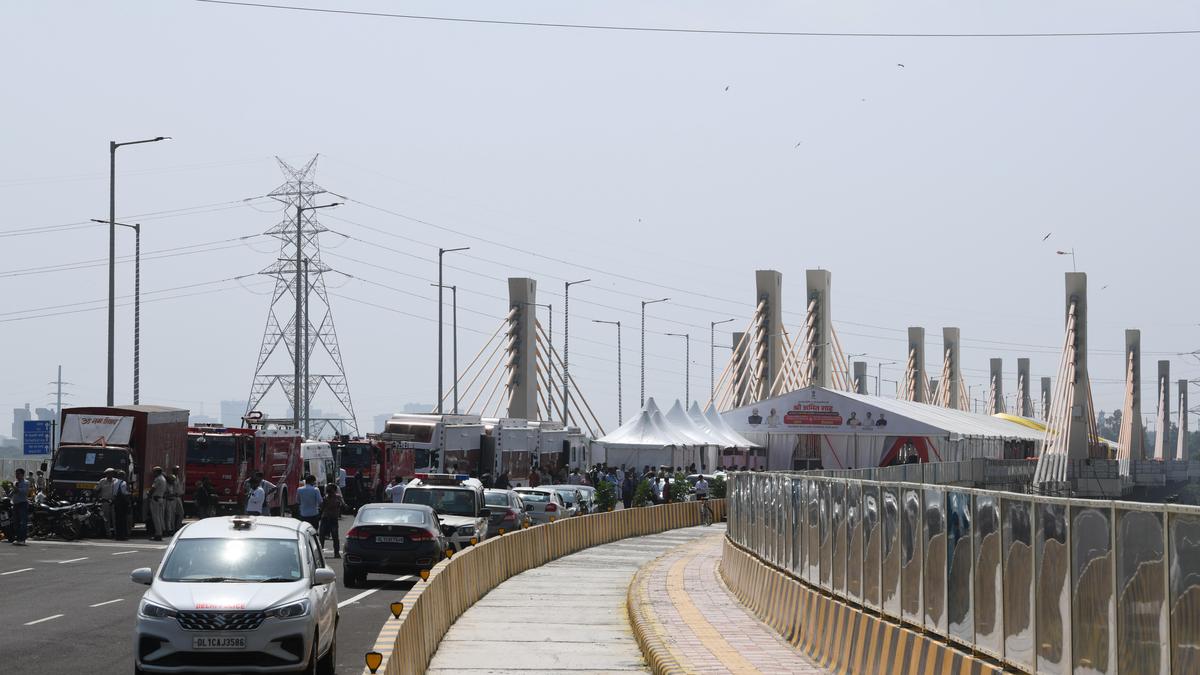
The Barapullah Phase-III elevated corridor, inaugurated on Tuesday (September 29, 2026) with the promise of cutting travel time between Mayur Vihar and south Delhi to about 15 minutes, ran into a day-one traffic jam on Wednesday (September 30, 2026) morning, with queues stretching up to 3.5 kilometres and commuters reporting waits of 40–60 minutes. Delhi traffic police said an estimated 5–6 lakh vehicles converged on the new route, overwhelming the road network at its exit.Social media was filled with accounts from frustrated commuters. “Stuck for the last 40 minutes going from Mayur Vihar-I to IIC across the river on the road Amit Shah inaugurated yesterday. The jam extends over 3–4 kilometres. So much for the claims the distance from MV-I to AIIMS will be reduced from 45 to 15 minutes,” one commuter posted.Another said the traffic on flyover had taken 55 minutes merely to reach its first merge point, while a third questioned how a newly built road system could become choked on its first day.A flyover built to save travel time...took 55 mins just to reach its first merge point 🤦♂️ Barapullah Phase III is finally inaugurated for Traffic Jams. Years and crores spent. Reduce travel time - mission apparently loading #BarapullahPhase3 #DelhiTraffic #Traffic https://t.co/alhKcrHi1K— Amit Kumar (@amitnigam2809) September 30, 2026A commuter also noted that he managed to move only a kilometre in 50 minutes.The congestion began building up during the morning peak, with a gridlock of around 3–4 kilometres reported between 9.30 a.m. and 10 a.m. Though traffic on NH-24 and NH-9 had eased by around 10.45 a.m. against the usual 11.30 a.m., the peak on the Barapullah corridor continued until around 1.30 p.m.A Mayur Vihar traffic police official deployed on the ground said the new route drew traffic from several directions as soon as commuters learnt that it could cut the travel time to AIIMS.“Thousands of cars that used to take NH-24 took the left from Mayur Vihar and came towards the flyover. Those who take the Delhi–Noida Direct (DND) Flyway also took the flyover,” the official said.The police deployed around 10–12 personnel on the Lajpat Nagar side and a similar number on the Mayur Vihar side to manually regulate traffic.Speaking to The Hindu, South Delhi traffic Deputy Commissioner of Police Sandeep Gupta said Google Maps had directed commuters towards the new corridor without reflecting the developing congestion, resulting in a sudden concentration of traffic.“Google showed commuters the route but did not show the traffic layering. Everyone kept coming, but there was no option to return or get down,” he said.Once the queues had stretched to around 3.5 km, the police temporarily stopped vehicles from entering the flyover from the Mayur Vihar side by placing barricades and diverted traffic towards NH-24. Vehicles were subsequently allowed onto the corridor in phases as the backlog cleared, Mr. Gupta said. This also led to congestion at the entry point.“I normally take NH-24 while going to court, so I was on my regular route when I saw on Google Maps that the new route was being shown. I turned towards it, but the turn ended up costing me about 20–25 minutes. The entry to Barapullah Phase-III was barricaded and there was a huge traffic jam at Mayur Vihar,” said Alabhya Dhamija, an Advocate-on-Record in the Supreme Court who lives in Noida and commutes daily to the court.The problem was compounded by the road geometry, the official said. The new corridor has six lanes, three in each direction, but feeds into the existing Barapullah Phase-II stretch, which has only two lanes.“The old Barapullah flyover is already taking the traffic load from Ring Road and Sarai Kale Khan. Now three additional lanes of traffic are being added to that. So, seven to eight lanes of traffic are merging into two lanes, making it a bottleneck,” Mr Gupta said.The police are also in touch with Google to address the absence of live traffic layering on the new route. Mr. Gupta said that once the mapping system begins factoring in the congestion, traffic should be distributed between the new and existing routes rather than being directed overwhelmingly towards the new corridor.The other side of the flyover was not opened to traffic on Wednesday (September 30, 2026) as the tents and other inauguration arrangements had not yet been removed by the Public Works Department. The department has assured the police that the arrangements will be cleared overnight and the other carriageway will be opened on Thursday (October 1, 2026).The police expect the situation to improve during the evening peak as traffic patterns settle. The new corridor’s three lanes, Mr. Gupta said, could also help ease the Sarai Kale Khan stretch by allowing some traffic to bypass the existing exit there.The Phase-III corridor was among four road infrastructure projects worth ₹1,941 crore inaugurated by Union Home Minister Amit Shah on Tuesday (September 29, 2026) after years of delay. The long-pending project was billed as a major link between east and south Delhi, with the government saying it would cut travel time between Mayur Vihar Phase-I and south Delhi by around 20–25 minutes.
Barapullah Phase-III flyover leaves commuters in 3.5-km traffic jam a day after inauguration, morning peak stretches into afternoon
Full Article
Original Source
Read the full article at Thehindu →KhanList aggregates and links to publicly available news content. We do not host full articles from third-party sources. Always verify important information with original sources.