
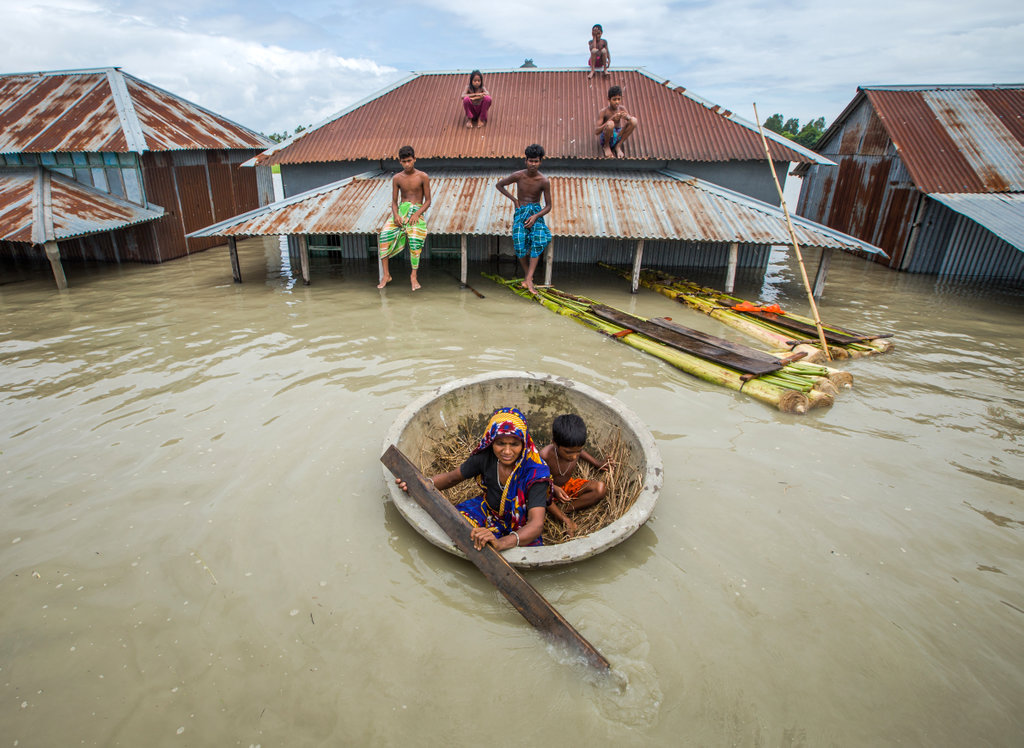
The flow of bank credit to climate-vulnerable regions remains low, with lending heavily concentrated in major commercial areas, including Dhaka.In the coastal districts Satkhira, Patuakhali and flood-prone Sunamganj, the volume of loans is significantly lower than that of deposits.Low-cost and affordable loans on favorable terms are needed to support climate-resilient agriculture, fisheries and local businesses, climate finance researcher Md Shamsuddoha says.However, the central bank says the low lending levels are partly due to a scarcity of local businesses and a lack of profitable projects. For 34-year-old Saiful Gazi — a resident of Ramjannagar Union in Shyamnagar, Satkhira, an area highly vulnerable to climate change — securing institutional financing is a major struggle. Gazi, who supports a family of four, endured the devastating Cyclone Aila on May 25, 2009. Cyclone Aila claimed 190 lives and affected approximately 3.9 million people in Bangladesh. Despite living in a disaster-prone region, he ventured into the fish business in 2022. Although he recently applied for a loan from a private bank to expand his operations, his application was rejected due to a lack of collateral and the necessary documentation. He was compelled to take out a high-interest loan from a local NGO to keep his business running. Across Bangladesh, some of the regions most exposed to cyclones, floods, salinity and river erosion continue to receive only a small share of the country’s bank credit, raising questions about whether formal financing is reaching communities that need it in order to adapt to a changing climate. In Bangladesh, there are eight divisions named after the major regional cities: Barishal, Chattogram, Dhaka, Khulna, Rajshahi, Rangpur, Mymensingh and Sylhet. These divisions are the highest administrative unit in the country. Bangladesh Bank data show that lending remains heavily concentrated in Dhaka and Chattogram divisions, the country’s main commercial and industrial centers. Together, the two divisions accounted for about three-quarters of total bank loans and advances in the April-June quarter of 2026. The concentration is particularly striking in climate-vulnerable areas. Barishal, Khulna, Sylhet and Mymensingh received much smaller portions of total bank lending, despite large numbers of people in these regions depending on agriculture, fisheries, livestock and small businesses that are highly exposed to climate-related shocks. At the end of June, banks’ total loans and advances stood at $146.55 billion (18.09 trillion Bangladeshi Taka), an increase of $2.01 billion (248.18 billion Bangladeshi Taka) or 1.39%, during the April-June quarter. The geographical distribution of credit for climate risk-prone areas, however, remained highly uneven. In the arid landscape of Shyamnagar, Satkhira district, women trek through the coastal area to a reservoir to collect water, 2023. Even years after Cyclone Aila, the community continues to struggle for access to clean drinking water. Image by Muhammad Amdad Hossain/World Meteorological Organization via Flickr (CC BY-NC-ND 2.0). Dhaka accounted for 67.84% of total loans and advances, with 65.48% going to urban areas and 2.36% to rural areas. Chattogram accounted for another large share, leaving the country’s other divisions with considerably smaller portions of formal bank credit. In Khulna, loans and advances increased 2.23% during the quarter to $5.45 billion (672.27 billion Bangladeshi Taka). Barishal received $1.58 billion (194.86 billion Bangladeshi Taka), up 1.27%, while Sylhet’s loans increased 2.31% to $1.50 billion (185.73 billion Bangladeshi Taka). Mymensingh recorded $1.80 billion (222.49 billion Bangladeshi Taka), up 1.15%. In Patuakhali, a coastal district in Barishal division that is exposed to cyclones, tidal flooding, salinity intrusion and river erosion, total bank loans stood at $280.13 million (34.58 billion Bangladeshi Taka) at the end of June, equivalent to only about 0.19% of total lending. Deposits in the district were much higher than the loans and advances, at $573.54 million (70.80 billion Bangladeshi Taka). In Satkhira, another climate-vulnerable coastal district in Khulna division, banks had $355.71 million (43.91 billion Bangladeshi Taka) in loans, or about 0.24% of total lending, while deposits stood at $745.03 million (91.97 billion Bangladeshi Taka). The disparity was even more pronounced in Sunamganj, in northeastern Bangladesh. The district had $191.67 million (23.65 billion Bangladeshi Taka) in bank loans, equivalent to about 0.13% of total lending, compared with deposits of $642.74 million (79.31 billion Bangladeshi Taka). Villagers making a dam to protect the village from the high tide water In the Sundarbans forest area, 2021. People living in this region suffer from a water shortage in the dry season as a result of increasing salinity in the groundwater. Image by IMF Photo/K M Asad via Flickr (CC BY-NC-ND 2.0). Finance gap in climate-exposed communities For many households in coastal and flood-prone Bangladesh, climate shocks can destroy crops, livestock, fishing equipment, homes and small businesses within a matter of days. Cyclones and tidal surges affect the southern districts, while salinity intrusion can reduce agricultural productivity and limit access to freshwater. In the northeast, flash floods can damage crops and livestock in the haor wetlands. River erosion in other parts of the country can force households to abandon land and livelihoods. The World Bank has identified Bangladesh as highly vulnerable to climate change because of its low-lying geography, dense population and high exposure to climate-related hazards. The government’s Bangladesh Delta Plan 2100 identified 58 of the country’s 64 districts as highly vulnerable to climate change in 2022. The risks differ by region, ranging from cyclones and salinity on the coast to drought and groundwater stress in the northwest and flash floods in haor areas. Yet much of the country’s formal lending continues to follow the existing concentration of industries and commercial activity. Drought in Satkhira. Image by Md Harun Or Rashid / IAPB/VISION 2020 via Flickr (CC BY-NC-SA 2.0). The pattern matters because households and businesses in vulnerable regions often require financing not only to recover after disasters but also to prepare for them. Farmers may need credit to adopt salt-tolerant crops, improve irrigation or raise livestock in more climate-resilient ways. Fishers may need financing to replace equipment after storms, while small businesses may require working capital to recover from prolonged flooding. Without suitable financing, adaptation can remain out of reach for people who are already facing repeated climate shocks. Md Shamsuddoha, chief executive of the Center for Participatory Research and Development-CPRD, said the limited flow of bank credit to climate-vulnerable regions is hindering the ability of local populations to adapt to climate change and build resilience. He pointed out that communities most severely affected by climate change require low-interest loans with easy terms to sustain their agriculture, fisheries, small businesses and livelihoods. Shamsuddoha added that affordable and flexible loans could play a crucial role not only in post-disaster rehabilitation but also in fostering climate-resilient agriculture, livelihoods and local economies. Satkhira resident Mehrunessa and her husband growing chillies at their climate smart house, 2024. Image by M. Yousuf Tushar/WorldFish via Flickr (CC BY-NC-ND 2.0). Banks focus on major commercial centers Arief Hossain Khan, executive director and spokesperson of Bangladesh Bank, said regional disparities in bank financing could not be addressed simply by requiring banks to lend fixed amounts in particular districts. Lending, he said, depends on the availability of commercially viable projects and borrowers. Around 75% of bank lending is concentrated in Dhaka and Chattogram, reflecting the concentration of large industries and business activities in the two divisions, Khan said. Climate-vulnerable regions, meanwhile, may require different types of investment suited to their local economies rather than conventional large-scale industrial financing. “Banks have a degree of lethargy in exploring opportunities in local areas. They should go around the regions, identify promising economic activities and help refine them into viable products and businesses,” Khan said. He pointed to opportunities including agro-tourism, climate-adapted agriculture, handloom, light engineering and local handicrafts, saying targeted financing could help develop local economies. “Banks are commercial institutions, not social institutions,” he said, adding that climate-resilient projects also need to demonstrate their ability to generate returns. Syed Mahbubur Rahman, managing director and CEO of Mutual Trust Bank PLC, (MTB) said low bank exposure to climate-vulnerable areas was not solely due to climate risks, with demand-side factors and industrial concentration also influencing lending. Businesses tend to locate where skilled labor, raw materials and manufacturing inputs are available, while limited business activity in vulnerable regions reduces demand for bank credit, he said. Rahman acknowledged that MTB’s own lending portfolio in climate-vulnerable and less-developed regions remains below the desired level, despite efforts through green, sustainable and SME financing products. He stressed the need for greater adaptation finance but said banks face challenges because adaptation projects often lack adequate or predictable returns. Salt-tolerant crops, for example, can face limitations in productivity, scalability and market demand. Buildings in Dhaka. Around 75% of bank lending is reportedly concentrated in Dhaka and Chattogram, reflecting the concentration of large industries and business activities in the two divisions. Image by ASaber91 via Wikimedia Commons (CC BY 2.0). Climate finance doesn’t reach vulnerable communities Masrur Reaz, chairman of Policy Exchange Bangladesh, said the geographical concentration of bank lending was important from a climate-resilience perspective because livelihoods in many vulnerable regions depend on agriculture, fisheries and small businesses. Climate adaptation, he said, cannot depend solely on government spending or development-partner financing. Affordable and appropriate private-sector finance is also needed. Vulnerable households and small businesses need financing to invest in climate-resilient livelihoods, infrastructure and technology, Reaz said. “It is not enough to look at the total amount of climate finance, but also whether that money is reaching vulnerable populations,” he said. “If the financing system can be made more geographically balanced and inclusive, both the economic and climate resilience of Bangladesh will be strengthened.” Banner image: Houses nearly submerged due to flooding in Sirajganj, 2020. Image by Moniruzzaman Sazal / Climate Visuals Countdown via Flickr (CC BY-SA 2.0). Climate-resilient housing models slow to gain ground in disaster-prone Bangladesh Citations: Ahmed, M. R. (2024). Climate shocks’ impact on agricultural income and household food security in Bangladesh: An implication of the food insecurity experience scale. Heliyon, 10(4). doi: 10.1016/j.heliyon.2024.e25687 Baten, M. A., Seal, L. and Kazi, K. M. (2015). Salinity Intrusion in Interior Coast of Bangladesh: Challenges to Agriculture in South-Central Coastal Zone. American Journal of Climate Change, 4(3), 248-262. doi: 10.4236/ajcc.2015.43020 Barua, P., Rahman, S. H. and Molla, M. H. (2019). Impact of river erosion on livelihood and coping strategies of displaced people in South-Eastern Bangladesh. International Journal of Migration and Residential Mobility, 2(1), 34-55. doi:10.1504/IJMRM.2019.103275 Bhuyan, M.I. Supit, I., Kumar, U., Mia, S. and Ludwig, F. (2024). The significance of farmers’ climate change and salinity perceptions for on-farm adaptation strategies in the south-central coast of Bangladesh. Journal of Agriculture and Food Research, 16, 101097. doi: 10.1016/j.jafr.2024.101097 Feedback: Use this form to send a message to the author of this post. If you want to post a public comment, you can do that at the bottom of the page. Credits Topics
Bank credit remains scarce in Bangladesh where climate risks are highest
Full Article
Original Source
Read the full article at News →KhanList aggregates and links to publicly available news content. We do not host full articles from third-party sources. Always verify important information with original sources.