
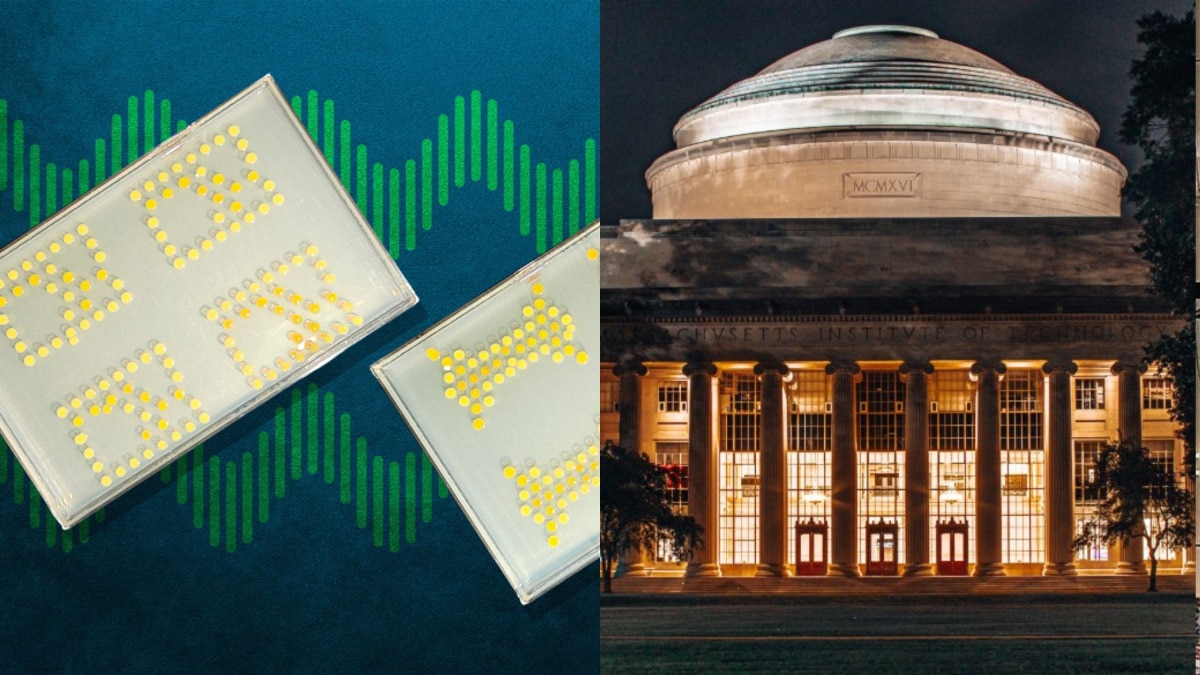
MIT researchers engineered bacterial colonies to act like transistors and relay chemical signals through living circuits. The work points to plants and other living systems that could sense threats, process them and respond on their own.MIT engineers create living bacterial circuit boards capable of computer-like tasks (Image: MIT News)Imagine a circuit board that is alive, not powered by electricity, but by colonies of bacteria quietly passing chemical messages from one cell to another. That is the striking idea behind new research from MIT, where scientists have engineered living bacteria to perform computer-like calculations.The technology is slow by electronic standards, but it could eventually allow plants and other living systems to sense problems, process information and respond on their own.Led by Christopher Voigt, head of MIT's Department of Biological Engineering, and postdoctoral researcher Hamid Doosthosseini, the team engineered the bacterium Pantoea agglomerans to behave much like the basic switching elements inside conventional computers.Instead of controlling electrical current, however, these biological transistors control chemical signals. The researchers created two types of bacterial transistors. Both respond to a molecule called OC-6, but they react in opposite ways: one switches on when OC-6 is present, while the other switches off. A second molecule, OC-12, serves as the information being processed. Depending on the combination of signals, the bacterial transistor produces another molecule, OHC-14, which carries the result onward.In effect, the bacteria are performing the same fundamental job as electronic logic components, just using chemistry instead of electricity.A CIRCUIT BOARD MADE OF LIVING COLONIES Getting one bacterial transistor to work is only the beginning. A computer needs many components connected together.To solve that problem, the MIT researchers created three additional bacterial strains that act as biological relays. These relay strains detect the OHC-14 signal and convert it into a chemical message capable of activating the next bacterial transistor.The colonies can then be printed onto a surface in carefully arranged patterns. Because neighbouring colonies are separated by only about five millimetres, chemical signals primarily reach the intended next component, allowing information to travel through the biological circuit in a controlled direction.The result is something remarkably close to a circuit board, but one made from living organisms. With just two transistor strains and three relay strains, the researchers say a wide range of computational circuits can theoretically be constructed.FROM LOGIC GATES TO ADDITIONThe system is already capable of more than simple on-and-off switching. The researchers demonstrated bacterial circuits that perform logic operations such as OR and implication gates, as well as more sophisticated functions.They also built circuits capable of adding two or three inputs and demonstrated a demultiplexer, a circuit that takes one incoming signal and directs it toward different outputs depending on a control signal.Their largest demonstration so far was a two-input adder involving 24 bacterial colonies working together. The researchers' broader goal is to show that complex biological computation can emerge by connecting relatively simple components.Doosthosseini said that, computationally, there is nothing an iPhone can do that these circuits could not do, according to MIT News. There is, however, a very important catch.EIGHT HOURS FOR ONE CALCULATIONThe bacterial computer is nowhere near replacing silicon. A single calculation takes roughly eight hours. An electronic computer can perform comparable operations in fractions of a second.But speed is not the point. The researchers envision biological computers operating in environments where the timescale is measured in hours, days or weeks, not milliseconds.A plant, for example, does not need to respond to drought in a microsecond. If a biological circuit can detect a developing problem overnight and trigger a response by morning, that may be fast enough.Voigt said the goal was not to replace computers but rather to bring computational control into biology.THE FARM COULD BECOME THE COMPUTERThat vision points to one of the most intriguing applications of technology: agriculture. In the future, researchers hope bacterial circuits could be placed on plant roots or leaves and programmed to recognise environmental threats.A circuit might detect a combination of signals associated with drought, disease or insect attack. Once the appropriate pattern is recognised, the system could trigger a biological response, potentially causing the plant or its associated microbes to produce a protective compound.The plant would not simply be sensing its environment. It would be computing what that environment means, and deciding how to respond.COMPUTING WITHOUT OVERLOADING ONE CELLThe approach also tackles a major challenge in synthetic biology. Researchers often try to place sensing, logic and response mechanisms inside a single engineered cell. But cells have limited molecular machinery.Packing too many genetic components into one organism can create interference, slow growth and produce unwanted interactions between biological parts.MIT's strategy takes a different route. Instead of forcing one cell to perform every task, the researchers distribute computation among multiple specialised bacterial strains. Each strain performs a relatively simple job, while chemical signals connect the pieces into a larger computational network.It is, in essence, a biological version of dividing a complicated computer into many smaller components.A NEW KIND OF COMPUTERThe work, published in Nature Chemical Biology, suggests that computing does not necessarily have to happen in silicon, wires and electrical currents. It can happen in living cells, across colonies, through molecules moving between biological components.For now, the technology is slow and remains at an experimental stage. But its promise lies somewhere very different from faster smartphones or more powerful processors.The long-term possibility is a world in which living systems can sense their surroundings, calculate what those signals mean and respond without a conventional computer telling them what to do.A plant with its own biological circuit board may sound futuristic. The MIT researchers have taken a significant step toward making it real.- EndsPublished By: Apoorva AnandPublished On: Aug 22, 2026 10:00 IST
Bacteria that think? MIT engineers build living systems that compute
Full Article
Original Source
Read the full article at Indiatoday →KhanList aggregates and links to publicly available news content. We do not host full articles from third-party sources. Always verify important information with original sources.