
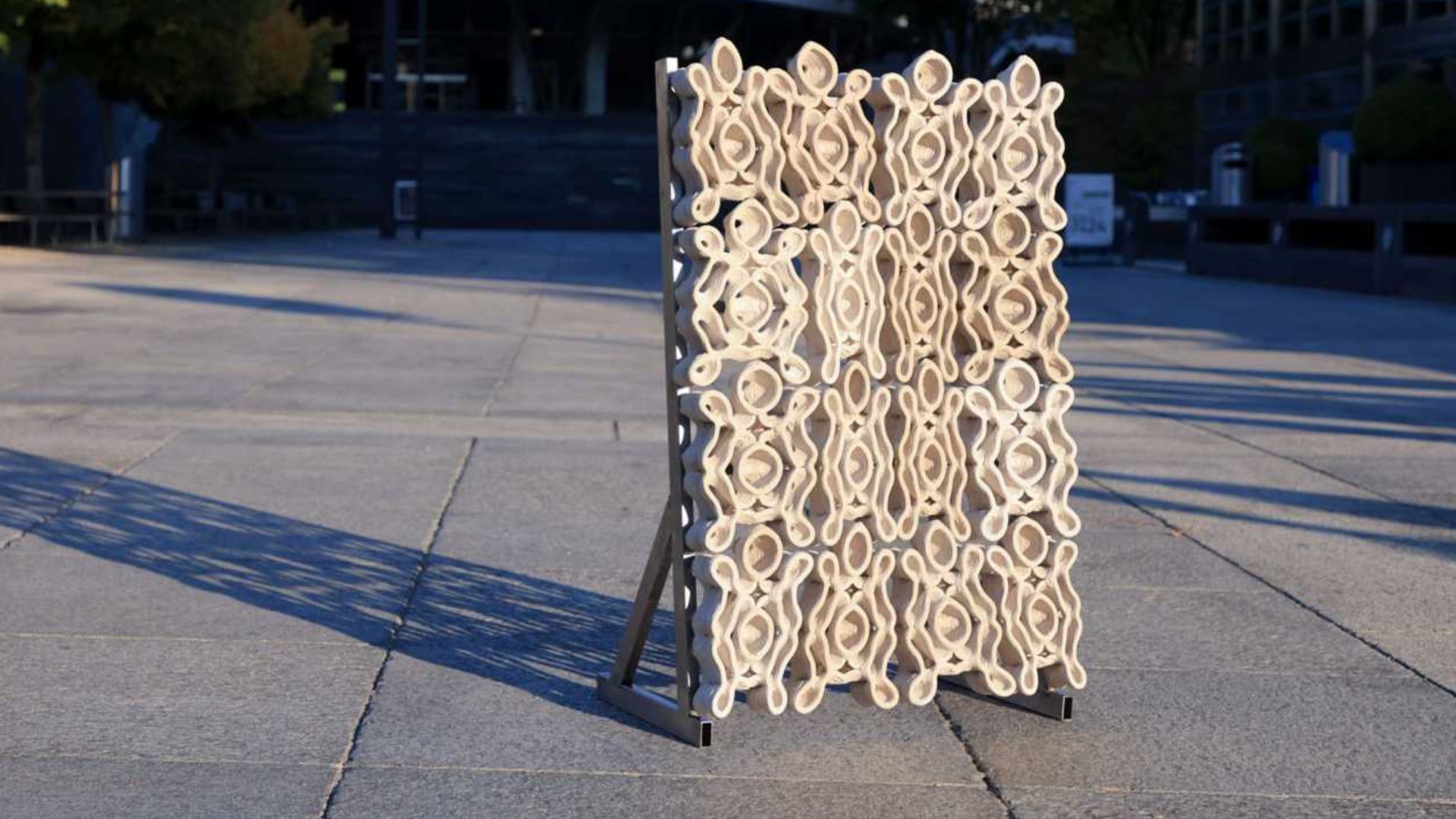
To build the sustainable cities, scientists at ETH Zurich are turning to some of the smallest living organisms on Earth. Dr. Karen Antorveza Paez, an architect and researcher, has merged biology with digital fabrication, using living bacteria, sand, and robotics to manufacture solid architectural components without burning a single fossil fuel. The development targets one of the planet’s biggest environmental culprits. Cement production accounts for roughly 8 percent of global carbon emissions, largely because key ingredients must be fired in massive kilns at extreme temperatures. Antorveza Paez skips the heat entirely. And recruits Sporosarcina pasteurii, a soil bacterium capable of producing “mineral glue”. “We use bacteria to produce a kind of mineral adhesive,” Antorveza Paez noted. A robotic arm repeatedly applies bacteria, the substances necessary for calcification, and sand to a surface, allowing it to grow layer by layer. (Image: Gerhard Bliedung / ETH Zurich) No kilns required Microbially induced calcium carbonate precipitation allows living bacteria to bond sand and loose grains into solid structural components without high-heat processing. Although the idea is not new, experts have previously considered this approach to build structures on Mars. Bacterial breakdown of urea via a natural enzyme produces carbonate ions within the mixture. When they interact with calcium chloride, these ions form microscopic limestone crystals that mechanically interlock sand grains and solidify the material at room temperature. “It’s a bit like baking a cake,” Antorveza Paez explained. “You have the dough, which is still very malleable and fragile. Only the oven turns it into something solid.” In her work, the bacteria take on the role of the oven. The team developed two digital manufacturing methods to create biocement architectural elements. Researchers developed a 3D bio-printing process for biocement elements using a custom bio-ink made of water, natural gums, sand, and live bacteria. Once printed into shape, the structure undergoes a two-to-five-day mineralization bath that is refreshed daily to supply necessary nutrients. Like an oven, the bacteria cure the material at room temperature without external heat, leaving a fully solidified, inactive mineral component after drying. Strength challenge remains The second approach uses a robotic arm to spray alternating layers of sand, bacteria, and mineralizing agents onto surfaces, drawing inspiration from natural microbial rock structures like stromatolites. “As an architect, you usually don’t know exactly what’s in a material – it’s manufactured somewhere else,” she said. “I’m fascinated by the fact that nature has found ways to produce highly sophisticated materials, and that we can use this to address our current problems.” It is a promising approach. But biocement is not yet ready to replace structural concrete. Currently, its strength is closer to mortar, making it better suited for non-load-bearing elements like partition walls or facade panels. Furthermore, the chemical reaction releases ammonium, a polluting byproduct that must be safely treated or recycled. “Unless we consider the disposal of this chemical byproduct, building with biocement is unfortunately not sustainable,” added Antorveza Paez. Demonstrating the potential for automated construction, a six-month installation at the Venice Architecture Biennale 2025 showed a biocement structure growing live in front of visitors. Scientists have already proven that bacteria can grow building materials. Now, the race is on to make those materials strong enough to support our cities. Get the latest in engineering, tech, space & science - delivered daily to your inbox.Mrigakshi is a science journalist who enjoys writing about space exploration, biology, and technological innovations. Her work has been featured in well-known publications including Nature India, Supercluster, The Weather Channel and Astronomy magazine. If you have pitches in mind, please do not hesitate to email her.
Bacteria replace high-heat furnaces to grow greener building materials from sand
Full Article
Original Source
Read the full article at Interestingengineering →KhanList aggregates and links to publicly available news content. We do not host full articles from third-party sources. Always verify important information with original sources.