
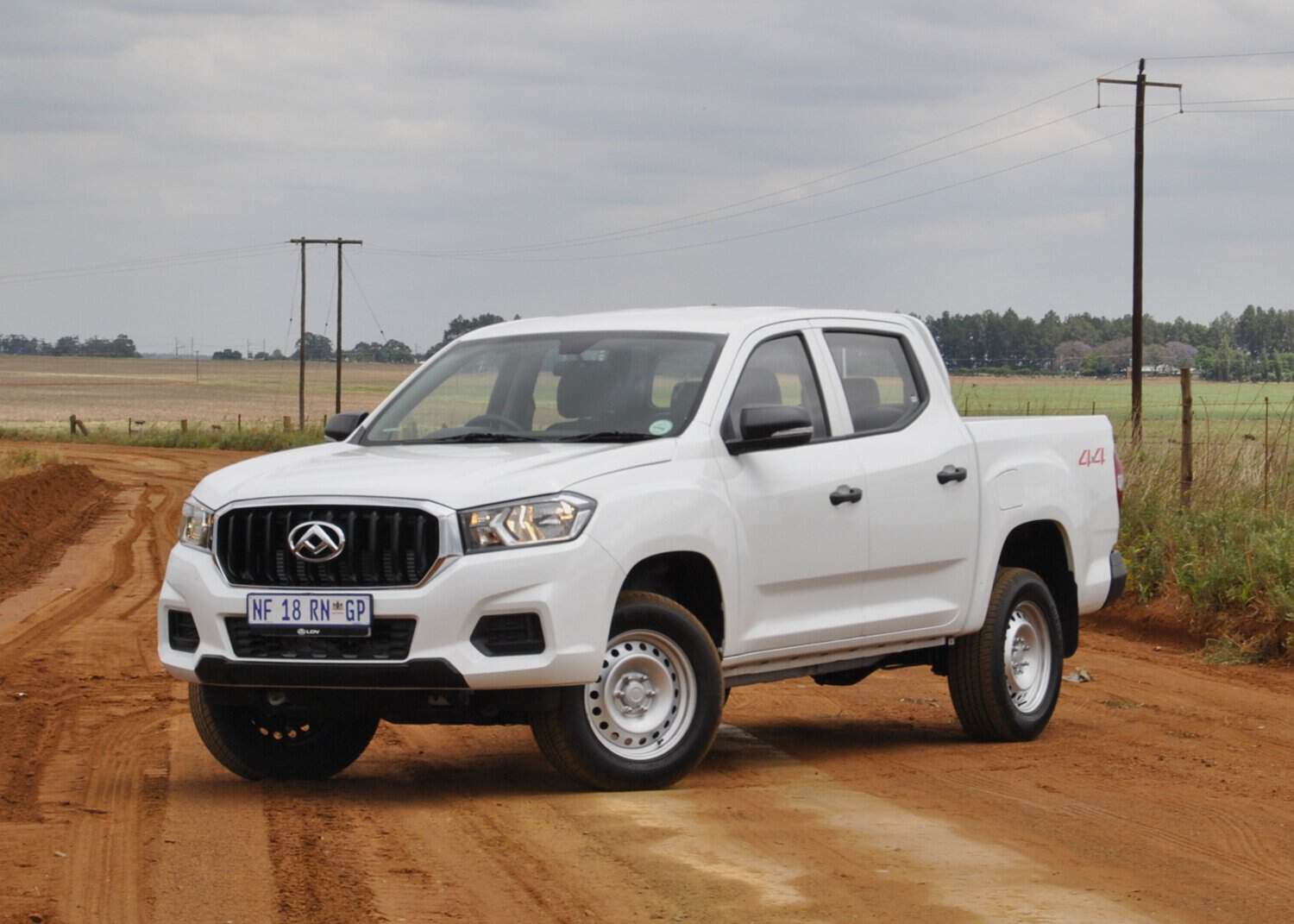
Utility represents a big move from LDV by entering the workhorse-focused bakkie segment for the first time. Whereas the majority of its countrymen have enjoyed moderate to strong success in the bakkie segment, SAIC Motor-owned LDV hasn’t had the easiest of times since entering the South African market two years ago. It has been tough One of the most popular commercial vehicle brands in Australia, it has struggled to gain a strong strong foothold based on its original line-up comprising solely of the T60 bakkie. While additions such as the D90 SUV and massive Terron 9 bakkie have taken place since then, the export moniker of what is known as Maxus in China has been lagging on both bakkie and SUV segment sales, to the point where its future became a topic of discussion. An imminent departure was subsequently shutdown following what is best described as a relaunch in August, followed by a line-up rejig for the T60 days later at the Kyalami Festival of Motoring. The reshuffle sees the T60 now span 11 derivatives, one more than when it was launched in 2024, but with the pruning of the mid-range Max Pro model from two to one and the simply titled Pro dropped altogether. At the range’s sharp end, the Max Luxe doesn’t escape the chop either, as its manual variant departs in favour of the automatic Max Plus that debuted at Kyalami with a redesigned interior first shown on the Australian version two years ago. More crucially, price drops have been applied across the entire line-up, with the Max Luxe now carrying a sticker of R702 900 versus the R790 000 it did in 2024. Ready for work It is, however, at the lower end of the spectrum where matters have changed the most with the debut of the workhorse Utility models in single and double cab bodystyles. The former being a first for LDV in South Africa, the Utility, which starts at R299 900 for the single cab and at R389 900 for the double cab, brings the T60 range’s opening price down by R180 100. Barebones, with the sole difference, apart from bodystyle, being two-wheel drive or four-wheel drive, the arrival of the all-paw gripping double cab promised a great deal considering the Max Luxe having fallen flat when sampled during the weeklong stay and tested at Gerotek previously. T60 Utility lacks any form of body cladding or alloy wheels, but does get a rear bumper with an integrated step aid loading without opening the tailgate. Picture: Charl Bosch An opportunity seldom granted to the media to drive a base bakkie with only the essential creature comforts, the T60 Utility double cab 4×4’s no-frills approach was to be expected, yet still underwhelmed in several areas despite taking into account what it ultimately represents. Compared to its plusher siblings, the Utility is modelled on the lesser T60 Elite, which, unlike the T60 Max Pro and Max Plus/Luxe, has been around since 2016 as the Maxus T60. More confusingly, the latter pair carry the Maxus T90 moniker in China, but for export markets, are bundled under the same LDV T60 nameplate. No frills Given its design age, the Utility is all about function and as such, lacks any form of body cladding or colour coding for the door handles and mirror caps. A chrome grille is, however, standard, as is a rear bumper with an integrated step and steel bar behind the rear window. double cab 4×4 can carry 1 060kg, however, the loadbin is not rubberised as standard. Picture: Charl Bosch Lacking what LDV calls “superfluous add-ons” such as side-steps, sport bars and flared arches, the Utility rides on 16-inch steel wheels because, as the brand states, it is about “load and longevity, not kerb appeal”. Aside from LED daytime running light and, in the case of the four-wheel drive, a red 4×4 decal on the loadbin, the T60 Utility also only has one colour option, Blanc White, and doesn’t make apologies for being an out-and-out workhorse which, arguably, suits its character a lot better than its upscale siblings. Inside The same applies to the interior where the seats are finished in heavy-duty cloth, the steering wheel in polyurethane without any audio or cruise control buttons, and the materials from durable and hard plastics. Broken up by imitation silver accents and an unnecessary gloss black finish on top of the gear lever, the cabin feel is solid and work-ready instead of leisure-focused. While air-conditioning is standard, modern fripperies such as an infotainment system and a reverse camera are all absent, the former replaced by a conventional audio system with two speakers, Bluetooth and a single type-C USB slot. Interior is basic workhorse, with only a handful of features present. Picture: Charl Bosch Electric windows are standard, though bizarrely, the side mirrors are fixed and not only lack electrical adjustment, but also manual prongs. Instead, the actual glass of the mirror requires adjusting to see what goes on behind. The interior’s basicness leaves little to complain about. However, the driving position is compromised by not only a lack of seat adjustment, but a steering column that only goes up or down. More accomplished is rear passenger space. While an armrest is omitted, both head and legroom are impressive, not only for a double cab, but more specifically, one designed for work. Sound system is a basic two-speaker unit with Bluetooth and USB compatibility. Picture: Charl Bosch Added storage comes in the form of the centre console box, glovebox and door pockets, as well as a slot below the audio system. The rest of the Utility’s specification sheet, by modern standards, is resoundingly sparse, but in some instances, on the luxury side for a workhorse. These include dual front airbags, ABS and EBD, a drive mode selector with Eco, Normal and Power settings, an LCD display within the instrument cluster and four cupholders up front – two in the centre console and a pair below the air vents. What could have been Starting the engine by inserting a key into the ignition barrel is where matters start to go wrong in a way similar to the Max Luxe. Loud both on start-up and on the move, the 2.0-litre turbodiesel engine develops 120kW/410Nm, which can be seen as impressive considering the T60’s comparatively low kerb mass of 1 940kg. Indeed, the engine not only pulls strong from low down, but is eager to rev despite its generated noise being audible at the national limit. Seats are trimmed in heavy-duty cloth and while reasonable in comfort, will prove the opposite over longer periods. Picture: Charl Bosch The downside is the six-speed manual gearbox, which has been poorly matched to an engine deserving of a lot better. Besides a grating sensation in second gear, of which no driving style adjustment could cure, each upshift comes with an auto blip-type “function” – the opposite of Toyota’s iMT that can be activated on downshifts. More than likely non-deliberate to keep momentum and speed up when towing, the “function” is irritating and isn’t helped by the gearing that leaves the engine revving at an uncharacteristically high 2 800rpm at the national limit. Space in the rear is one of the T60 Utility’s biggest standouts. Picture: Charl Bosch The transmission, therefore, tarnishes what is an otherwise a punchy engine that feels more than up to the task of hauling a few hundred kilogrammes. In four-wheel drive form, the T60 Utility double cab has a claimed payload of 1 060kg and a braked trailer tow rating of 3 000kg. A more than useful 215mm of ground clearance adds to its off-road prowess, with four-wheel drive being selected via a rotary dial next to the gear lever. Noisy On the move, and apart from the noise, the T60’s ride proved the biggest surprise. Even with no load, the suspension has been tuned properly to iron out imperfections, while failing to be bouncy or jarring with a sudden surface change. Moreover, the brakes are decent in feel, but the steering is heavy to the point of feeling almost power unassisted. As for fuel consumption, the weeklong stay and 453km netted an eventual best of 7.8 L/100km being displayed within the instrument cluster, well up on LDV’s 9.3 L/100km claim. Conclusion Considering what it is, and at a more than price-competitive R429 900, the LDV T60 Utility double cab 4×4 has a lot going for it from a pure and simple work-bakkie perspective. While some of its foibles are easy to overlook, the transmission mismatch is not as forgivable as it spoils what should have been a better match to a loud but muscular engine. For what it will be used for, the Utility is otherwise ideal and could well be the kickstart LDV needs to finally make a name for itself in the price-sensitive lower-end of the double cab bakkie segment.
Back-to-basics LDV T60 Utility a work bakkie with a lot to prove
Full Article
Original Source
Read the full article at Citizen →KhanList aggregates and links to publicly available news content. We do not host full articles from third-party sources. Always verify important information with original sources.