
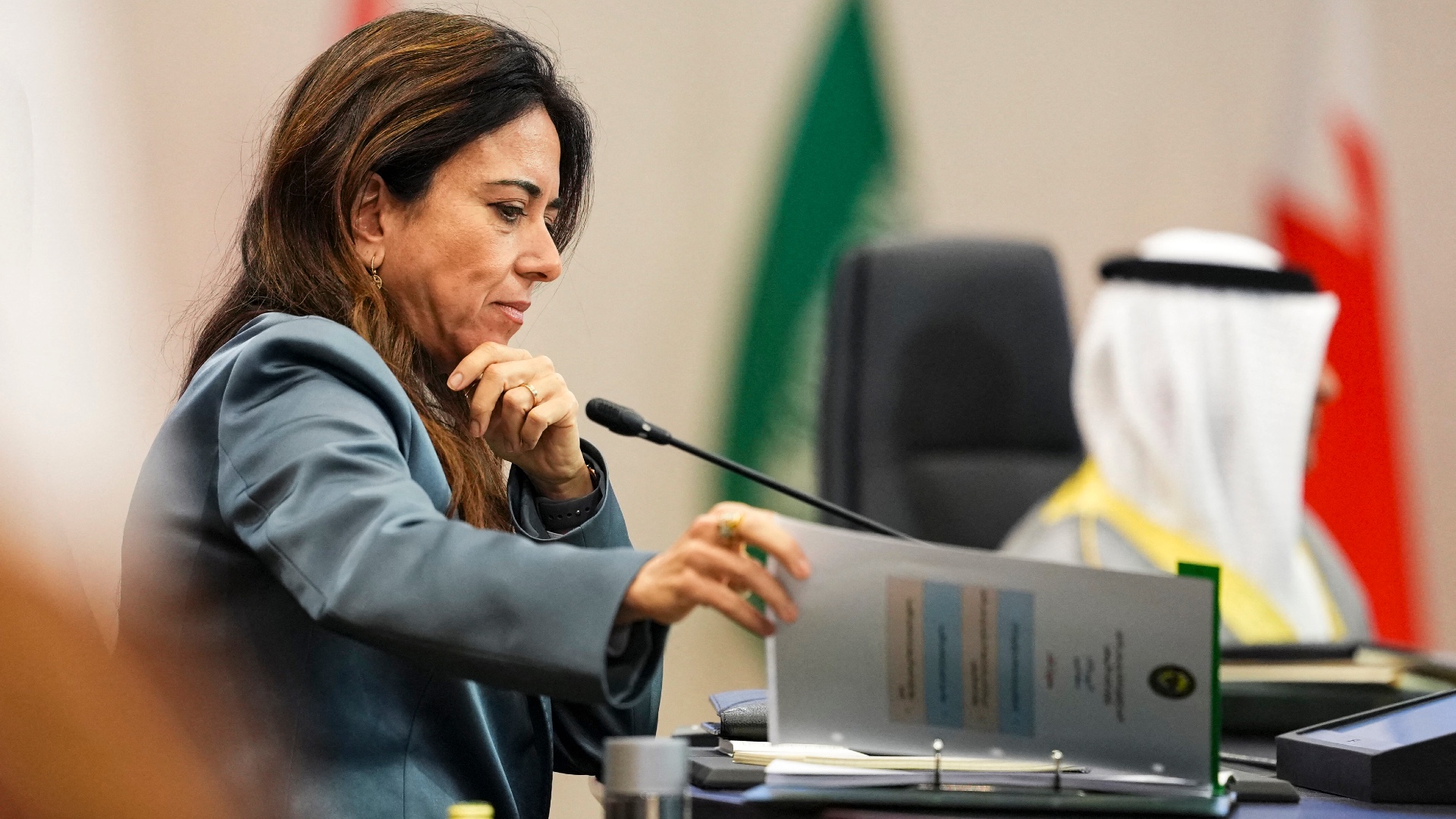
Rights groups on Tuesday called on members of the United Nations to oppose the candidacy of an Emirati diplomat who has consistently denied her country's involvement in propping up what has been termed a genocide in Sudan, deeming her too dangerous to the international order. Last week the United Arab Emirates formally nominated Lana Nusseibeh, its former ambassador to the United Nations and current minister of state at the Ministry of Foreign Affairs, to succeed Antonio Guterres as the body's secretary general, adding a last-minute contender to a deadlocked race. Her candidacy drew immediate criticism, owing to the UAE's support for parties accused of genocide, namely the breakaway paramilitary Rapid Support Forces (RSF) in Sudan, as well as Israel, whose acts of genocide in Gaza continue despite a year-long ceasefire. Some members of the former Biden administration, as well as other former US diplomats, praised her on social media, and Abu Dhabi's close ties with Washington may indeed prove a boon for her candidacy. Middle East Eye also learned this week that the UK is leaning towards backing her nomination. New MEE newsletter: Jerusalem Dispatch Sign up to get the latest insights and analysis on Israel-Palestine, alongside Turkey Unpacked and other MEE newsletters The UN has never had a woman be its chief, and certainly not one with Palestinian roots, hailing from a well-known Jerusalemite family. But rights groups on Tuesday argued she is far too dangerous to take on the role. "We cannot afford to have the UN led by somebody who is a genocide denier, and indeed somebody who heads a government that has been aiding and abetting genocide, that is basically criminally complicit in that genocide, and she's a lead person in covering that up," Kenneth Roth, the former executive director of Human Rights Watch, said on a joint virtual panel on Tuesday that called for Nusseibeh's disqualification. "This is the opposite of the kind of moral standing, the human rights leadership that we want from a UN secretary general," he added. Kate Ferguson, co-executive director of the UK non-profit Protection Approaches, called Nusseibeh's bid "autocratic capture of our most significant multilateral institution". "None of us are safer with a captured United Nations, and while our insecurity will be unequal, all of us will become less safe if this candidacy is allowed to proceed," she said. "There is not, as far as I have seen, sufficient evidence that this candidate is independent from the state from which she comes, and we must not be naive... that this is not a calculated effort of autocratic capture, backed by the United States, to seize and asset-strip the United Nations." 'Blocked' every pathway to justice This week marked the one-year anniversary of the RSF's takeover of Sudan's southwestern city of El Fasher, in the North Darfur region, where now only 70,000 people remain from what humanitarian organisations and the Sudanese government said were upwards of a million displaced people seeking safety there last year. "Unlawful killings, detention and torture... [and] surveillance" are "rife" in the city, Amnesty International said, based on new survivor testimonies. "The United States government determined that RSF committed genocide in February 2025, and put sanctions on seven of the companies [backing] the RSF, and those companies were either based on the UAE or linked directly to the United Arab Emirates," Ibrahim Alduma, who is from El-Fasher and is co-founder of Sudan Action Hub, said on Tuesday's panel. Sudan decries Nusseibeh UN candidacy as ‘whitewashing' Emirati role in civil war Read More » Washington followed up that determination with an "agreement of $6.4bn of international trade between the UAE and the United States, and this is one of the main things we need to stop", he added. According to the Center for International Policy, the UAE has received well over $2bn in US military deliveries alone since January 2025. "The second thing that we are talking about is the partnership between the UAE and the US and the AI, because the UAE cannot do anything with the AI without the chips of the United States," Alduma said. The US artificial intelligence corporation Anthropic said last month it had disrupted a UAE-directed influence operation using its own tools, and that the operation was designed to change perceptions of Abu Dhabi vis-a-vis the civil war in Sudan. "This lady has blocked every justice pathway that could be achieved for the people of El Fasher or Sudan, and what [the] UAE is doing with [the] RSF is a closed loop support," Alduma said. "Not only the military support and enabling them to committing the genocide, but also the international [community] covering through different ways, different means." The UAE continues to deny its involvement in the war, despite mounting evidence reported on by Middle East Eye's correspondents, human rights organisations, and the UN itself. UAE role in Sudan Nathaniel Raymond, the executive director of the Humanitarian Research Lab at the Yale School of Public Health, laid out how his team tracked the way technical military support from the UAE to the RSF allowed for the takeover of El Fasher, as well as the killing of more than 150,000 Sudanese, and the displacement of 12 million others since April 2023. The RSF's objective, "which they clearly stated, was not only to defeat the Sudanese Armed Forces in El Fasher... but it was specifically to hunt and kill Zagawa and Fur people", referencing two of the targeted ethnic groups. Sudan is home to at least 500 ethnic groups. "The UAE made it possible technically for the RSF to... effectively trap and kill civilians," Raymond said. He pointed to intelligence sensor reconnaissance drones which the RSF has used to find out where civilians were hiding. "They also did another thing. They blocked phone communications," he explained. "They prevented civilians from being able to call for help and from being able to access the internet, and in the last 72 hours... there was a full blackout that was caused by drones as people were trying to escape, so they couldn't call for help and they couldn't send images." Exclusive: UK leans towards backing UAE's Lana Nusseibeh for UN secretary-general Read More » There is also the observable and swift upgrade of armaments used by the RSF, which had previously only stolen weapons from the Sudanese army, Raymond noted. The RSF's AH4 howitzers - a lightweight artillery gun capable of continuous firing at two rounds per minute - could only have come from the UAE, he said. "The RSF 20 years ago was the Janjaweed, and the weapons systems they had were basically horses, camels, pickup trucks, Enfield rifles, AK-47s. Suddenly, cut forward 20 years, they have an air force. They have electronic jamming capability. They have advanced mapping and tracking capability for civilians, including quadcopters, hexcopters. None of that came out of nowhere." Last week, Amnesty International reiterated its years-long call for an "immediate ceasefire" and the "urgent deployment of an international force to protect civilians". "All countries must also immediately stop providing arms and ammunition to all parties to the conflict in Sudan," it said. "In particular, all countries must cease arms transfers to the United Arab Emirates until it stops supplying weapons to RSF in violation of the UN embargo on Darfur. The UN Security Council must also expand the existing arms embargo on Darfur to the rest of the country." While the Trump administration's African affairs envoy, Massad Boulos, appeared to prioritise a diplomatic solution earlier this year, there has been little to no known movement on that front since.
'Autocratic capture': Rights groups say UAE diplomat Lana Nusseibeh too dangerous to lead UN
Full Article
Original Source
Read the full article at Middleeasteye →KhanList aggregates and links to publicly available news content. We do not host full articles from third-party sources. Always verify important information with original sources.