
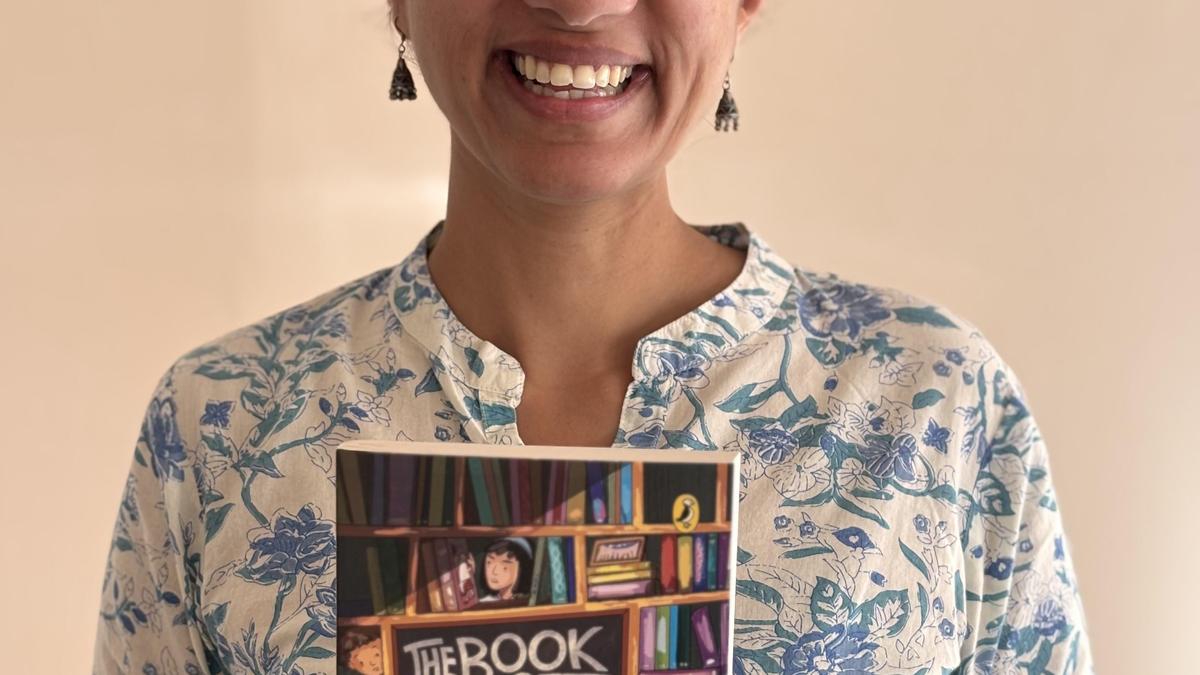
Children who question rules, challenge authority and insist on having their say are at the heart of Varsha Seshan’s stories. From defending books against censorship to exploring democracy, the author makes a case for giving young readers the freedom to think, disagree and make their own choices.Her latest book, The Book Ghosts, takes up one such concern through the story of children who rally to protect books labelled silly or banned. The idea, she says, grew out of conversations with parents who were reluctant to let their sons read certain books. One example that stayed with her was Shabnam Minwalla’s The Pink Dress, a book she describes as lovely, but one that some parents felt their seven-year-old sons should not read.“Who puts these ideas into children’s heads and why?” she asks. Varsha believes every child deserves an answer to a question beginning with ‘why’. “If a book is considered unsuitable, I believe that an explanation and an invitation to give it a try work well. Children are capable of making these decisions themselves,” says Varsha. Recalling her own experience of reading a Judy Blume book at a young age, she says she was not ready for it then. That, too, was a decision she could make for herself.Her research into banned and challenged books across the world brought her face to face with what she considers some “rather unreasonable adult anxieties”. “Books have been challenged because animals speak in them or because someone fears that a story might influence a child’s sexual orientation,” she says. For Varsha, the unease often lies in the conversations adults may have to confront afterwards.Access to booksThe question of access to books acquires a wider significance in The Book Ghosts, particularly through the threat to a free mobile library. Varsha’s concern comes partly from her experience of working with underfunded libraries in Navi Mumbai. “There, I was startled to encounter Class VIII students who could not read the alphabet but continued to be promoted to the next grade. The consequences of such learning gaps extend beyond academic performance,” she says.Varsha also draws attention to the summer slide, the decline in children’s academic progress when they do not have access to books during school vacations. Two children who begin their holidays at the same academic level can return with markedly different abilities, depending on whether they had books to read. Access, in this context, means books that children pick up for pleasure rather than prescribed schoolwork. “It raises uncomfortable questions about equality in education and the opportunities available outside the classroom,” adds Varsha.The perfect classroomThe importance of allowing children a voice runs through another of her books, Dhara’s Revolution. Varsha advocates involving children in decisions that affect them, including classroom rules. In her own teaching sessions, she asks children to describe their idea of a perfect classroom and then discusses how the group can work towards it. “Rules framed collectively are more likely to be respected,” she says. A similar approach, she suggests, could help schools formulate policies on emerging issues such as the use of artificial intelligence.Her other books explore equally pertinent concerns. In Think Big!, the emphasis is on nurturing ideas through skills and perseverance, while Sisters at New Dawn examines adoption, family and belonging. She believes children’s books and visual media can help normalise diverse family structures, particularly when these are presented as an ordinary part of the narrative rather than as an issue requiring explanation.For all her enthusiasm for reading, she is reluctant to turn it into a competition with other childhood pursuits. “A child who prefers hiking or sport is not leading a lesser life than one who spends hours with books,” she stresses. Offering children a range of choices is more meaningful than framing their lives around a contest between screens and reading.Social changeVarsha identifies justice and belonging as the two concerns she repeatedly returns to in her writing, although she does not consciously begin a story with a social message in mind. She acknowledges that children’s literature can contribute to social change, even if that is never her primary reason for writing. “Reading is something intimate, something personal. Yet, from that private space, social change is born,” she says.Her observations extend to the way adults organise children’s lives. “Adults should stop assigning a specific learning outcome to every activity and instead allow children the freedom to explore without constantly turning an experience into a lesson,” she says. Free time and boredom, she believes, can be valuable teachers. At a recent writing programme, Varsha asked children to maintain a question journal, inviting them to record questions to which there were no easy answers. The entries ranged from the existence of God and aliens to the more immediate concern of what was for dinner.At the Vizag Junior Literary Festival scheduled to be held on November 21 and 22, where she will conduct sessions on her books, Varsha hopes to discuss the joy of writing, retaining one’s voice in the age of AI and resisting the pressure to publish too soon. However, she is equally happy to let the children steer the conversation elsewhere. “After all,” she says, “children have a way of surprising us!”(To register for Vizag Junior Literary Festival, contact 9985122022, 9866628484 or 9841117400).
Author Varsha Seshan on children’s books, freedom to read and independent thinking
Full Article
Original Source
Read the full article at Thehindu →KhanList aggregates and links to publicly available news content. We do not host full articles from third-party sources. Always verify important information with original sources.